Up 8.1% from This Year
30 Billion Won Allocated for Extension of Special Prosecutors,
Ballot Band and Coupang Severance Pay Investigations
The first main budget proposal of the Lee Jaemyung administration, totaling 727.9 trillion won, has passed the Cabinet meeting.
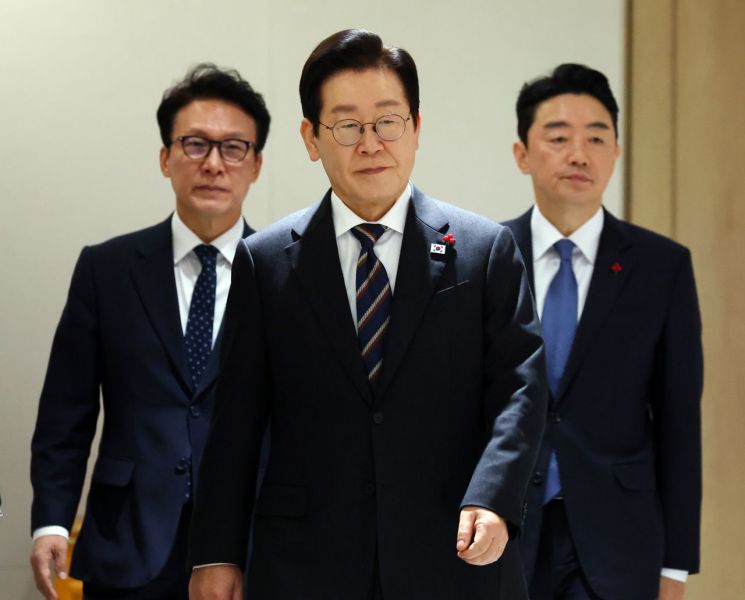
On December 9, the government, presided over by President Lee, deliberated and approved the 2026 budget proposal at a Cabinet meeting held at the presidential office in Yongsan. The National Assembly had already passed next year's budget bill at a plenary session on December 2, following bipartisan agreement.
The first main budget of the Lee Jaemyung administration is 1 trillion won less than the government’s original submission of 728 trillion won, but it represents an 8.1% increase compared to the 673.3 trillion won allocated by the previous Yoon Suk-yeol administration last year. An additional 400 billion won has been allocated for the establishment of a disaster recovery system at the National Information Resources Service, and 61.8 billion won for the creation of new pilot cities for autonomous vehicle commercialization. However, funding for artificial intelligence (AI) support and policy funds has been reduced, and the contingency fund has also been cut by about 200 billion won. Support for issuing local gift certificates (1.15 trillion won) and the National Growth Fund (1 trillion won) will remain unchanged from the original plan.
At the Cabinet meeting, a proposal to allocate 3,051,430,000 won from the contingency fund for expenses related to the launch of special prosecutors investigating the insurrection, the extension of the investigation period for the Kim Keonhee special prosecutor, the maintenance of prosecution for the special prosecutor on the deceased Marine case (whose activity period has ended), the alleged destruction of ballot band seals, and the alleged external pressure to drop the indictment regarding Coupang severance pay, was also approved.
Additionally, an amendment to the Act on Special Cases Concerning the Confiscation and Recovery of Corrupt Assets, which allows for the confiscation and recovery of proceeds from specific fraud crimes such as voice phishing to be returned to victims, was passed. This amendment changes the principle from discretionary to mandatory confiscation and recovery of crime-related assets resulting from specific fraud crimes such as fraud or extortion by criminal organizations, and also eases the burden of proof regarding the connection between the assets and the crime.
The Cabinet also approved a revision to the Enforcement Decree of the Public Service Ethics Act, which will significantly strengthen employment screening standards for retired public officials in the architecture and construction sectors starting next year, and expand the scope of Korea Land and Housing Corporation (LH) employees subject to employment screening from the current level 2 and above to level 3 and above. Employment screening institutions are those where, for three years after retirement, candidates must undergo review by the relevant Public Service Ethics Committee in order to be employed.
Under the revised regulations taking effect in January next year, construction engineering firms and architectural offices performing design or supervision work in the architecture and construction sectors will be designated as employment screening institutions if their annual transaction volume exceeds 1 billion won, regardless of their capital size.
© The Asia Business Daily(www.asiae.co.kr). All rights reserved.

















