Latest Blackwell Not Included
Compromise Amid China’s Ban on U.S. Chips
Strategy to Increase Chinese Dependence on U.S. via H200
Rapid Shift After Trump and Jensen Huang Meeting
Uncertainty Over China’s Acceptance
Nvidia Stock Rises 1.7%
On December 8 (local time), U.S. President Donald Trump announced that he would allow American AI semiconductor company Nvidia to export its products to China. Analysts believe that this decision to permit exports will mark a new phase in China's pursuit of AI chip self-sufficiency.
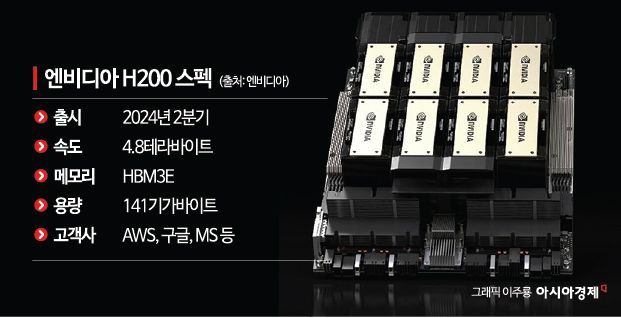
After the market closed on the same day, President Trump posted on his own social networking service, Truth Social, stating, "I have informed Chinese President Xi Jinping that Nvidia will be allowed to sell 'H200' chips to approved customers in China and other countries." He added, "This will be done under the condition that strong national security continues to be ensured," and "President Xi responded positively. Twenty-five percent of the sales amount will be paid to the United States."
Bloomberg reported that this 25% of the sales amount is expected to be collected by the U.S. government in the form of a surcharge.
However, President Trump appeared to take security concerns into account by limiting Nvidia's exports to China to only the H200 chip. He emphasized that Nvidia's latest chip, 'Blackwell,' and the upcoming 'Rubin,' scheduled for release next year, are not included in this agreement. This measure will also apply to other U.S. semiconductor companies such as AMD and Intel in the same manner. According to foreign media, this policy is a compromise designed to avoid the extreme measure of a complete halt in the supply of American AI chips to China, while still prohibiting the export of the cutting-edge Blackwell chip. Earlier this year, the Trump administration allowed Nvidia to sell its lower-spec 'H20' chip to China, but the Chinese government raised its own security concerns and banned domestic companies from using the H20.
The Wall Street Journal and Bloomberg reported that this decision came shortly after a meeting last week between President Trump and Nvidia CEO Jensen Huang. CEO Jensen Huang has publicly argued for the resumption of Nvidia's exports to China, claiming that the regulations benefit Chinese companies, including Huawei.
Local media view President Trump's decision as a full acceptance of CEO Huang's position. CEO Huang believes that exporting semiconductors to China and making China dependent on American technology is ultimately the path to true victory for the United States in the AI competition. The fact that the United States offered the higher-performing H200, rather than the previously discussed H20, is interpreted as an incentive to open China's tightly closed doors. Previously, in August, the Chinese government issued a recommendation banning domestic companies from using the H20 for national security reasons. While the H200 lags far behind Nvidia's latest GPU, 'Blackwell,' in terms of components and actual performance, it is known to be vastly superior to the H20.
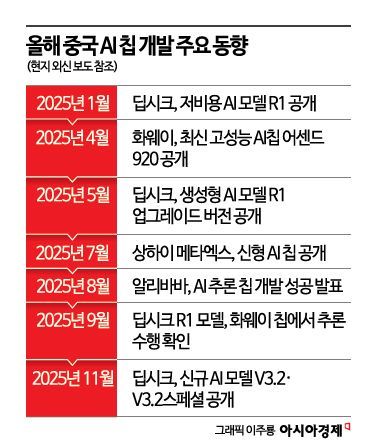
It remains unclear whether China will accept this U.S. measure. Although President Trump stated that "President Xi was also positive," most analysts expect that China will be cautious in deciding whether to actually implement the relevant measures. China has steadily increased its self-sufficiency by encouraging domestic companies to develop new AI chips in order to reduce reliance on Nvidia's H20. In April, Huawei unveiled its high-performance AI chip, the 'Ascend 920,' promoting it as a complete replacement for the H20. In July, Shanghai-based AI startup MetaX developed a new AI chip, and in August, Alibaba announced the successful development of an AI inference chip. These developments suggest that China may be able to compete independently in the AI market even without accepting the H200. However, there is also a prevailing view that President Xi will have no choice but to allow the import of the H200, given the significant technological gap that remains beneath China's domestically developed AI chips. In chip manufacturing, Chinese companies are still limited to processes at or above 14 nanometers (nm; 1 nm is one billionth of a meter). Even SMIC, considered the most advanced, is reportedly only at the 7-nanometer level, with a yield rate of just 20%.
Following the news of the export control relaxation, Nvidia's stock price closed up 1.7% from the previous trading day on the New York Stock Exchange. As of 10:20 a.m. on December 9 (Korea Standard Time), Samsung Electronics was trading at 108,600 won, up 900 won (0.82%) from the previous trading day, while SK Hynix was trading at 566,000 won, down 11,000 won (1.91%) from the previous trading day.
© The Asia Business Daily(www.asiae.co.kr). All rights reserved.
![Clutching a Stolen Dior Bag, Saying "I Hate Being Poor but Real"... The Grotesque Con of a "Human Knockoff" [Slate]](https://cwcontent.asiae.co.kr/asiaresize/183/2026021902243444107_1771435474.jpg)

















