All Three Century-Old Studios Now in Tech Hands
Writers, Directors, and Actors Unions Issue Joint Statements of Opposition
Theater Industry Warns of "Unprecedented Threat to Theatrical Business"
 Warner Bros. logo displayed on the water tower at Warner Bros. Studio in Burbank, California Photo by Getty Images Yonhap News
As a tech company swallows a century-old film studio, alarm bells are ringing throughout Hollywood. Immediately after Netflix announced its acquisition of Warner Bros., writers', directors', and actors' unions, as well as the theater industry, simultaneously voiced opposition and concern.
On December 5 (local time), the Writers Guild of America (WGA) issued a statement saying, "The world's largest streaming company absorbing one of its major competitors is a textbook example of what antitrust laws are designed to prevent," adding, "This merger must be blocked." The WGA expressed concerns about job losses, declining wages, and the overall deterioration of working conditions for entertainment workers.
The Directors Guild of America (DGA) and the Screen Actors Guild-American Federation of Television and Radio Artists (SAG-AFTRA) echoed similar sentiments. The Directors Guild stated, "This deal raises serious concerns," and signaled that it would seek further discussions with Netflix about its future vision. The Screen Actors Guild commented, "While this may benefit shareholders, it raises significant questions about the livelihoods and careers of creative professionals."
The Teamsters Local 399, representing on-set crew members such as truck drivers, also warned, "The concentration of corporate power driven by greed threatens good union jobs, the livelihoods of our members, and the sustainability of the industry itself."
The unions' sensitive reactions are rooted in lessons learned from past mergers. After Disney acquired 21st Century Fox, thousands faced layoffs, and Warner also conducted several rounds of job cuts following its merger with Discovery. Just two years after overhauling the streaming compensation system in the wake of the 2023 writers' and actors' strikes, there is now a growing sense of crisis that another round of "downsizing" is being justified.
The theater industry is also on edge. Warner films have maintained an average theatrical exclusivity window of 77 days this year, already down from 90 days before the pandemic. Netflix releases most of its titles exclusively on streaming, with only a few getting brief theatrical runs. Industry insiders believe that if this strategy is applied to Warner, the theatrical exclusivity window could shrink further, potentially to less than 45 days.
The National Association of Theatre Owners and Chains in the United States issued a statement warning, "Netflix's acquisition of Warner is an unprecedented threat to the global theater industry," adding, "The impact will be felt not only by major multiplexes but also by single-screen theaters in small towns and on screens around the world."
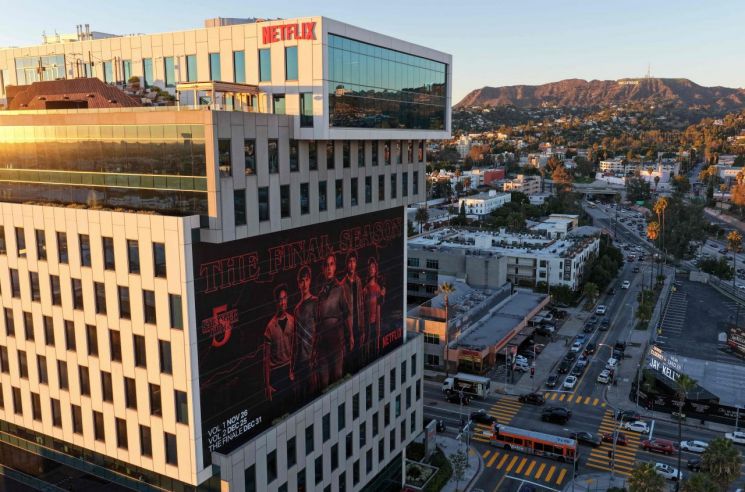 Netflix logo displayed at Netflix Studio in Los Angeles, California, USA. Photo by Getty Images Yonhap News
Similar controversy arose during the Disney-Fox merger. After the merger, the number of mid-budget films under the Fox label sharply declined, leading to criticism that theater programming had become polarized between a handful of blockbusters and low-budget films. Major Canadian newspapers at the time described it as "almost catastrophic for theaters," and now predict that the Netflix-Warner combination could have an even greater impact.
There are also fundamental concerns about changes to the industry's structure. Netflix, which once disrupted the traditional studio order with its "no rules" approach, is now absorbing one of the oldest studios, Warner, and is thus seen as returning to the established system. As Netflix takes on physical studios, powerful unions, and massive fixed costs, many predict that the company will shift from bold experimentation to a more conservative slate focused on "proven sequels."
Hollywood trade media outlet Deadline described this deal as "the moment tech capital completes its takeover of Hollywood." With Amazon having acquired MGM, Oracle founder Larry Ellison taking control of Paramount, and now Netflix acquiring Warner, three of the industry's major studios with a combined history of 100 years have all come under the umbrella of tech companies or tech moguls.
Potential clashes in corporate culture are also being discussed. Deadline predicted that "Netflix's unique performance-driven culture could deliver another culture shock to Warner employees." Over the past 20 years, Warner has undergone repeated changes in corporate culture and restructuring as it passed through the hands of major shareholders with differing management styles, including AOL, AT&T, and Discovery. Even three years ago, when Discovery acquired Warner, there were intense layoffs and internal conflicts.
However, some analysts believe that many key creative personnel are likely to remain. In particular, HBO CEO Casey Bloys and Warner TV Chairwoman Channing Dungey are cited as figures who are likely to retain their positions. Bloys is regarded as one of the most successful TV programming executives in the industry over the past decade. Dungey, who previously led Netflix's drama division before moving to Warner in 2020, was reportedly asked by then-CEO Ted Sarandos not to leave at the time.
© The Asia Business Daily(www.asiae.co.kr). All rights reserved.
![Clutching a Stolen Dior Bag, Saying "I Hate Being Poor but Real"... The Grotesque Con of a "Human Knockoff" [Slate]](https://cwcontent.asiae.co.kr/asiaresize/183/2026021902243444107_1771435474.jpg)
















