FortyTwoDot Unveils Video Demonstrating E2E Autonomous Driving Technology
SDV Pace Car, the Pinnacle of Its Technology, to Be Unveiled in August Next Year
'Level 2+' Technology to Be Introduced Starting Q4 2027
Development Leadership Uncertain After Leadership Change
FortyTwoDot, the software development subsidiary of Hyundai Motor Group, has announced a concrete timeline to unveil its software-defined vehicle (SDV) pace car in August next year. This announcement sends a clear message that the company will steadfastly implement its existing roadmap, even after the recent resignation of FortyTwoDot CEO and Hyundai Motor Group SDV Division Head (President) Song Changhyun.
According to industry sources on December 8, FortyTwoDot stated through its official YouTube channel on December 6, "We have been developing the SDV pace car, the first vehicle to fully incorporate the technologies we have built so far, with the goal of unveiling it in August next year." Previously, FortyTwoDot had only mentioned the pace car's release as being scheduled for the third quarter of 2026, but this time, they specified "August next year," revealing a more detailed plan down to the month.
Alongside the SDV pace car unveiling, FortyTwoDot also released a video showcasing its proprietary end-to-end (E2E) autonomous driving technology. This move is interpreted as a rebuttal to some skepticism regarding whether FortyTwoDot possesses its own E2E autonomous driving model. The company explained, "The transition of our technology stack to E2E was completed in October, and we are currently working to enhance its completeness by early March next year, which is a key milestone for the SDV pace car."
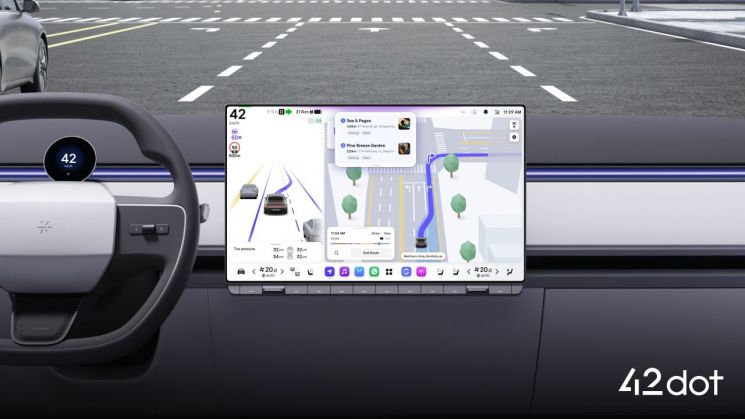 The next-generation infotainment system "Pleos Connect" being developed by Hyundai Motor Group. Provided by FortyTwoDot
The E2E-based autonomous driving system 'Atria AI' developed by FortyTwoDot recognizes its surroundings using only eight cameras and one front radar. Unlike conventional rule-based autonomous driving systems that rely on high-definition maps (HD maps), this system processes sensor input data through a single deep learning model, performing the entire process of perception, prediction, planning, and control within the vehicle's neural processing unit (NPU).
The released video shows the autonomous vehicle recognizing traffic light states via camera, making left and right turns at intersections with the driver's hands off the wheel, automatically adjusting speed according to the speed limit, and recognizing pedestrians and surrounding vehicles to navigate urban right turns in line with traffic flow. It also demonstrated the vehicle passing through a narrow parking lot entrance and automatically parking in an empty space.
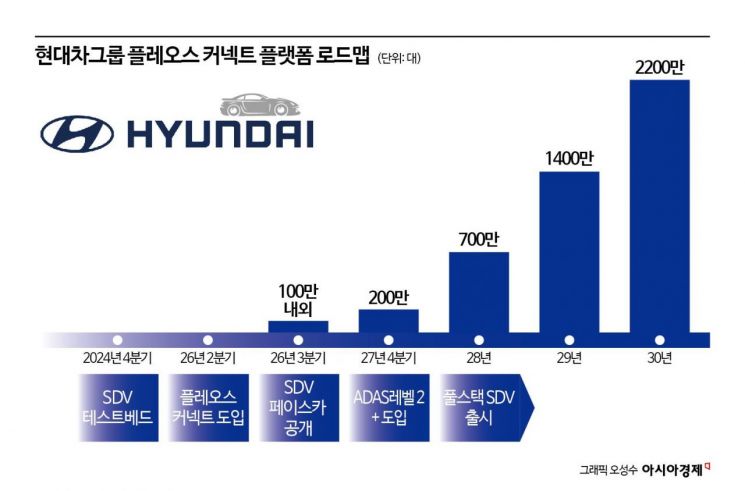
FortyTwoDot plans to unveil the SDV pace car, which integrates these technologies, in August next year, and then sequentially apply 'Level 2+' deep learning-based autonomous driving technology to mass-produced vehicles starting from the fourth quarter of 2027.
Meanwhile, concerns are growing over the autonomous driving competitiveness of Hyundai Motor and Kia as Tesla's "supervised FSD (Full Self-Driving)" was recently introduced in Korea. Tesla's FSD allows the vehicle to drive itself with the driver’s hands off the wheel after simply entering a destination, and it is recognized within the industry as having secured a technological edge by enabling autonomous driving even in complex urban environments such as alleyways and underground parking lots.
The introduction of Tesla’s FSD in Korea is based on the self-certification system under the Korea-US Free Trade Agreement (FTA), which simplifies domestic certification for vehicles that meet the US Federal Motor Vehicle Safety Standards (FMVSS). This means that up to 50,000 vehicles produced in the United States per year can be brought into Korea without additional certification for FSD.
There is also analysis that the introduction of Tesla FSD could influence the choices of Korean consumers, who are highly sensitive to IT technology. In fact, preference for the Tesla brand in the Korean market is gradually increasing. According to the CarIsYou Data Research Institute, from January to November this year, 46,927 units of the Tesla Model Y were sold, making it the best-selling electric vehicle in Korea, and it ranked 11th among all vehicle models, including internal combustion engine and hybrid vehicles.
Industry insiders predict that Hyundai Motor and Kia may accelerate the adoption of FortyTwoDot’s Atria AI. However, there are also concerns about whether FortyTwoDot can maintain the same level of influence in software development for Hyundai Motor and Kia following the resignation of President Song Changhyun. As of now, neither FortyTwoDot nor Hyundai Motor Group has announced a successor since Song’s departure.
After Jang Jaehun, Vice Chairman of Hyundai Motor Group, mentioned the possibility of organizational restructuring centered on artificial intelligence (AI) and energy during an interview with Korean reporters at the World Hydrogen Expo on December 4, some interpret that the status of the autonomous driving division within the group could be relatively diminished.
An industry official commented, "We will move in a direction that maximizes the use of the SDV platform and autonomous driving technology developed over the past three years," but added, "With the sudden replacement of the head of the SDV division, it remains to be seen how much development leadership FortyTwoDot can maintain going forward."
© The Asia Business Daily(www.asiae.co.kr). All rights reserved.


















