Godeok Arteon Explains:
“It Is Not a Total Ban on Outsiders...
Central Pedestrian Path Remains Open”
The Godeok Arteon Residents’ Representative Council (hereinafter referred to as the “Council”) in Seoul, which recently sparked controversy by notifying neighboring apartment complexes that it would impose order maintenance fees (violation fines) on outsiders entering the premises, has clarified that “this is not a total ban on outsiders” and stated that “the central pedestrian path remains accessible.” Additionally, the Council demanded improvements to the current system, arguing that since the designation of the public pedestrian path, the responsibility for its maintenance and management has been excessively shifted onto the residents.
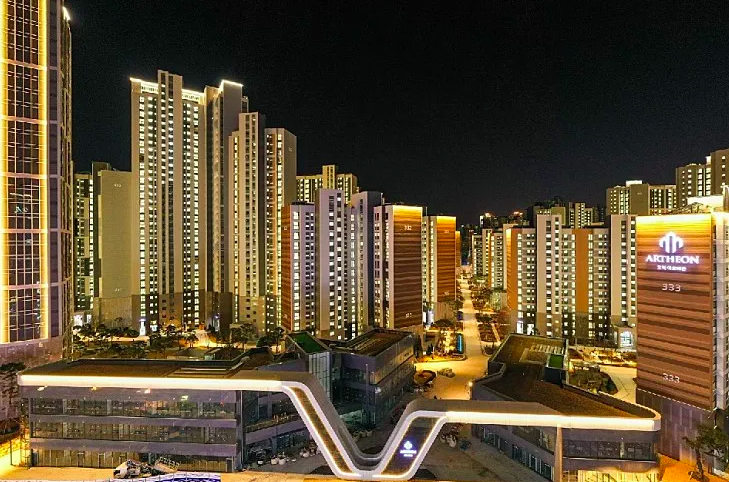
Previously, an official notice sent by Godeok Arteon to nearby apartment complexes spread online. The notice stated that violation fines would be imposed for riding electric scooters or electric bicycles on the ground level, as well as for smoking, failing to clean up after pets, and entering restricted areas such as children’s playgrounds within the complex. This sparked controversy.
Godeok Arteon: “It Is Not True That Fines Are Imposed Simply for Passing Through”
Regarding this, the Council stated on December 8, “The order maintenance cooperation notice was sent equally to neighboring complexes, including Godeok Gracium, and was a request for cooperation from the residential support center regarding the maintenance of order.” In particular, concerning the details of the ‘order maintenance cooperation notice,’ the Council explained, “One apartment omitted the part about ‘no entry with pets’ in relation to the children’s playground,” adding, “It is not true that a fine or violation fee of 100,000 won is imposed simply because outside children enter the playground.”
The Council stated, “The reason for restricting pets in the children’s playground is safety and public hygiene,” and argued, “If a resident brings an excited dog without an identification tag into private property, causing concerns about potential harm such as dog bites, the decision to take measures such as eviction rests with the party responsible for managing and overseeing the private property.”
Regarding claims of a “total ban on outsiders,” the Council emphasized, “The central pedestrian path (Arang-gil), which directly connects to Sangil-dong Station, remains accessible. Outsiders can use Arang-gil to pass through. It is not true that access is completely blocked or that fines are imposed simply for passing through.”
“From Reckless Cyclists to Fire Extinguisher Incidents”... Residents Voice Concerns Over Outsider Issues

The Council also shared the difficulties residents have experienced due to outsiders entering the complex. For example, in July, an outsider discharged a fire extinguisher, causing a disturbance, and there was an incident where a fire nearly broke out because someone smoked in an area with fallen leaves. There have also been cases where security guards and residents trying to stop reckless cycling were threatened. The Council pointed out, “With the opening of the pedestrian path, the number of outsiders passing through has surged, increasing the risk of accidents for residents. Furthermore, residents are now burdened with the legal and financial responsibility for accidents involving outsiders.”
The Council further stated, “Godeok Arteon did not receive any benefits, such as floor area ratio incentives, in exchange for opening the pedestrian path. The Seoul Metropolitan Government and district office only designated the area as a public pedestrian path and have not provided any support or management plans for its maintenance, management, or safety measures.” In conclusion, the Council argued, “This case is not simply a conflict between complexes. It is a structural issue where the government assigns public functions to private property under the name of public pedestrian path designation, while shifting management responsibility onto the residents. To prevent similar conflicts, a comprehensive review of the public pedestrian path designation system and improvements to the administrative framework are necessary.”
© The Asia Business Daily(www.asiae.co.kr). All rights reserved.
![Clutching a Stolen Dior Bag, Saying "I Hate Being Poor but Real"... The Grotesque Con of a "Human Knockoff" [Slate]](https://cwcontent.asiae.co.kr/asiaresize/183/2026021902243444107_1771435474.jpg)















