Controversy Over Only 3% Achieving Top Grade in CSAT English
Warm Message from Institute Employee Draws Attention
News has been circulating that an employee of the Korea Institute for Curriculum and Evaluation, which oversees the College Scholastic Ability Test, sent a message of encouragement to a student who, after four attempts, declared their intention to take the test for a fifth time. On December 8, several online communities featured a post titled "Someone Who Messed Up Their Fourth Try and Sent a DM to the Institute." The post included a conversation between a member of the institute's public relations team and an internet user, exchanged through the institute's official social media account.
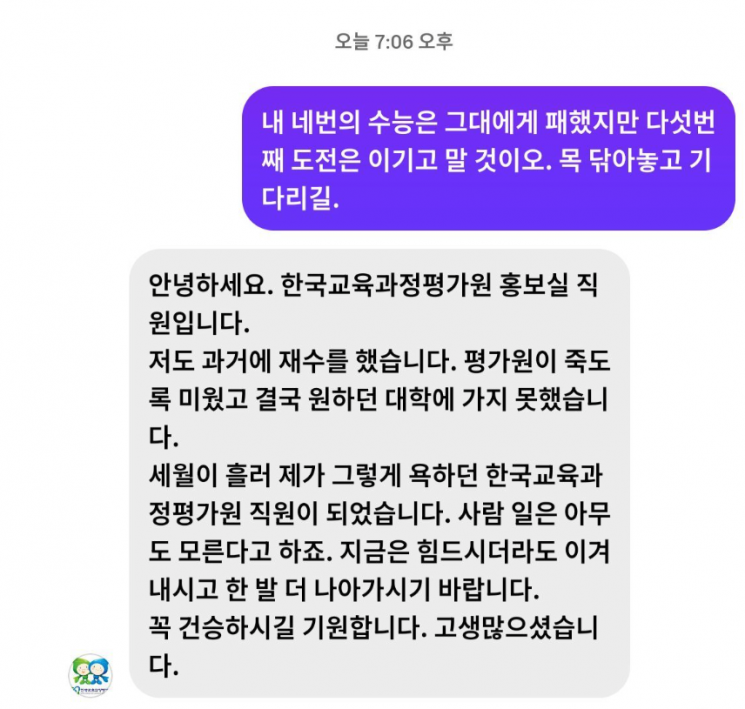 On the 5th, when the College Scholastic Ability Test scores were announced, an employee of the Korea Institute for Curriculum and Evaluation, which oversees the exam, sent a message of encouragement to a student retaking the test for the fifth time who had expressed their intention to challenge it again after four attempts. Online community
The conversation took place on December 5, the day the 2026 College Scholastic Ability Test scores were announced. In the message, the internet user wrote, "I have lost to you (the institute) four times, but I will surely win on my fifth attempt. Prepare yourself and wait for me," expressing their determination to try again with a sense of humor. In response, the institute's PR team member revealed their own background, saying, "I also retook the test in the past. I resented the institute deeply and ultimately did not get into my desired university. Years later, I became an employee at the very Korea Institute for Curriculum and Evaluation that I once criticized. Life is unpredictable."
The employee went on to say, "I know things are tough right now, but I hope you overcome this and take another step forward. I sincerely wish you the best of luck. You have worked very hard," sharing a heartfelt message based on their own experience. Among internet users, many commented that they could feel the sincerity of the institute employee. An official from the institute clarified, "This is not the institute’s official stance," adding, "It appears the employee responded out of personal empathy."
Continued Criticism Over Distortion of Absolute Grading, Institute Issues Unprecedented Official Apology
Despite an apology from the education authorities, criticism has not subsided after the percentage of students achieving the highest grade in English on the 2026 College Scholastic Ability Test, held last month, remained in the 3% range. According to the Korea Institute for Curriculum and Evaluation on December 7, only 15,154 students, accounting for 3.11% of all test takers, received a Grade 1 (raw score of 90 or above) in English this year. This is even lower than the percentage for relative grading subjects, which is around 4%. The institute stated, "Contrary to our intentions, the difficulty level increased, which is regrettable," and added, "Next year, we will aim for 6-10% of students to achieve Grade 1." Nevertheless, dissatisfaction among this year's test takers continues to grow.
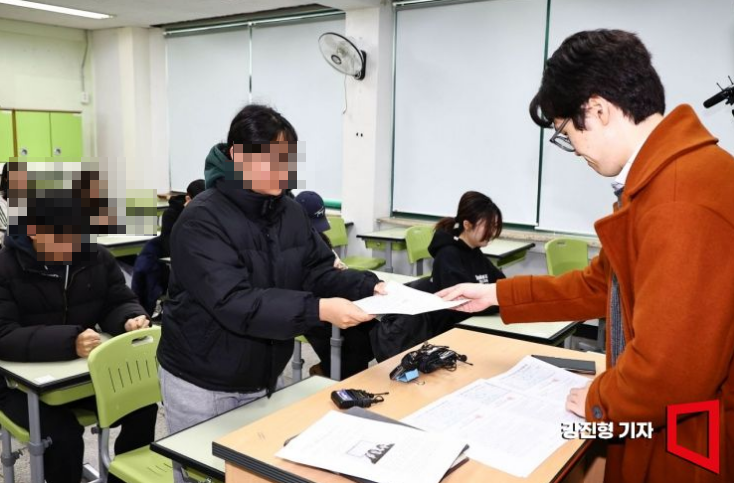 On the 5th, in a third-year classroom at Gwangnam High School in Gwangjin District, Seoul, where the 2026 College Scholastic Ability Test score reports were distributed, the homeroom teacher is handing out the score reports to the test takers.
Following the release of the test scores, the institute’s website bulletin board was flooded with posts protesting the difficulty of the English section. Internet user A wrote, "This is a failure in question design that goes against the purpose of absolute grading," and called for urgent measures to minimize the impact, such as score adjustment or more flexible application of minimum academic requirements in cooperation with universities. User B also commented, "Where is the compensation for the time, money, and effort invested by students who aimed for early admission? It is said that demand for English academies has surged due to this year’s test. Please take responsibility and come up with measures for this year’s examinees." It was reported that some rural high schools did not have a single student achieve Grade 1 in English.
As the controversy grew, the institute issued an unprecedented official apology on December 5. "We take seriously the criticism that the test did not meet the appropriate difficulty level and burden reduction required under the absolute grading system," the institute stated. "We deeply apologize for causing concern to examinees and their parents." The institute also promised to "not only analyze the English questions but also thoroughly review the test-setting and review processes to come up with improvements." The Ministry of Education added, "We will use this incident as an opportunity to thoroughly investigate the entire test-setting and review process for the College Scholastic Ability Test and respond strictly according to the results." However, since the institute's proposed improvements are focused on the next test, it appears that practical measures such as score adjustment or flexible application of minimum academic requirements for this year's examinees will be difficult to implement.
© The Asia Business Daily(www.asiae.co.kr). All rights reserved.
![Clutching a Stolen Dior Bag, Saying "I Hate Being Poor but Real"... The Grotesque Con of a "Human Knockoff" [Slate]](https://cwcontent.asiae.co.kr/asiaresize/183/2026021902243444107_1771435474.jpg)

















