125 Detailed Safety Management Measures Established
Civil Defense Plan Reflects Changes in Security Environment
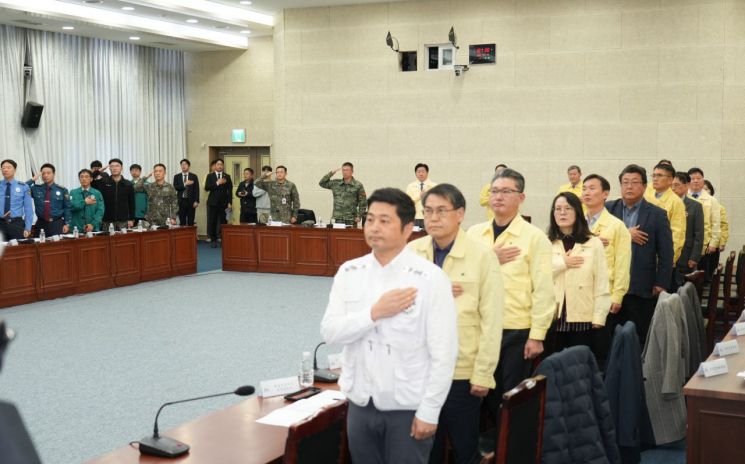 Jeju Special Self-Governing Province held the Jeju Safety Management Committee and the Integrated Defense Council at Tamna Hall of the provincial government office on the 8th, and finalized the "2026 Jeju Special Self-Governing Province Safety Management Plan" and the "2026 Civil Defense Plan." Provided by Jeju Special Self-Governing Province
On December 8, Jeju Special Self-Governing Province held the Jeju Safety Management Committee and the Integrated Defense Council at Tamna Hall of the provincial government office, and finalized the "2026 Jeju Special Self-Governing Province Safety Management Plan" and the "2026 Civil Defense Plan."
This meeting was conducted as a statutory procedure in accordance with Article 24 of the Framework Act on the Management of Disasters and Safety and Article 5 of the Integrated Defense Act, with the goal of realizing "a safer Jeju created together with residents."
The meeting was presided over by Governor Oh Younghun, who serves as the chairperson, and was attended by 45 members of the safety management committee and the integrated defense committee, including representatives from the Jeju Provincial Council, the Prosecutors' Office, the Police Agency, and the Navy.
The "2026 Safety Management Plan" is a statutory plan under the Framework Act on the Management of Disasters and Safety, providing a comprehensive strategy to protect the lives and property of residents from disasters and safety accidents.
This plan consists of 62 safety management plans and 125 detailed implementation measures across three areas: natural disasters, social disasters and safety accidents, and common sectors.
In particular, 14 types of disasters and accidents that occur repeatedly or pose a high risk of damage (such as wind and flood damage, heat waves, crime, fires, road traffic, infectious diseases, suicide, workplace industrial accidents, fishing accidents, and water-related accidents) were selected as priority management types, with a focus on strengthening prevention, proactive response, and on-site response systems.
The "2026 Civil Defense Plan" is a statutory plan designed to protect the lives and property of residents in times of war, emergency, or national crisis.
The plan includes core civil defense functions such as civil defense education and training, management of facilities, equipment, and supplies, issuance of civil defense alerts, and preparation for mobilizing civil defense units in emergencies.
Notably, the plan has been updated to reflect changes in the security environment, with a focus on enhancing disaster preparedness training closely related to daily life and designating additional evacuation facilities in towns and rural areas to improve its effectiveness.
Governor Oh Younghun emphasized, "In increasingly complex disaster situations, cooperation among agencies and proactive response are more important than ever to protect the lives and safety of residents," adding, "We must establish a close cooperation system to ensure tangible safety that residents can truly feel."
He further stressed, "Protecting the lives and safety of residents is the most important mission of the provincial government," and stated, "Jeju Province will align with national policy directions and make residents' safety the top priority as we continue to strengthen our disaster safety management capabilities."
Jeju Province has not recorded any fatalities from wind and flood disasters over the past seven years, and despite the record heat this summer, the number of heat-related illnesses decreased by 13% compared to last year. In recognition of these achievements, on December 5, the Ministry of the Interior and Safety selected Jeju as an outstanding local government for summer natural disaster countermeasures.
In particular, Jeju plans to further reduce the fatality rate from road traffic accidents, suicide rate, number of the five major crimes, and fishing vessel accident rate by categorizing disaster and safety accidents by type, and by strengthening both data-based disaster prediction systems and on-site response systems.
© The Asia Business Daily(www.asiae.co.kr). All rights reserved.
![Clutching a Stolen Dior Bag, Saying "I Hate Being Poor but Real"... The Grotesque Con of a "Human Knockoff" [Slate]](https://cwcontent.asiae.co.kr/asiaresize/183/2026021902243444107_1771435474.jpg)
















