"Reunited After Seeing the Poster... Happens Once Every 2 to 3 Years"
"AI Is More Effective in Finding Short-Term Missing Persons"
Unlike in the past, when only the faces of missing children at the time of their disappearance could be seen, it is now possible to see posters depicting how these children might look as adults. This has been made possible through artificial intelligence (AI) technology.
On the bulletin board next to the entrance of Namdaemun Police Station in Jung-gu, Seoul, a poster searching for missing children draws the attention of passersby. The poster features youthful photos taken as recently as 15 years ago and as long as 40 years ago, alongside an image labeled “Estimated appearance in 2025.” Kim Igon, who was 13 years old at the time of his disappearance, and Kim Taehui, who was 14, are now depicted as men in their 50s, resembling ordinary middle-aged individuals one might see in everyday life.
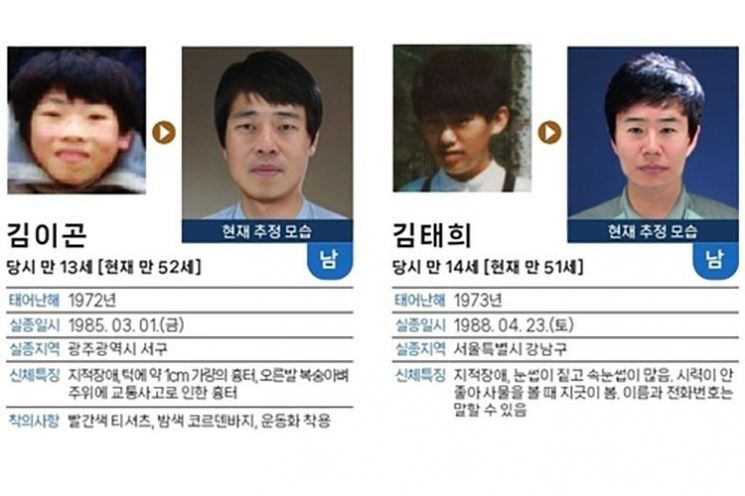 An aged appearance of a missing child realized through artificial intelligence (AI) technology. National Institute for Korean Medicine Development.
This technology was developed by the Korea Institute of Science and Technology (KIST), which uses AI to generate aged images of missing children. In the past, such results required a costly request to a U.S. company and a month-long wait. Since 2015, KIST has localized this process. With rapid advances in AI technology, the introduction of “super resolution” technology in 2023 has improved image quality, increasing resolution by four times compared to previous methods.
Kim Ikjae, Director of the AI and Robotics Research Division at KIST, explained in a phone interview with Yonhap News on December 7, “We trained the AI to recognize the facial features that change over time.”
For example, as boys go through adolescence, their jaws become more angular, while girls’ faces become softer and more oval-shaped. Both men and women experience lengthening of the nose and a higher nasal bridge. In middle age, crow’s feet, nasolabial folds, age spots, and freckles appear, and the jawline becomes more square. The AI is trained on data from many individuals to identify these common age-related patterns and apply them to photos taken at the time of disappearance.
Director Kim also noted that not only facial features but also clothing and hairstyles change with age and trends. Generative AI can now create a variety of hairstyles, such as perms, and different outfits, dramatically shortening production time.
The Child Rights Protection Agency, which produced the posters in collaboration with the National Police Agency and the Ministry of Health and Welfare, has used AI to create current images for 60 out of 189 long-term missing children under its management. According to the agency, cases where someone is reunited after a tip-off based on a poster occur about once every two to three years.
As of last year, there were a total of 1,417 long-term missing children and persons with disabilities who had not returned home more than a year after being reported missing. Of these, 1,128 have been missing for more than 20 years.
AI is playing a greater role in locating short-term missing persons. In Anyang, Gyeonggi Province, where the “AI route tracking system” is being piloted, AI recently located an elderly person in their 80s with dementia and a man in his 20s who had hinted at suicide. This method, in which AI remembers characteristics such as the missing person’s appearance and age group and simultaneously tracks them across multiple closed-circuit (CC) TV feeds, has been transferred to KT. Police agencies and local governments nationwide are considering adopting this technology.
© The Asia Business Daily(www.asiae.co.kr). All rights reserved.
![Clutching a Stolen Dior Bag, Saying "I Hate Being Poor but Real"... The Grotesque Con of a "Human Knockoff" [Slate]](https://cwcontent.asiae.co.kr/asiaresize/183/2026021902243444107_1771435474.jpg)
















