"If Forced, Backlash Will Follow"
The People Power Party has pushed back after lawmakers from the broader pro-government bloc proposed a bill to abolish the National Security Law.
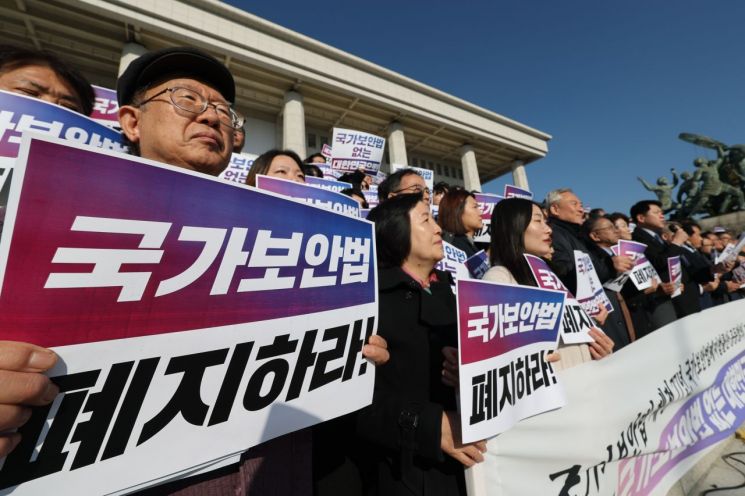 On the 1st, participants of the National Action for the Abolition of the National Security Law held placards at a press conference for the proposal of the abolition bill of the National Security Law on the stairs in front of the National Assembly Main Building in Yeongdeungpo-gu, Seoul. Photo by Yonhap News
Cho Yongsool, spokesperson for the People Power Party, stated in a commentary on the 7th, "If the abolition of the National Security Law is forced without social consensus, there will be strong backlash and repercussions." He went on to say, "The Constitutional Court has maintained its decision that the law is constitutional since the 1990s, citing North Korea's continued hostile strategy and the existence of similar legislation in other countries. Furthermore, a public opinion poll conducted on July 8 showed that a majority of citizens opposed the abolition of the National Security Law, and responses confirmed the presence of spies in our society."
He added, "Abolishing the National Security Law in a situation where there is neither national agreement nor any alternative legislation could be perceived as having an ulterior motive."
Previously, Min Hyungbae of the Democratic Party of Korea, Kim Junhyeong of the Korea Innovation Party, and Yoon Jongoh, floor leader of the Progressive Party, jointly sponsored the bill to abolish the National Security Law on December 2. Including Assemblyman Min and others, a total of 31 lawmakers from the Korea Innovation Party, the Progressive Party, and other pro-government factions signed on as sponsors.
In the explanatory note for the bill, they stated, "The National Security Law has long been criticized as a draconian law that suppressed freedom of thought, having inherited the Public Order Maintenance Act of Japanese imperialism at the time of its enactment." They added, "Most provisions of the National Security Law can already be replaced by the Criminal Act, and related laws such as the Inter-Korean Exchange and Cooperation Act are sufficient to regulate relevant matters."
© The Asia Business Daily(www.asiae.co.kr). All rights reserved.
![Clutching a Stolen Dior Bag, Saying "I Hate Being Poor but Real"... The Grotesque Con of a "Human Knockoff" [Slate]](https://cwcontent.asiae.co.kr/asiaresize/183/2026021902243444107_1771435474.jpg)















