9.7% of Total Population
Strengthening Support for Adaptation, Child Education, and Self-Reliance
Expansion of E-7-4R Visas, Counseling Centers, and Community Engagement Programs
As the number of foreigners and multicultural residents in the Gyeongju area continues to rise, the Gyeongju City government is working to strengthen its settlement support system.
On December 7, Gyeongju City announced that it is expanding a comprehensive support system-including education, counseling, job placement, and family assistance-to help marriage immigrants and foreign residents achieve stability in their daily lives and successfully settle into the local community.
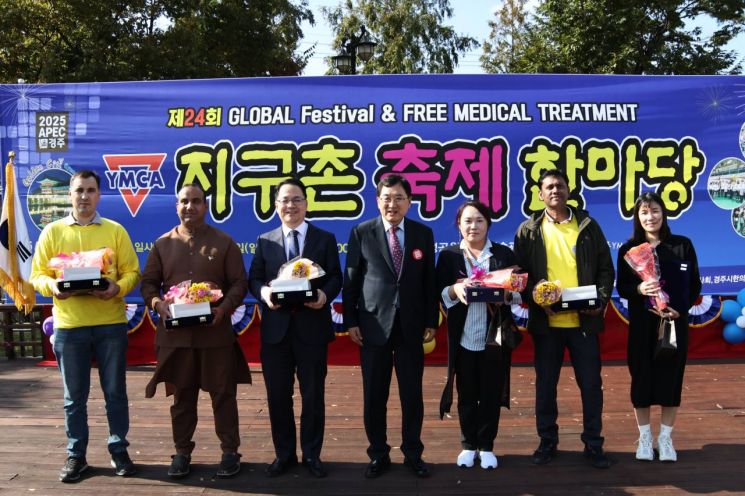 At the 24th Global Village Festival, Mayor Jun Nakyoung of Gyeongju City (fourth from the right) and attendees are taking a commemorative photo. Provided by Gyeongju City
According to statistics from the Ministry of the Interior and Safety, as of the end of October this year, there were 6,827 members of multicultural households in Gyeongju. Of these, 2,142 were marriage immigrants or naturalized citizens, and 1,926 were multicultural children.
During the same period, the number of foreign residents, including overseas Koreans and Koryoin, reached 20,698, accounting for 9.7% of the total population-the second-highest proportion in North Gyeongsang Province.
The city explained that the rapid increase in the multicultural and foreign population has made the need for settlement support even more urgent.
This year, Gyeongju City is investing 1.9 billion won to implement 23 support programs for multicultural families and 11 programs for foreign residents.
Next year, the city plans to broaden its support by newly introducing the "Whole Family Embrace Project," which identifies vulnerable and at-risk families to provide counseling, education, and cultural programs, as well as the "Hope Connection Project," which supports families accompanying skilled workers with the region-specific E-7-4R visa.
The Gyeongju City Family Center, the core institution for settlement support, operates step-by-step programs ranging from initial adaptation to self-reliance. Key initiatives include interpretation and translation services, Korean language education, home-visit education, certification acquisition and job training, and training for bilingual instructors, all aimed at establishing a foundation for independence.
Additionally, the city is expanding support throughout pregnancy, childbirth, and child-rearing with services such as the Mom Coach home-visit program, joint childcare centers, and parental education. Child learning support programs-including language development guidance, educational and activity fee support, crisis family home builder services, and bilingual classes-are also being offered.
Policies for foreign residents are also being strengthened. For the first time this year, Gyeongju City, together with Yeongcheon City, was allocated the largest quota in the province-130 slots-for the E-7-4R visa conversion recommendation system, and by the end of November, 101 individuals had been recommended.
The city believes this is significant in establishing an institutional foundation to help foreign workers in industrial sectors stay long-term and settle with their families.
In addition, Gyeongju operates four counseling and support centers for foreign workers, offering labor, legal, and daily life counseling, interpretation and translation in 13 languages, Korean language classes, safety education, and rest areas.
Annual events to foster communication with the local community, such as festivals for foreign workers, soccer tournaments, and foreign student security volunteer groups, are also ongoing.
Mayor Jun Nakyoung of Gyeongju City emphasized, "In this era of population decline, foreign residents are valuable neighbors of Gyeongju and reliable partners who support the local industry. Attracting skilled workers and supporting family settlement will help sustain the local economy and promote population inflow."
© The Asia Business Daily(www.asiae.co.kr). All rights reserved.
![Clutching a Stolen Dior Bag, Saying "I Hate Being Poor but Real"... The Grotesque Con of a "Human Knockoff" [Slate]](https://cwcontent.asiae.co.kr/asiaresize/183/2026021902243444107_1771435474.jpg)















