The amendment to the Criminal Act, which abolishes the so-called "kinship privilege" that exempts punishment for property crimes among family members, passed the Subcommittee on Bill Examination of the Legislation and Judiciary Committee of the National Assembly on December 5.
On this day, the Legislation and Judiciary Committee held the first Bill Examination Subcommittee and, with bipartisan agreement, approved the amendment to the Criminal Act containing these provisions.
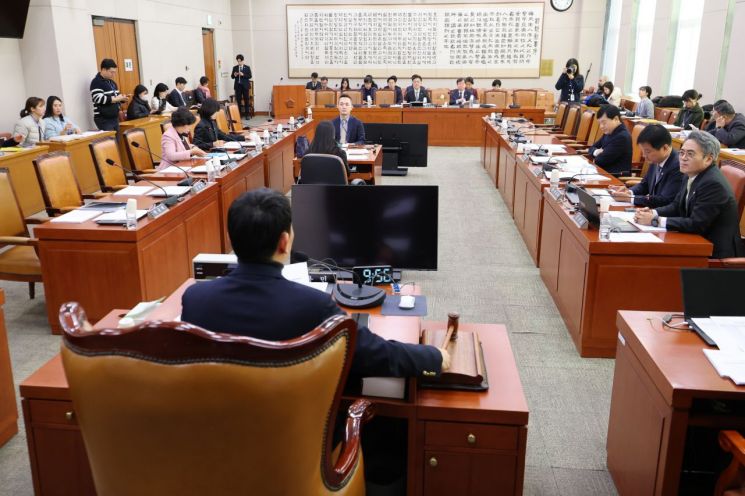 On the 5th, the Subcommittee on Bill Examination was held at the National Assembly Legislation and Judiciary Committee in Yeouido, Seoul, to review the amendment to the Attorney Act expanding lawyers' confidentiality privileges. Photo by Yonhap News
Article 328 of the Criminal Act stipulates the kinship privilege, which exempts punishment for property crimes such as theft, fraud, extortion, embezzlement, and breach of trust committed between direct blood relatives, spouses, or cohabiting family members, and requires a complaint for prosecution in the case of other relatives.
The kinship privilege was introduced in 1953 as a special provision based on Confucian values that the state should not intervene in property disputes within families.
However, as a series of high-profile cases involving celebrities such as broadcaster Park Soo-hong and golfer Pak Se-ri have brought attention to property damage within families, public criticism of the kinship privilege has grown. In practice, it is widely known that many cases cannot be prosecuted due to this provision, even when family members suffer property damage.
In response, the Constitutional Court ruled in June last year that the kinship privilege in the Criminal Act was inconsistent with the Constitution, and ordered the National Assembly to amend the law by December 31, 2025.
If the amendment passes the full session of the Legislation and Judiciary Committee and the plenary session of the National Assembly and takes effect, property crimes among family members will become "crimes subject to complaint," meaning prosecution will require a complaint from the victim.
On the same day, the subcommittee also passed an amendment to the Criminal Procedure Act that allows prosecutors to request the preservation of electronic information. This amendment is intended to enable Korea to join the "Budapest Convention" (Convention on Cybercrime), an international framework for responding to cybercrime.
The so-called "law to prevent delays in trials of insurrection and treason" (amendment to the Constitutional Court Act), sponsored by Legislation and Judiciary Committee Chairperson Choo Mi-ae of the Democratic Party of Korea, and the amendment to the Attorney-at-Law Act that expands attorney-client privilege, will continue to be discussed.
© The Asia Business Daily(www.asiae.co.kr). All rights reserved.
![Clutching a Stolen Dior Bag, Saying "I Hate Being Poor but Real"... The Grotesque Con of a "Human Knockoff" [Slate]](https://cwcontent.asiae.co.kr/asiaresize/183/2026021902243444107_1771435474.jpg)















