Bank of Korea, "Industry-Specific Loans by Deposit-Taking Institutions for Q3"
Regional Downturn and Restructuring Lead to Decline as Non-Performing Loans Are Disposed and Amortized
Due to the sluggish regional real estate market, real estate industry loans decreased for the third consecutive quarter in the third quarter of this year. This marks the first time since the second quarter of 2008, when the Bank of Korea began compiling industry-specific loan statistics, that real estate industry loans have declined for three straight quarters.
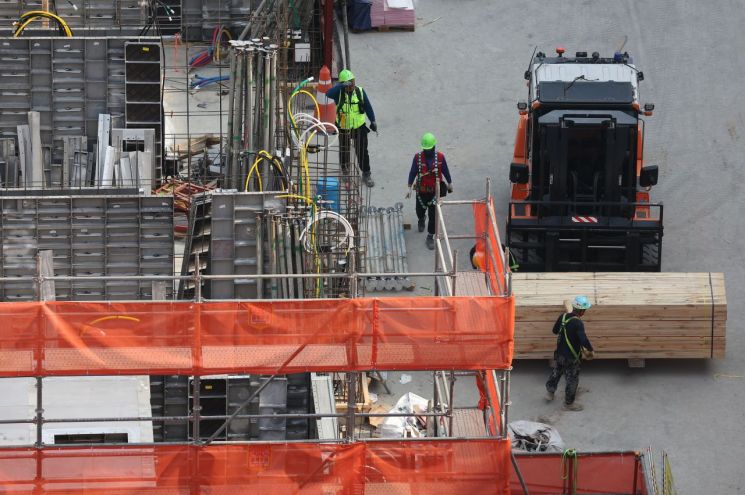 Construction work is underway at an apartment construction site in Seongbuk-gu, Seoul. Photo by Yonhap News
According to the “Industry-Specific Loans by Deposit-Taking Institutions for the Third Quarter of 2025” released by the Bank of Korea on December 5, outstanding real estate industry loans stood at 468.6 trillion won as of the end of September, down 1.4 trillion won from the previous quarter. This is the first time that real estate industry loans have posted a decline for three consecutive quarters since the Bank of Korea began compiling these statistics in the second quarter of 2008.
Kim Minsoo, Head of the Financial Statistics Team at the Economic Statistics Department 1 of the Bank of Korea, explained, “The decrease was due to restructuring resulting from the continued downturn in regional real estate markets, which led to the disposal and amortization of non-performing loans.” According to the Korea Real Estate Board, the rental price index for medium and large commercial properties in the third quarter of this year fell by 0.5% compared to the same period last year. The decline has been widening since the second quarter of last year. Data from the Ministry of Land, Infrastructure and Transport also show that unsold housing units after completion reached 27,000 in the third quarter of this year, remaining at a high level. The number of unsold units after completion has been on the rise, increasing from 11,000 at the end of 2023 to 21,000 at the end of last year, and further to 25,000 and 27,000 in the first and second quarters of this year, respectively.
Loans to the financial and insurance industries also increased by 9.6 trillion won in the third quarter. The increase was larger than in the second quarter (1 trillion won), driven by factors such as loans from banks to holding companies and special purpose companies (SPCs), refinancing of acquisition finance through banks, and funding by asset management companies for the purchase of non-performing real estate loans. As a result of the increases in both real estate and financial and insurance industry loans, service industry loans also saw a larger increase of 15.7 trillion won, up from 7.2 trillion won in the second quarter. Construction industry loans (-1 trillion won) continued to decline due to ongoing disposal and amortization of non-performing loans.
The outstanding balance of industry-specific loans by deposit-taking institutions in the third quarter of this year was 2,014.1 trillion won, up 20.2 trillion won from the previous quarter. The increase was also larger than in the previous quarter (14.5 trillion won). While the service industry saw a greater increase, the manufacturing industry’s loan growth slowed. Manufacturing industry loans increased by 4.1 trillion won, down from a 6 trillion won increase in the previous quarter. This was influenced by the base effect of policy loans to the semiconductor industry in the second quarter.
By use of funds, operating capital loans increased by 13.6 trillion won in the third quarter, with the service industry accounting for much of the growth. Facility funds (+6.6 trillion won) saw a smaller increase in the manufacturing sector, particularly in electronic components, computers, video, audio, and telecommunications equipment, due to the base effect of policy loans to the semiconductor industry in the second quarter. However, in the service industry (+5.5 trillion won), the increase was larger, driven by the growth in financial and insurance industry loans.
By institution type, deposit banks posted a larger increase (+20.4 trillion won), while non-bank deposit-taking institutions shifted to a decrease (-300 billion won). By company size, deposit banks saw increases in loans to large corporations (+7.9 trillion won), small and medium-sized enterprises (excluding sole proprietors, +10.3 trillion won), and sole proprietors (+2.1 trillion won).
© The Asia Business Daily(www.asiae.co.kr). All rights reserved.
![Clutching a Stolen Dior Bag, Saying "I Hate Being Poor but Real"... The Grotesque Con of a "Human Knockoff" [Slate]](https://cwcontent.asiae.co.kr/asiaresize/183/2026021902243444107_1771435474.jpg)















