KCCI and Bank of Korea Co-host Seminar
Special Dialogue Between Chairman Choi Taewon and Governor Lee Changyong
In-depth Exchange on AI Bubble, International Competitiveness, and Digital Assets
Keynote Speech and Presentation Sessions Also Held
"Need to Foster AI Talent and Establish New Regulatory Framework"
In order for the Korean economy to achieve a new leap forward amid the increasingly fierce global artificial intelligence (AI) race, it has been argued that a "selection and concentration" strategy for AI investment is needed. Additionally, active development of specialized talent to drive AI transformation, as well as the creation of growth-oriented ecosystems in the areas of regulation, energy, labor, and finance, are also necessary.
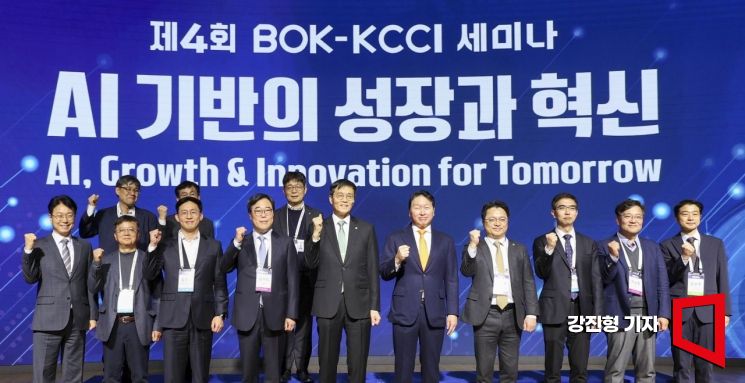 Choi Tae-won, Chairman of the Korea Chamber of Commerce and Industry, Lee Chang-yong, Governor of the Bank of Korea, and other key attendees are posing for a commemorative photo at the "4th Bank of Korea-Korea Chamber of Commerce and Industry Seminar, AI-Based Growth and Innovation" held on December 5, 2025, at the Korea Chamber of Commerce and Industry in Jung-gu, Seoul. Photo by Kang Jinhyung
On December 5, the Korea Chamber of Commerce and Industry held the 4th BOK-KCCI Seminar under the theme "AI-Based Growth and Innovation" at its international conference hall, jointly organized with the Bank of Korea.
This seminar was organized to explore strategies for building an AI-based industrial innovation and corporate growth ecosystem in a rapidly changing global environment. Since 2023, the Korea Chamber of Commerce and Industry and the Bank of Korea have been regularly co-hosting this seminar to expand discussions on sustainable growth strategies for the Korean economy. This is the fourth edition.
During a special discussion, Choi Tae-won, Chairman of the Korea Chamber of Commerce and Industry and SK Group, who leads a global advanced semiconductor company, and Lee Chang-yong, Governor of the Bank of Korea, who has advocated for structural reform of the Korean economy, exchanged in-depth views on major AI-related issues such as the AI bubble, international competitiveness, digital assets, corporate response strategies, and government policy directions.
In addition to the discussion, Ha Jungwoo, Chief of AI Future Planning at the Office of the President, and Moon Sinhak, Vice Minister of the Ministry of Trade, Industry and Energy, delivered congratulatory remarks, expressing their commitment to providing full support for achieving an AI-driven transformation in industry.
In the subsequent keynote speech, Lee Honglak, Director of the LG AI Research Institute, emphasized that "securing competitiveness through AI transformation is a matter of corporate survival," and stressed the critical importance of developing internal specialized talent. He noted that while organizations in the past were operated mainly by experienced personnel who had accumulated expertise in the field, in the future, all work will be reorganized around AI by applying AI to each business area and learning through this process. He also stated that "expanding employees' AI literacy (the ability to understand and utilize AI technologies and tools) through AI universities and similar initiatives will be key" in this process.
In the thematic presentations, Oh Samil, Head of the Employment Research Team at the Bank of Korea, pointed out that "the wage premium for domestic AI technology professionals (6% as of 2024) has been steadily rising, but remains low compared to major advanced countries." He further emphasized that "low performance-based compensation is a cause of the outflow of AI specialists overseas." Kim Cheongu, Research Fellow at the Korea Chamber of Commerce and Industry's SGI, stated that "if AI is actively adopted, the potential growth rate is expected to increase by 0.66 percentage points between 2024 and 2040, but the regulatory system, including the Basic AI Act, is not supporting this." He argued for the need to newly establish an AI regulatory framework, including the creation of a manufacturing AI mega-sandbox, negative regulations, and a regulatory sunset system (a system that requires clear evidence, objectives, and effects to be proven in advance when introducing new regulations).
© The Asia Business Daily(www.asiae.co.kr). All rights reserved.
![Clutching a Stolen Dior Bag, Saying "I Hate Being Poor but Real"... The Grotesque Con of a "Human Knockoff" [Slate]](https://cwcontent.asiae.co.kr/asiaresize/183/2026021902243444107_1771435474.jpg)















