496 Emergency Calls Overnight for Pileups and Other Accidents
Traffic Jams and Stranded Vehicles Across Icy Roads
11 Flights and 13 Passenger Ferries Suspended
"It felt like the entire city of Seoul was paralyzed by about 5 centimeters of snowfall."
A sudden heavy snowfall in the Seoul metropolitan area led to major roads in the city being closed, resulting in severe traffic congestion during the evening commute. As the cold weather caused roads to freeze, there were severe traffic jams in many areas, and some vehicles were stranded for extended periods inside tunnels. The heavier-than-expected snowfall left many citizens stuck in the middle of the roads, causing widespread inconvenience.
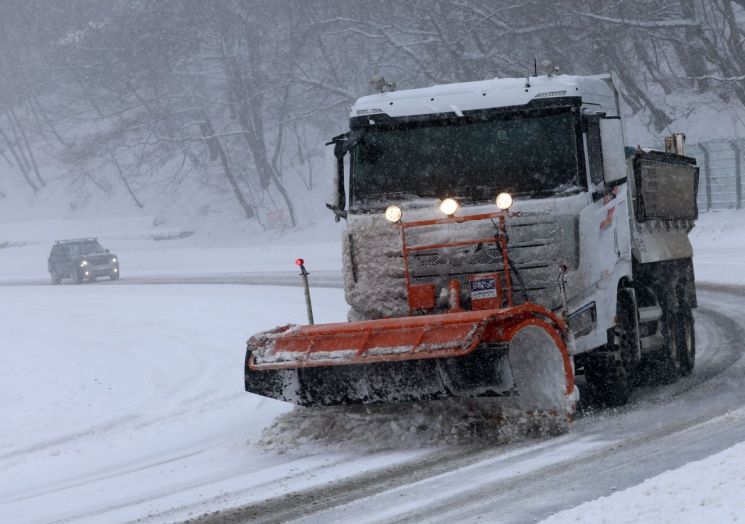 On the 4th, a snowplow is busy clearing snow in the Daegwallyeong section of Gangneung City, Gangwon Province. Photo by Yonhap News Agency
Around 7 a.m. on December 5, snowplows were busy spreading calcium chloride on roads throughout Seoul. However, on sidewalks where the snow had not been cleared in time and had frozen over, citizens moved cautiously, taking small, hurried steps. The recorded snowfall from the previous day was 5.6 centimeters in Gyeonggi Province, 5.1 centimeters in Seoul, 4.3 centimeters in Gangwon Province, 3.4 centimeters in North Chungcheong Province, 3.1 centimeters in South Chungcheong Province, and 2.6 centimeters in Sejong.
According to the Central Disaster and Safety Countermeasures Headquarters (CDSCH) of the Ministry of the Interior and Safety, as of 5 a.m. on this day, there were no reports of casualties or facility damage due to the heavy snow. However, there were numerous reports of slip-and-fall accidents and vehicles being stranded, leading to 496 fire department dispatches. The Seoul Metropolitan Police Agency received a total of 1,981 emergency calls, including 442 reports of traffic disruptions (166 of which were traffic accidents), 1,444 reports related to risk prevention (safety incidents), and 95 other cases. The Seoul Metropolitan Government had deployed 5,052 personnel and 1,145 snow removal vehicles since the previous day to clear the snow, but the heavier-than-expected snowfall limited the effectiveness of these efforts. An office worker, identified as Mr. A, said, "It took me more than three hours to get from Yangjae-dong in Gangnam District to Buam-dong in Jongno District in the evening. I was stuck in the middle of the road and couldn't move at all."
Numerous accidents occurred on icy roads as well. At 5:51 a.m., on Nodeul-ro in Dangsan-dong, Yeongdeungpo District, a six-vehicle pileup occurred when a passenger car and other vehicles collided with a Starex van that had stopped near the guardrail. The driver of the Starex was transported to a nearby hospital. At 6:05 a.m., a seven-vehicle pileup occurred on the north end of Banpo Bridge on Gangbyeonbuk-ro, heading toward Guri. No injuries have been reported so far. Air and sea transportation were also disrupted. Eleven flights were canceled, including three at Gimpo Airport, seven at Jeju Airport, and one at Cheongju Airport. In addition, the operation of 13 passenger ferries connecting Mokpo, Hongdo, Jindo, and Jukdo was suspended.
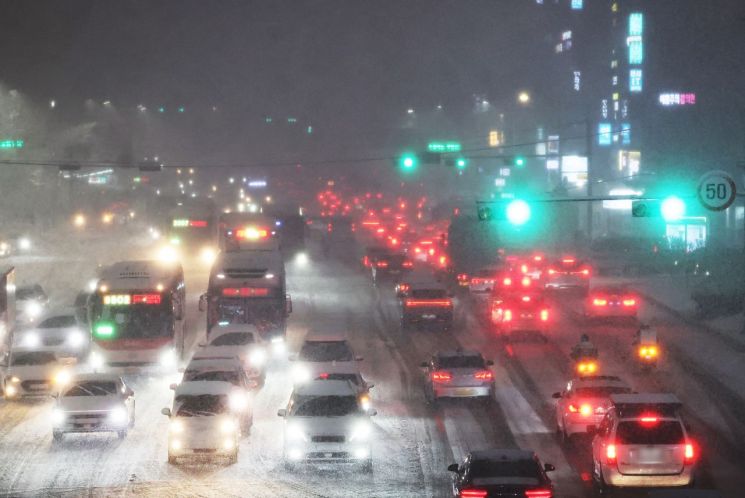 On the 4th, vehicles were moving slowly on Deokyeong-daero in front of Suwon Station, Paldal-gu, Suwon-si, Gyeonggi-do. Photo by Yonhap News Agency
Fortunately, by the morning commute, all roads in Seoul that had been closed due to the sudden heavy snowfall had returned to normal. Twenty-eight sections of expressways and nine city roads in downtown Seoul were fully reopened at 4:53 a.m., following the completion of snow removal on the south end of Cheongdam Bridge to Tancheon 1 Bridge section of Bundang-Suseo Road toward Seongnam. To prevent confusion during the morning commute, the Seoul Metropolitan Government increased subway operations by 20 runs and extended the intensive bus dispatch period by 30 minutes.
The government also ordered enhanced snow removal efforts to prevent a "morning commute crisis." Yoon Hojoong, head of the CDSCH and Minister of the Interior and Safety, instructed that not only should major roads be cleared of snow, but also that deicing agents should be subdivided and stocked in snow removal bins along key sections. Kim Kwangyong, Director of Disaster and Safety Management, said, "To prevent road icing accidents during the sub-zero morning commute, thoroughly clear snow from both major arterial roads and side streets," and added, "Local governments, including Seoul, should ensure that, in addition to main roads, side streets, sidewalks, and alleys are also thoroughly cleared to prevent icing, so that there are no problems during the morning commute."
The Ministry of the Interior and Safety activated Level 1 of the CDSCH at 6 p.m. the previous day and raised the heavy snow crisis alert from "Attention" to "Caution." Although the heavy snow advisory has been lifted, the CDSCH will continue operations to address delayed snow removal and traffic congestion in the metropolitan area. Weather advisories and safety instructions will continue to be provided through all available channels, including disaster text messages (CBS) and subtitle broadcasts (DITS).
© The Asia Business Daily(www.asiae.co.kr). All rights reserved.
![Clutching a Stolen Dior Bag, Saying "I Hate Being Poor but Real"... The Grotesque Con of a "Human Knockoff" [Slate]](https://cwcontent.asiae.co.kr/asiaresize/183/2026021902243444107_1771435474.jpg)
















