KITA Export-Import Assessment and 2026 Outlook
Surging AI Demand for HBM Drives Sharp Price Increases
Delivery of High-Value Vessels Pushes Ship Exports Up Over 22%
IT Products Expected to Continue Growth Next Year
There are projections that South Korea's exports, which are expected to surpass the $700 billion mark for the first time ever this year, will continue their recovery trend into next year.
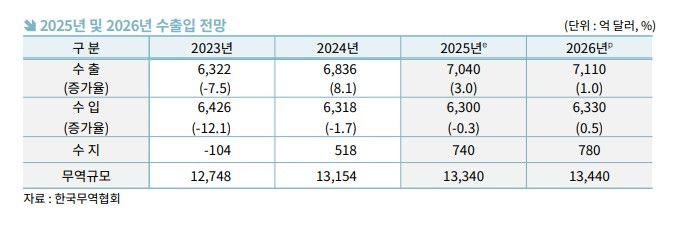
According to the "2025 Export and Import Assessment and 2026 Outlook" report released on December 5 by the Korea International Trade Association's Institute for International Trade and Commerce, exports for this year are expected to reach $704 billion, an increase of 3.0% compared to the previous year. Imports are projected to decrease by 0.3% to $630 billion, resulting in a trade surplus of $74 billion.
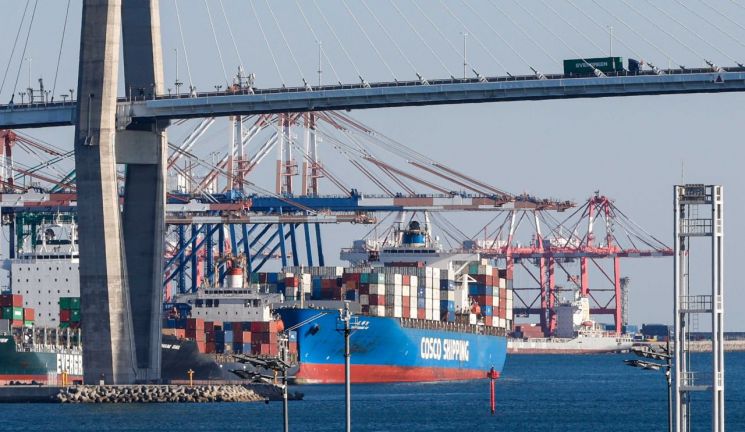
The report cites semiconductors and ships as the main factors behind the expected achievement of $700 billion in exports for the first time this year. In particular, semiconductors are forecast to post record-high performance this year, driven by a surge in demand for next-generation chips for artificial intelligence (AI), such as high-bandwidth memory (HBM), and a sharp rise in semiconductor prices due to limited production lines. For ships, exports are expected to increase by more than 22% this year as high-value vessels (including LNG carriers) that were intensively ordered in 2022 and 2023 are delivered sequentially.
Automobiles, which saw a sharp drop in exports to the United States due to tariffs (1.6%), are expected to maintain a modest recovery as exports are diversified to markets outside the United States, such as the European Union. In particular, with expectations of tariff reductions following the conclusion of Korea-U.S. negotiations, exports to the United States rebounded in November (up 13.7%), and it is anticipated that the sluggishness in exports to the United States will gradually ease by the end of the year. However, exports of steel (down 9.4%), which is subject to a high 50% tariff, and petroleum products (down 11.7%), which have seen a sharp drop in export prices due to falling oil prices, are expected to remain sluggish through the end of the year.
The report forecasts that despite uncertain conditions, South Korea will continue to see positive export growth next year. In 2026, exports are expected to rise by 1.0% year-on-year to $711 billion, with imports increasing by 0.5% to $633 billion, resulting in a trade surplus of $78 billion.
Next year, information technology (IT) items such as semiconductors, solid-state drives (SSD), and wireless communication devices are expected to maintain relatively high growth. Semiconductors (up 5.9%) are projected to continue their strong pricing trend due to expanding AI inference demand and supply constraints. SSDs (up 10.4%) are expected to see export growth centered on enterprise SSDs as the shift to high-capacity SSDs accelerates in response to increased demand for AI infrastructure and storage.
Wireless communication devices (up 5.4%) are forecast to see further growth driven by the continued expansion of foldable smartphones, with the rising prices of memory semiconductors leading to higher finished smartphone prices. Displays (up 2.9%) are also expected to see a slight increase due to favorable export conditions, such as the expanded application of OLED (organic light-emitting diode) technology in IT products and the move toward higher value-added smartphones.
In contrast, automobiles (down 1.0%) are expected to show a slight decline due to base effects and the gradual expansion of local production in the United States. Petroleum products (down 13.3%) are expected to see double-digit declines in exports as oil prices fall to the mid-$50 range, resulting in a sharp drop in unit prices. Petrochemicals (down 6.1%) are also projected to continue their downward export trend into next year due to large-scale new capacity additions in China and persistent oversupply. Steel (down 2.0%) is expected to remain sluggish as high U.S. tariffs persist, global demand stagnates, and protectionist trade policies spread among countries.
Imports next year (up 0.5%) are expected to remain flat overall, as the decline in energy imports due to falling international oil prices is offset by factors such as the possibility of oil-producing countries halting production increases and the expansion of imports of semiconductors and manufacturing equipment for export production.
Jang Sangshik, head of the Institute for International Trade and Commerce at the Korea International Trade Association, stated, "Next year, IT products including semiconductors are expected to drive our export growth, based on solid AI demand. However, since global trade growth is expected to be very limited (0.5%, WTO), and uncertainties such as the U.S. midterm elections and potential revisions to the USMCA (United States-Mexico-Canada Agreement) still remain, we must continue to diversify our export markets to regions such as the Middle East and ASEAN, and steadily expand our export base, especially for K-content and consumer goods."
© The Asia Business Daily(www.asiae.co.kr). All rights reserved.
![Clutching a Stolen Dior Bag, Saying "I Hate Being Poor but Real"... The Grotesque Con of a "Human Knockoff" [Slate]](https://cwcontent.asiae.co.kr/asiaresize/183/2026021902243444107_1771435474.jpg)
















