13 Research Teams Share Field-Based Achievements
Proposing Solutions to Coastal Issues Such as Regional Extinction and Digital Transformation
The Korea Maritime Institute (KMI), led by President Cho Jeonghee, held the "2025 Our Sea Field Research Support Project Final Presentation" on the 6th floor of the KMI conference room on November 28. At this event, research achievements directly collected from the field of maritime affairs and fisheries over the past year were shared.
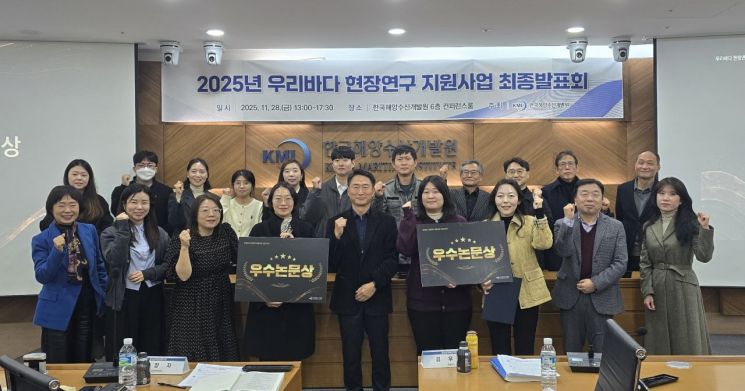 KMI is holding the "2025 Our Sea Field Research Support Project Final Presentation" and taking a commemorative photo. Photo by KMI
The "Our Sea Field Research Support Project" is KMI's flagship field-oriented research program that supports researchers in identifying maritime and fisheries issues and proposing solutions. Over the past eight years, from 2018 to this year, approximately 650 proposals have been submitted, with 93 projects selected and supported, serving as a catalyst for resolving issues in coastal areas.
This year's final presentation featured 13 research teams that had passed intense competition, presenting the results of their field-based studies conducted over several months. In particular, the teams focused on in-depth analysis of how social issues such as regional extinction, generational conflict, and digital transformation are manifesting in the maritime and fisheries sector, and proposed specific policy alternatives to address them.
The research topics presented were categorized as follows: responses to demographic changes in coastal regions, revitalization of marine tourism, and the establishment of logistics and safety networks based on advanced technologies. The research teams presented a wide range of solutions, from practical, daily-life issues such as the problem of vacant homes in fishing villages, expanding relational populations in super-aged regions, and creating pet-friendly beaches, to studies applying Fourth Industrial Revolution technologies, such as machine learning-based marine disaster prediction, drone delivery by post offices in island regions, and the introduction of autonomous ITT (Inter Terminal Transport) at Busan New Port.
In addition, the event highlighted the potential of new marine cultural industries, such as marine funerals, as well as economic approaches like the development of a shipping market bubble index.
The panel of judges commented, "While previous research focused on understanding the current situation, this year stood out for its attempts to derive practical solutions using advanced research methodologies such as machine learning and latent profile analysis. It was impressive to see creative approaches to new challenges in the maritime and fisheries sector."
The Excellent Paper Award (KMI President’s Award) was given to two studies: "A Study on the Spatial Typology of Vacant Homes in Fishing Villages and the Risk of Extinction" (Lee Jaeun, Sejong Institute), which addressed the major contemporary issues of regional extinction and youth employment, and "The Psychology of Avoidance of Marine Jobs Among Millennials & Gen Z and Rebranding Strategies" (Lee Eunyoung, Myongji University). Both studies received high praise for their originality and potential for policy application.
Cho Jeonghee, President of KMI, stated, "This presentation was a meaningful opportunity to reinterpret the complex crises facing the maritime and fisheries sector through field data and researchers’ fresh perspectives. We will actively review and utilize the 13 research achievements so that they do not end as mere reports, but are connected to effective policies that bring about real changes in coastal regions."
© The Asia Business Daily(www.asiae.co.kr). All rights reserved.

















