AI Talent Policy Should Focus on Attracting and Retaining Professionals in Korea
Beyond Quantitative Expansion: Emphasizing Quality Advancement and Preventing Talent Outflow
Establishing Career Development Pathways and Global-Level Compensation Systems Is Essential
The core of artificial intelligence (AI) talent policy design lies in ensuring that outstanding professionals continue to enter and settle in the country, according to recent analysis. To secure international competitiveness, it is essential to establish a compensation system and research and industrial ecosystem that meet global standards, as well as to systematically build career development pathways.
57,000 Domestic AI Professionals... Centered on Highly Educated and Engineering Majors
According to the "BOK Issue Note - Status and Imbalance of Supply and Demand for AI Professionals: Analysis of Scale, Wages, and Mobility" (Park Geunyong, Seo Donghyun, Oh Samil, Han Jinsu), published by the Bank of Korea on December 5, the number of AI professionals in Korea was estimated at about 57,000 as of last year, with a wage premium of approximately 6%.
This comprehensive analysis utilized LinkedIn-based online profile data to examine the scale, wages, and labor mobility of domestic AI professionals. By analyzing the work history of about 1.1 million employees who have worked in Korea between 2010 and 2024 and over 10 million job history records, the researchers identified individuals possessing AI skills and shed light on the domestic AI talent ecosystem.
As a result, the number of AI professionals in Korea has rapidly increased over the past decade, reaching an estimated 57,000 as of 2024. Among them, 58% hold master's or doctoral degrees, indicating a highly educated workforce, and 64% majored in engineering fields. Oh Samil, Head of the Employment Research Team at the Bank of Korea's Research Bureau, noted, "As the application of AI professionals expands across industries and occupations, the versatility of the technology has also been enhanced."
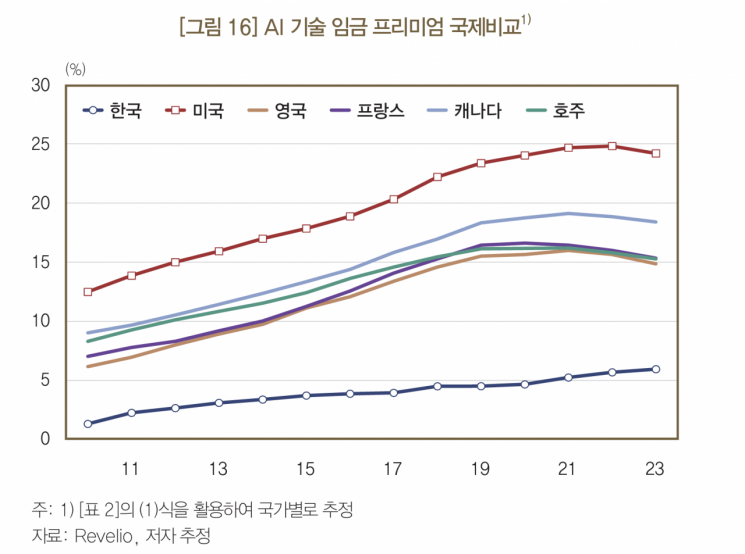
AI Technology Wage Premium: "U.S. 25% vs. Korea 6%"... Low Compensation Drives Talent Abroad
Korea's wage premium for AI technology remains low compared to international levels. In the United States, AI professionals receive a high wage premium approaching 25%. Canada offers an 18% premium, while the United Kingdom, France, and Australia provide around 15%. In contrast, Korea's wage premium in 2024 is about 6%, less than half that of major countries. Oh pointed out, "Relatively low compensation is one of the main reasons driving core domestic AI talent overseas."
AI professionals exhibit high labor mobility, with frequent job changes and continuous overseas outflow. Those with AI skills were found to have a 27 percentage point higher probability of working abroad. As of 2024, about 16% (11,000 people) of all domestic AI professionals are working overseas, which is approximately 6 percentage points higher than other workers. The rate of job transitions to foreign companies also remains consistently high. In 2024, 1.4% of AI professionals who changed jobs moved abroad, 0.6 percentage points higher than other workers.

Companies Want to Hire AI Professionals... But Face Challenges Due to Shortage of Skilled Talent and High Salary Expectations
Most companies, including 69.0% of large corporations and 68.7% of mid-sized companies, plan to expand AI hiring. However, they are struggling to secure talent due to a shortage of skilled professionals and high salary expectations. As a result, companies are increasingly willing to offer higher wages to attract top AI talent. In particular, the larger the company, the greater the intention to provide higher wage premiums to future AI professionals. Small and medium-sized enterprises also responded that they are willing to offer a wage premium of 18.2%, which is 4.4 percentage points higher than the current 13.8%. Oh analyzed, "If the supply of AI professionals does not sufficiently increase, the expansion of AI hiring by companies will lead to excess demand, and the upward trend in wage premiums may accelerate further."
Therefore, future AI talent policies by the government and companies need to focus not only on quantitative expansion but also on qualitative advancement and preventing talent outflow. Oh emphasized, "In particular, it is necessary to establish career development pathways for nurturing AI professionals and to create a compensation system and research environment that meet international standards, so that outstanding talent can continue to flow into and settle in the country."
© The Asia Business Daily(www.asiae.co.kr). All rights reserved.
![Clutching a Stolen Dior Bag, Saying "I Hate Being Poor but Real"... The Grotesque Con of a "Human Knockoff" [Slate]](https://cwcontent.asiae.co.kr/asiaresize/183/2026021902243444107_1771435474.jpg)

















