Significant Easing of Corporate Average Fuel Economy Standards
Large Vehicle Makers Like Ford Welcome Move
Hyundai Motor and Kia Likely to Delay Eco-Friendly Vehicle Investments
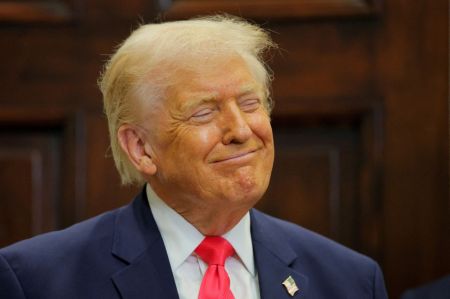
The administration of U.S. President Donald Trump is set to significantly ease the U.S. automobile fuel efficiency standards that were tightened under the previous Biden administration. As a result, global sales strategies of automakers, including Hyundai Motor, will inevitably need to be revised.
The regulatory proposal announced by President Trump on the 3rd (local time) centers on lowering the Corporate Average Fuel Economy (CAFE) standard, which automakers must comply with, for model year 2031 from the current 50 miles per gallon to 34.5 miles per gallon.
CAFE measures the average fuel efficiency of all vehicles sold by a manufacturer, and the average must exceed the set standard. Therefore, selling more electric vehicles, which have higher fuel efficiency than internal combustion engine vehicles, is advantageous. For companies with a high proportion of large vehicles with lower fuel efficiency, such as pickup trucks or sport utility vehicles (SUVs), it means they must sell enough electric vehicles to raise their average. As such, CAFE has served as an incentive for automakers to improve the fuel efficiency of internal combustion engine vehicles and to expand production of hybrids and electric vehicles.
The reason President Trump’s action is being described as drastic is that it not only nullifies the upward revision announced by the previous Biden administration, but also proposes a standard even lower than the one that existed before. The Biden administration had announced in June of last year that it would raise the CAFE standard for model year 2031 from the existing 39.1 miles per gallon to 50.4 miles per gallon.
President Trump also criticized the Biden administration’s green policies for driving up car production costs, asserting that “ordinary consumers will be able to save at least $1,000 when purchasing a new car.” The Financial Times (FT) pointed out that this policy also carries a political message, signaling the Republican Party’s efforts to address the issue of inflation.
Since taking office in January this year, the Trump administration has consistently pursued policies to slow the transition to electric vehicles, such as abolishing EV tax credits and blocking California’s regulations. President Trump has also personally expressed a preference for internal combustion engine vehicles and has not shown support for eco-friendly cars.
The global automotive industry has shown mixed reactions. Companies with a high proportion of large vehicle sales, such as Ford and Stellantis, welcomed the policy as positive for the industry. Stellantis shares rose by nearly 5% on the New York Stock Exchange the previous day. In contrast, electric vehicle makers like Tesla and companies such as Toyota, which have invested in fuel efficiency technologies, are expected to be negatively impacted.
Korean companies such as Hyundai Motor and Kia are also expected to slow the pace of their electric and hybrid vehicle production and investment. Hyundai Motor had previously announced an electrification strategy involving an investment of 77.3 trillion won by 2030, with plans to increase the proportion of eco-friendly vehicles to 60%. Kia had also announced plans to expand its hybrid and electric vehicle lineup and increase eco-friendly vehicle sales to 2.33 million units by 2030.
An official from the domestic auto industry commented, “Companies are likely to respond flexibly depending on policy and market conditions,” adding, “However, since it will take President Trump a considerable amount of time to make a final decision, they will closely monitor the situation for now.”
© The Asia Business Daily(www.asiae.co.kr). All rights reserved.
![Clutching a Stolen Dior Bag, Saying "I Hate Being Poor but Real"... The Grotesque Con of a "Human Knockoff" [Slate]](https://cwcontent.asiae.co.kr/asiaresize/183/2026021902243444107_1771435474.jpg)















