A new manufacturing process has been developed that not only improves the fabrication of Protonic Ceramic Electrochemical Cells (PCEC), which require ultra-high temperatures, but also achieves high performance. PCECs are gaining attention as next-generation energy technology, as they can simultaneously produce electricity and hydrogen-a key advantage in the current era of surging power demand driven by artificial intelligence (AI).
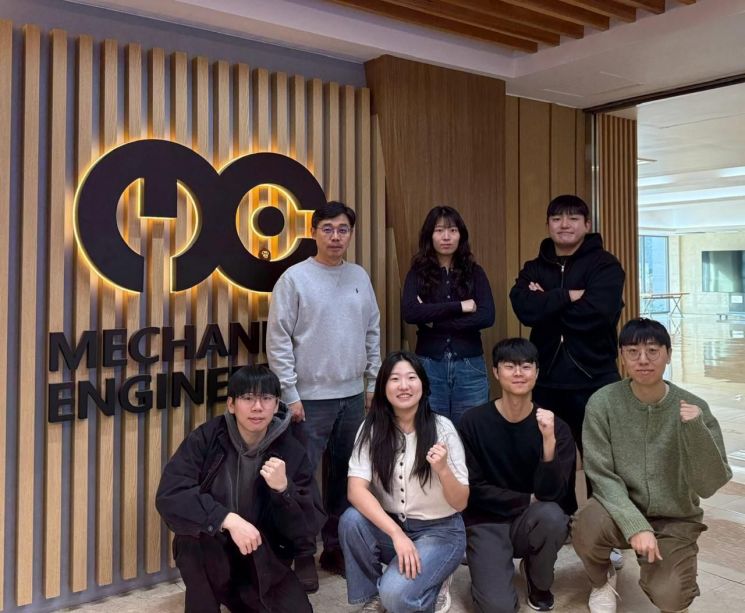 (From the top row, left to right) Professor Kangtaek Lee, PhD candidate Yejin Kang, PhD Dongyeon Kim, (from the bottom row, left to right) Master's candidate Mincheol Lee, PhD candidate Seeun Oh, PhD candidate Seungsu Jang, PhD candidate Hyeonggeun Kim. Provided by KAIST
KAIST announced on December 4 that the research team led by Professor Kangtaek Lee from the Department of Mechanical Engineering has developed a novel process that enables the production of high-performance PCECs at temperatures more than 500 degrees Celsius lower than conventional methods.
The new process incorporates a "microwave + vapor control technology," which utilizes the principles of microwave heating and a chemical vapor diffusion environment with specific chemical components.
The electrolyte, a core material in PCECs, contains barium (Ba). However, barium tends to evaporate easily at temperatures above 1,500 degrees Celsius, which has been identified as a major cause of reduced cell performance. Therefore, the ability to solidify the ceramic electrolyte at lower temperatures is a key factor in determining cell performance.
To address this issue, the research team devised a new heat treatment method called "Vapor Phase Diffusion." This technique involves placing a special auxiliary material (vapor source) next to the cell and irradiating it with microwaves to rapidly diffuse the vapor.
When this technology is applied, vapor generated from the auxiliary material at 800 degrees Celsius moves toward the electrolyte, causing the ceramic particles to bond tightly. As a result, the manufacturing temperature required to complete the PCEC was reduced from the conventional 1,500 degrees Celsius to 980 degrees Celsius.
A 1 cm² cell produced using the new process at 600 degrees Celsius stably generated 2 watts of power and produced 205 milliliters of hydrogen per hour. Most notably, it demonstrated excellent stability, maintaining performance without degradation even after 500 hours of continuous operation.
The research team further enhanced the reliability of the technology by using a digital twin to analyze gas movement within the cell's microstructure-phenomena that are difficult to observe in actual experiments.
Professor Lee stated, "This study is the world's first case of using vapor to lower the heat treatment temperature while simultaneously creating a high-performance, highly stable cell. We hope that this newly developed process will become a core manufacturing technology to address power issues in the AI era and accelerate the realization of a hydrogen society."
Meanwhile, Dongyeon Kim, PhD, and Yejin Kang, PhD candidate, both from the Department of Mechanical Engineering at KAIST, participated as co-first authors in this research. The results were published in the energy and materials journal Advanced Materials and were featured as the cover article in the October 29 issue.
© The Asia Business Daily(www.asiae.co.kr). All rights reserved.
![Clutching a Stolen Dior Bag, Saying "I Hate Being Poor but Real"... The Grotesque Con of a "Human Knockoff" [Slate]](https://cwcontent.asiae.co.kr/asiaresize/183/2026021902243444107_1771435474.jpg)















