Judicial Administration Committee Act, Act Prohibiting Preferential Treatment for Former Justices, and Judges' Disciplinary Act
"Judicial Personnel Committee Also Has a Majority of Non-Judges... Judicial Administration Committee Is Not Unconstitutional"
The Democratic Party of Korea has criticized the Supreme Court under Chief Justice Cho Hee-dae and proposed three bills aimed at normalizing judicial administration. Among these, the bill to establish the Judicial Administration Committee, which would have personnel authority over the judiciary, has faced criticism for potentially being unconstitutional due to the inclusion of a majority of non-judges. The party has refuted this, stating, "This is not true."
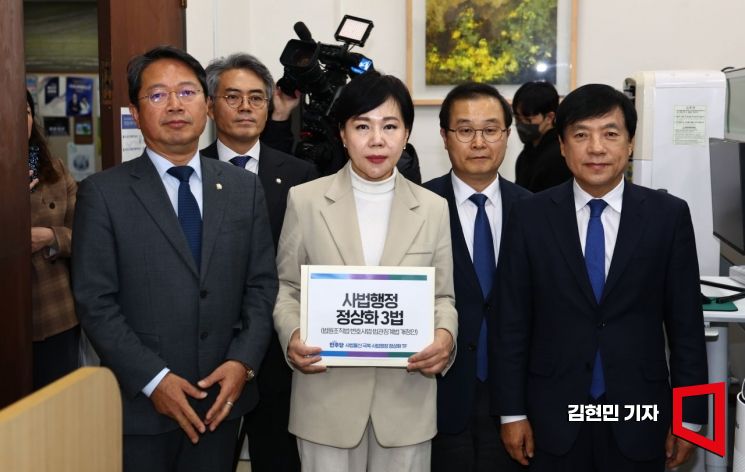 Jeon Hyunhee, Chair of the Task Force for Overcoming Judicial Distrust and Normalizing Judicial Administration of the Democratic Party of Korea, is submitting the three bills for the normalization of judicial administration at the National Assembly Secretariat on the 3rd. From left, Assemblymen Kim Seungwon, Kim Gipyo, Chair Jeon, Lee Geontae, and Kim Seongyun. 2025.12.3 Photo by Kim Hyunmin
On December 3, Assembly members Jeon Hyunhee, Lee Geontae, Kim Gipyo, Kim Seungwon, Kim Seongyun, and Park Kyuntaek, all part of the Task Force for Overcoming Judicial Distrust and Normalizing Judicial Administration, submitted the three judicial normalization bills to the National Assembly Secretariat in Yeouido. The three bills include: the Act on the Establishment of the Judicial Administration Committee (an amendment to the Court Organization Act), the Act Prohibiting Preferential Treatment for Former Supreme Court Justices (an amendment to the Attorney-at-Law Act), and an amendment to the Judges’ Disciplinary Act.
Jeon Hyunhee, head of the task force, told reporters, "We have witnessed numerous instances where judicial democracy and justice have been undermined by the Supreme Court under Cho Hee-dae." She continued, "We clearly saw an unprecedented cancellation of detention for Yoon Suk-yeol, the leader of the rebellion, and an unprecedentedly swift Supreme Court remand for Lee Jaemyung, the presidential candidate, which amounts to a judicial coup interfering in the presidential election."
Jeon also stated, "We have seen the true face of the Supreme Court under Cho Hee-dae, which has obstructed the special prosecutor's investigation aimed at settling and ending the rebellion by repeatedly rejecting warrants at every critical juncture." She pointed out, "The rejection of a warrant for former People Power Party floor leader Chu Kyungho is a second coup by the judiciary and an act of abetting rebellion."
She added, "Judicial reform is something the judiciary has brought upon itself," emphasizing the need for swift judicial reform by saying, "On this day, the National Assembly Legislation and Judiciary Committee will also pass the bills to establish a dedicated court for rebellion cases and the Act on Judges Dedicated to Warrant Review."
Regarding criticism that the bill to abolish the Court Administration Office and establish a Judicial Administration Committee with a majority of non-judges is unconstitutional, Jeon rebutted, "That is not true." She explained, "Currently, the Supreme Court Justice Recommendation Committee includes the Minister of Justice and many external members. Also, under the current Court Organization Act, the Judicial Personnel Committee, which is responsible for court personnel, has more non-judges than judges."
Jeon further stated, "If the bill we have proposed is unconstitutional, then those existing laws would also be unconstitutional. The claim that having a majority of non-judges is unconstitutional is simply not true."
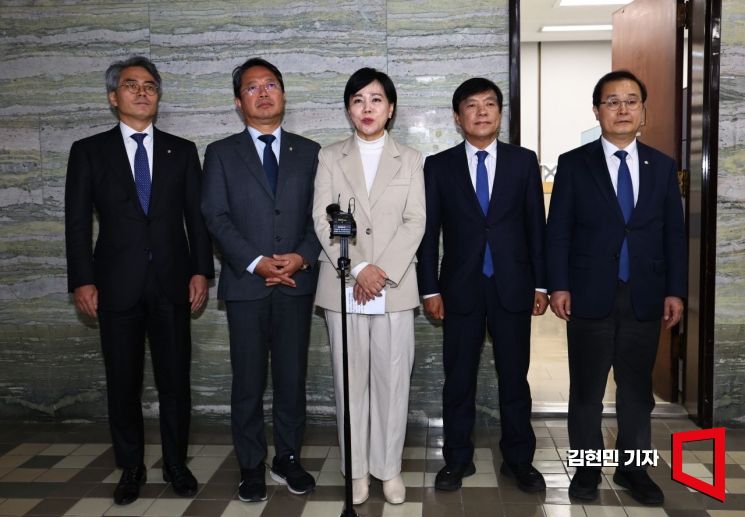 Jeon Hyunhee, Chair of the Task Force for Overcoming Judicial Distrust and Normalizing Judicial Administration of the Democratic Party of Korea, and members held a press conference on December 3, 2025, after submitting the three bills for normalizing judicial administration at the National Assembly Secretariat. Photo by Kim Hyunmin
Jeon also addressed concerns that political circles might be involved in judicial personnel or administration, which could violate the separation of powers and the Constitution. She clarified, "To eliminate any possibility of misunderstanding, we have completely excluded the National Assembly from involvement."
Meanwhile, Assemblyman Park stated, "I have personally concluded that the bill for public participation in detention reviews, which I proposed in October, is ultimately necessary," and added, "If the Legislation and Judiciary Committee convenes today, I plan to propose that the bill allowing citizen judges to participate in detention warrant reviews be pursued by the end of the year." Park has proposed a special bill on the public participation detention warrant review system, which includes appointing citizen representatives recommended by local bar associations and public councils near the locations of district courts and their branches as members of the detention warrant review committee.
© The Asia Business Daily(www.asiae.co.kr). All rights reserved.
![Clutching a Stolen Dior Bag, Saying "I Hate Being Poor but Real"... The Grotesque Con of a "Human Knockoff" [Slate]](https://cwcontent.asiae.co.kr/asiaresize/183/2026021902243444107_1771435474.jpg)
















