Advancing Surveillance and Response Systems for Future Pandemics
Focused Investment in Expanding Immunization and Managing Chronic Diseases
The Korea Disease Control and Prevention Agency (KDCA) announced on December 3 that the National Assembly had finalized the agency’s budget for 2026 at 1.3359 trillion won through a plenary session on December 2.
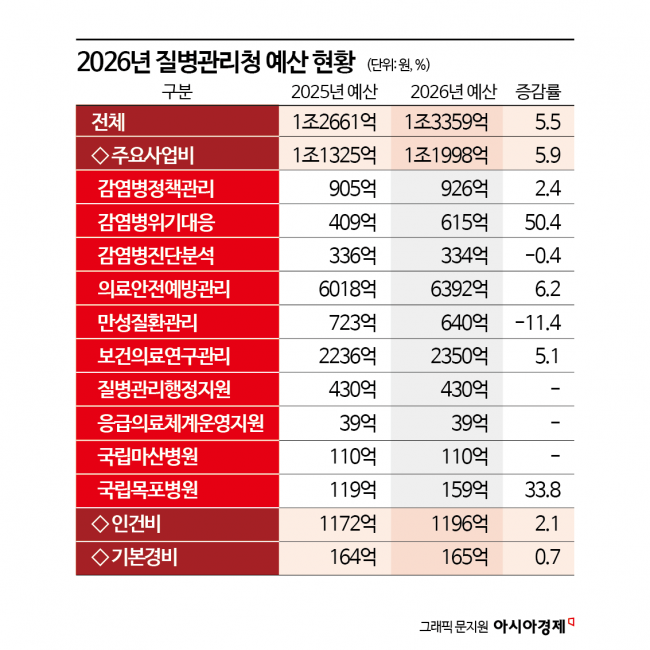
The KDCA’s budget for next year has increased by 5.5% (69.8 billion won) compared to this year’s 1.2661 trillion won.
Compared to the government’s original proposal, the budget for next year has been increased by a total of 4.7 billion won, including the following items: the purchase of avian influenza vaccines (for 38,000 people) in preparation for the next pandemic; expansion of specialized institutions and registration management projects to support patients with rare diseases; purchase of smallpox vaccines for bioterrorism preparedness and response; and research funding to strengthen the national injury prevention management system.
Compared to this year’s budget, the main project expenses (1.1998 trillion won) have increased by 5.9%, and personnel expenses (119.6 billion won) have risen by 2.1%.
Among the main projects, the budget for infectious disease crisis response saw the largest increase, rising from 40.9 billion won to 61.5 billion won, an increase of 50.4%. In contrast, the budgets for chronic disease management (64 billion won) and infectious disease diagnosis and analysis (33.4 billion won) were reduced by 11.4% and 0.4%, respectively.

Lim Seungkwan, Commissioner of the KDCA, stated, “Now that we have overcome the critical phase of the COVID-19 pandemic, this is the right time to prepare for the next pandemic. By advancing our infectious disease surveillance and response systems, we will ensure thorough preparedness for future outbreaks. In addition, we will provide comprehensive support for expanding national immunization programs, managing chronic diseases and health risk factors, and promoting healthcare research and development (R&D) to protect the public’s safety.”
© The Asia Business Daily(www.asiae.co.kr). All rights reserved.


















