Startup Alliance Surveyed 101 Companies
Unclear Standards and Preparation Uncertainty Pose Risks
"Need to Revise Standards and Procedures for Practical Implementation"
With only about one month left until the enforcement of the Artificial Intelligence (AI) Basic Act, it has been revealed that 98% of AI startups have not established a response system.
On December 3, Startup Alliance published a report titled "AI Basic Act and Startups: The Reality Faced by AI Startups." This report contains the results of a survey conducted with 101 AI startups regarding the "Framework Act on the Promotion and Trust Building of Artificial Intelligence (AI Basic Act)," which is scheduled to take effect in January next year.
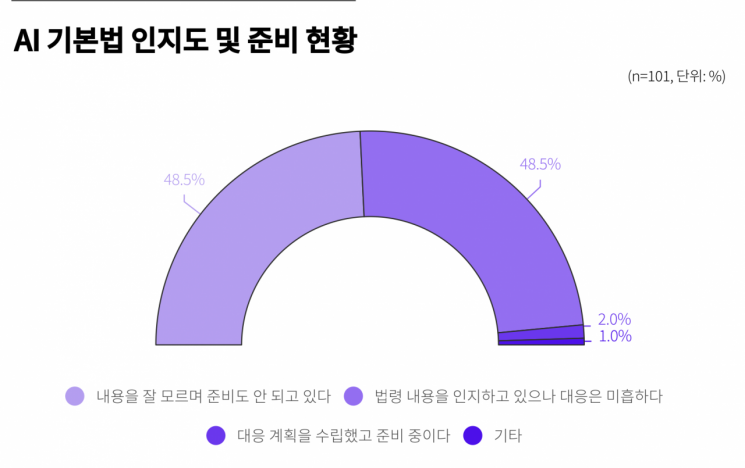 Survey Results on AI Basic Act Awareness and Preparedness Among AI Startups. Although only one month remains until the enforcement of the AI Basic Act, only 2% of startups have established response plans and are preparing for it. Startup Alliance
When asked about their preparedness for the AI Basic Act, only 2% of companies responded that they have established and are preparing a response plan. In contrast, 48.5% answered that they are not aware of the details and are not prepared, while another 48.5% said they are aware of the law but have insufficient measures in place. This indicates that the vast majority of respondents have not set up a response system.
Regarding the most restrictive provisions of the AI Basic Act for companies, the responses were as follows: ▲Reliability and safety certification system (27.7%), ▲Requirement to ensure dataset transparency (23.8%), ▲Obligation to designate, register, and verify high-risk AI (17.8%), and ▲Obligation to label generative AI outputs (15.8%).
As for the specific burdens associated with each provision, "unclear standards" was cited most frequently. Ambiguity was commonly pointed out regarding the scope of notification, the definition of generative AI, and the criteria for designating high-impact AI. In addition, companies reported significant burdens from practical processes such as certification procedures and data explanation requirements. The analysis suggests that most companies find the uncertainty in the preparation process to be a greater challenge than the regulations themselves.
The report recommended that, before the enforcement ordinance is finalized, the following should be reconsidered: ▲Establishing concrete criteria and realistic procedures for high-impact AI, ▲Applying the obligation to label generative AI outputs differently according to media type and risk level, ▲Setting computational power standards based on the "AI model," and ▲Recognizing that simply deferring fact-finding requirements or imposing minor fines will not sufficiently resolve regulatory risks.
Lee Gidae, Director of Startup Alliance Center, stated, "Although the enforcement of the AI Basic Act is imminent, this survey once again confirms that preparations on the ground remain insufficient," adding, "We hope the government will actively listen to the voices of the industry during the legislative notice period and establish a system that can be practically implemented in the field."
© The Asia Business Daily(www.asiae.co.kr). All rights reserved.
![Clutching a Stolen Dior Bag, Saying "I Hate Being Poor but Real"... The Grotesque Con of a "Human Knockoff" [Slate]](https://cwcontent.asiae.co.kr/asiaresize/183/2026021902243444107_1771435474.jpg)















