Cancer Has the Highest Mortality Probability
Eliminating Cancer Would Increase Life Expectancy by 3.3 Years
Life Expectancy Excluding Years Lived With Illness Is 65.5 Years

The life expectancy for children born last year was found to be 83.7 years. This means that a baby born in 2024 is expected to live up to 83.7 years. The leading cause of death threatening newborns is cancer, with a probability of death from cancer at 19.5%. If cancer-related deaths were eliminated, life expectancy would be expected to increase by 3.3 years. However, the period spent in good health, excluding years lived with illness, has slightly decreased.
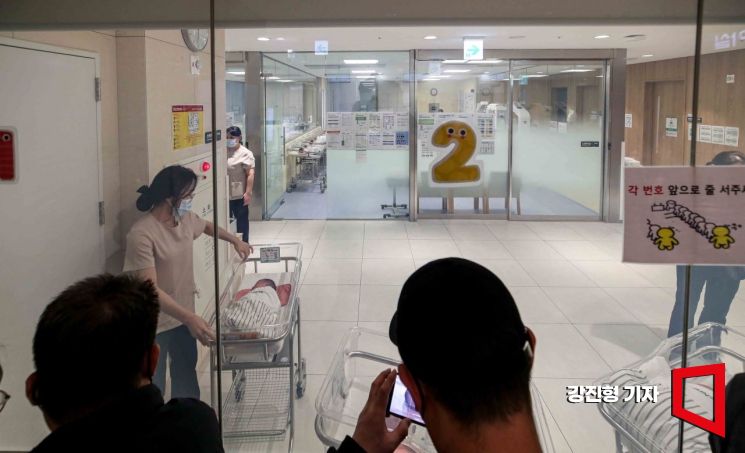 Statistics Korea announced that the number of births last year increased by 8,300 from the previous year to 238,300. On February 27, in front of the newborn room at Ain Hospital in Michuhol-gu, Incheon, parents and families of newborns are looking at their babies through the window. 2025.2.27. Photo by Kang Jinhyung
According to the “2024 Life Table” released by the National Data Agency on December 3, the life expectancy of babies born in 2024 is 83.7 years, an increase of 0.2 years compared to the previous year. Life expectancy for men is 80.8 years and for women is 86.6 years, with both increasing by 0.2 years. Compared to ten years ago, life expectancy for men has increased by 2.2 years and for women by 1.6 years. The life table is a statistical estimate of how long a person of a certain age can expect to live, assuming current age-specific mortality rates remain unchanged.
The gender gap in life expectancy increased from 7.1 years in 1970 to 8.6 years in 1985, but has gradually narrowed since then. The difference in life expectancy between men and women born last year was 5.8 years, down 0.1 years from the previous year and 0.7 years from ten years ago. Park Hyunjung, Director of Population Trends at the National Data Agency, explained, “Men tend to work in more hazardous occupations and are more exposed to drinking and smoking. However, last year, the male mortality rate decreased due to a decline in deaths from pneumonia.”
The probability of a newborn surviving to age 80 is 64.4% for boys and 82.2% for girls. This is an increase of 5.6 times and 2.5 times, respectively, compared to 1970. The probability of a newborn reaching 100 years old is estimated at 1.2% for boys and 4.8% for girls. Survival indicators for the elderly have also generally improved. As of 2024, a 60-year-old man is expected to live another 23.7 years and a woman another 28.4 years, which is an increase of 0.3 years and 0.2 years, respectively, compared to the previous year.
“Cancer is the leading cause of death at 19.5%”... Without cancer, men live 4.1 years longer, women 2.5 years longer
Cancer remains the most common cause of death among Koreans. The National Data Agency stated, “The probability of a baby born in 2024 dying from cancer is 19.5%, the highest among all causes.” The probability of dying from cancer is 24.5% for men and 15.2% for women.
An analysis of the potential increase in life expectancy if specific causes of death were eliminated showed that removing cancer as a cause would increase the life expectancy of 0-year-old boys in 2024 by 4.1 years and girls by 2.5 years. If pneumonia were eliminated, life expectancy would increase by 1.0 year, and if heart disease were eliminated, by 1.2 years.
Life expectancy in Korea is higher than the average for the Organisation for Economic Co-operation and Development (OECD). According to OECD data, Korean men live 2.3 years longer and women 2.9 years longer than the OECD average. Male life expectancy ranks 11th out of 38 OECD countries, and female life expectancy ranks 3rd (86.6 years), with Korean women maintaining one of the highest life expectancies in the world.
Unlike overall life expectancy, healthy life expectancy, which excludes years lived with illness, is 65.5 years. The period spent in good health decreased by 0.5 years for men and 0.2 years for women compared to 2022. Healthy life expectancy refers to the period during which a person can live in good health, excluding years spent suffering from disease or injury, and is 64.6 years for men and 66.4 years for women. Director Park explained that the increase in years lived with illness is due to more people visiting hospitals even for minor ailments as medical service usage rises. She added, “As access to health insurance improves, the number of outpatient visits increases, which in turn lengthens the period spent living with illness.”
© The Asia Business Daily(www.asiae.co.kr). All rights reserved.


















