Participation from Local Governments, Universities, and Research Institutes
Multi-Disciplinary Public Interest Missions
The Korea Aerospace Administration and the Korea Aerospace Research Institute (KARI) have finalized the selection of six CubeSats to be loaded as secondary payloads on the sixth Nuri rocket, scheduled for launch in 2027.
The selected missions focus on public interest and technology demonstration, including ecological and environmental change observation, national cybersecurity verification, AI autonomous flight demonstration, forest and disaster analysis, and trajectory research for deep space exploration.
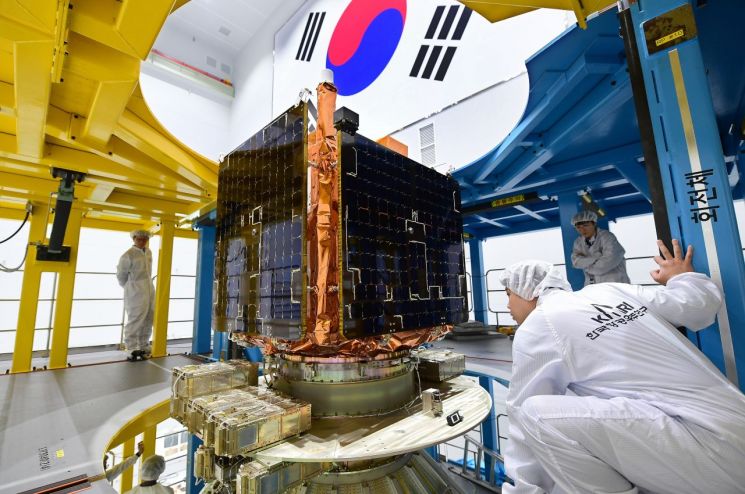 Researchers are conducting final inspections of the next-generation medium satellite 3 and the CubeSat deployment tube mounted on the third stage of the Nuri rocket at the Satellite Test Building of the Naro Space Center, Korea Aerospace Research Institute, located in Goheung, Jeollanam-do. Provided by Korea Aerospace Research Institute
A total of six satellites have been selected this time. "SuncheonSat-1" from Suncheon City will capture images of the Suncheonman National Garden and wetlands to collect ecological change data and verify the performance of local companies' space components. "K-STAR" from the National Security Research Institute will test national cybersecurity technologies in the space environment and demonstrate response systems.
"KAFASAT-2" from the Korea Air Force Academy will be used to accumulate experience in designing and operating ultra-small satellites, serving as infrastructure for education and training. "GAIMSat-1" from Gwangju Metropolitan City will verify AI-based onboard data processing and autonomous flight algorithms. "KMU ET-02" from Kookmin University will analyze nationwide forest data to detect disaster risks early and will be used for research to foster talent in related fields.
KARI's "Deep Space Exploration Demonstrator" will conduct experiments to change its orbit to geosynchronous orbit (GSO, approximately 36,000 km) using low-thrust propulsion and will also carry out imaging missions of the Moon and the asteroid Apophis.
The Korea Aerospace Administration and KARI held a public call for proposals from industry, research institutes, universities, and local governments between September and October last year. The final selection was made through expert evaluation based on public purpose and technical feasibility. The six selected CubeSats consist of one 3U, four 6U, and one 27U, reflecting national demands and the needs of research and industrial sites in their respective missions.
In addition to these six CubeSats, five additional ultra-small cluster satellites (numbered 7 to 11) will be loaded as primary payloads, along with KARI's third domestically-developed component verification satellite and KAIST Satellite Research Center's active control satellite "ADRSat," bringing the total number of satellites on the sixth Nuri launch to thirteen.
Park Jaeseong, Director of Space Transportation at the Korea Aerospace Administration, stated, "We prioritized public purposes such as disaster and environmental monitoring, land management, and talent development as the most important criteria. The selected satellites are designed to make substantial contributions to national needs. The Korea Aerospace Administration will closely cooperate with each institution to support launch preparations and satellite development."
An expert in the domestic satellite development field commented, "CubeSats are now moving beyond educational platforms to the stage of performing practical missions such as data applications, autonomous operation verification, and deep space core technology experiments. The demonstration system linked to the Nuri rocket launch will strengthen the domestic ultra-small satellite industry base and, in the long term, serve as a significant milestone in securing deep space exploration capabilities."
© The Asia Business Daily(www.asiae.co.kr). All rights reserved.
![Clutching a Stolen Dior Bag, Saying "I Hate Being Poor but Real"... The Grotesque Con of a "Human Knockoff" [Slate]](https://cwcontent.asiae.co.kr/asiaresize/183/2026021902243444107_1771435474.jpg)















