Fed to Cut Rates Twice by End of 2026
Target Range Expected at 3.25?3.5% in 2027
Eurozone and Canada: "No Further Rate Cuts"
The Organisation for Economic Co-operation and Development (OECD) has forecast that the world’s major economies will complete the current interest rate cut cycle by the end of next year. This outlook is based on the expectation of slower growth, but also on the assessment that most central banks have limited room for further monetary easing.
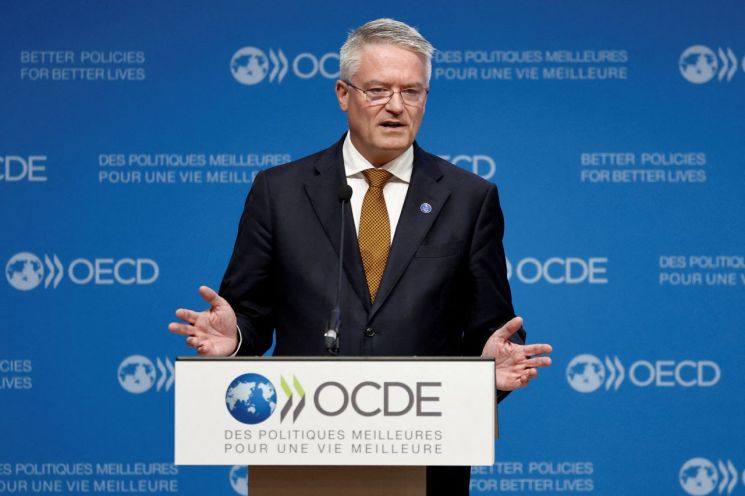
According to the Financial Times (FT) on December 2 (local time), the OECD projected that the US Federal Reserve (Fed) would lower rates two more times by the end of 2026, then maintain its target range for the federal funds rate at 3.25-3.5% throughout 2027. The Fed is currently weighing inflationary pressures from tariffs against a slowing labor market and remains cautious about cutting rates. With President Donald Trump signaling plans to nominate a new Fed chair, the Federal Open Market Committee (FOMC) is scheduled to meet on December 9-10.
The OECD predicted there would be no further rate cuts in the Eurozone (the 20 countries using the euro) or in Canada. The OECD noted that in many advanced economies, real policy rates are already close to the real neutral rate, and in the Eurozone, persistently high service prices mean monetary policy should not be eased prematurely. The neutral rate refers to the level of interest rates that allows the economy to achieve its potential growth rate without overheating or falling into recession. As rates are already close to appropriate levels for current economic conditions, further cuts could risk reigniting inflation or disrupting the balance between economic growth and interest rates.
In the United Kingdom and Australia, the interest rate cut cycle is expected to conclude by 2026. In the UK, where the burden of welfare spending and massive national debt have raised concerns, rate cuts are expected to end by the first half of 2026. The Bank of England (BOE) signaled last month that further short-term cuts were possible, but the OECD believes that, considering inflation, wages, and the neutral rate, the scope for further easing is limited and the rate cut cycle will likely end around the first half of next year.
The Reserve Bank of Australia (RBA) is expected to complete its rate cut cycle in the second half of 2026. At the end of last month, the RBA kept its benchmark rate unchanged at 3.6%, maintaining a cautious stance on further easing due to persistent inflation, a recovery in consumption, and a rebound in the housing market.
In Japan, where a rate hike is being suggested for this month, monetary policy is expected to gradually shift toward tightening. As inflation stabilizes around 2% and wage growth becomes more pronounced, it is analyzed that Japan, which has maintained an accommodative stance, will gradually normalize its policy.
The OECD stated that in order to contain inflation, it will be necessary to keep policy rates at levels higher than before the pandemic for a considerable period. This is due to higher levels of public debt compared to the past. Lowering rates in an environment of excessive public debt could heighten fiscal instability and risk pushing prices up again.
The OECD also noted, "In many advanced economies, real policy rates are already close to or within the range of the real neutral rate, and by the end of 2027, all countries are expected to be within this range."
The OECD assessed that the global economy is withstanding the shock from President Trump’s tariff policies better than initially feared. Accordingly, it projected that global GDP growth would expand to 3.2% this year, slow to 2.9% next year, and rebound to 3.1% in 2027. This is broadly in line with the latest forecasts from the International Monetary Fund (IMF).
The OECD also warned that if optimism about artificial intelligence (AI) fades, asset prices could undergo a sudden correction. It particularly noted that such shocks could be amplified by forced asset sales by non-bank financial institutions, which are increasingly tied to the traditional financial system.
© The Asia Business Daily(www.asiae.co.kr). All rights reserved.
![Clutching a Stolen Dior Bag, Saying "I Hate Being Poor but Real"... The Grotesque Con of a "Human Knockoff" [Slate]](https://cwcontent.asiae.co.kr/asiaresize/183/2026021902243444107_1771435474.jpg)
















