Total Revenue Set at 675.2 Trillion Won, Total Expenditure at 727.9 Trillion Won
Legal Deadline Met for the Third Time Since National Assembly Advancement Act
Plenary Session Passes Bill Just Before Midnight After Ruling and Opposition Negotiations
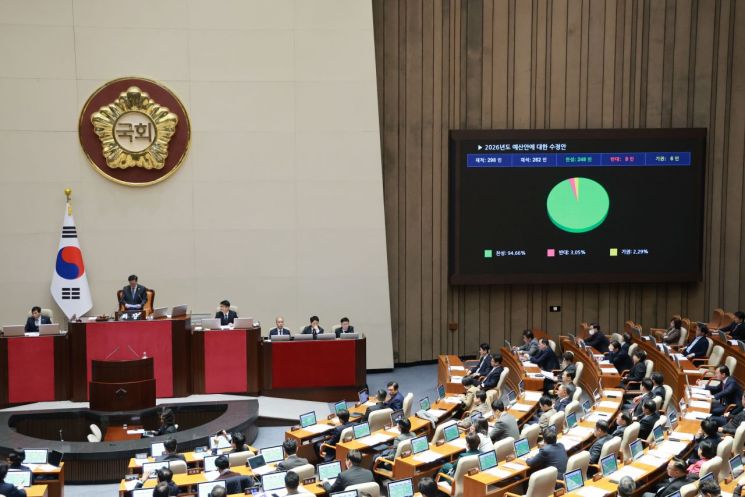
On December 2, the National Assembly approved the budget bill for next year. For the first time in five years, the budget bill has been processed within the statutory deadline.
The budget bill for next year passed the plenary session of the National Assembly with 248 votes in favor, 8 against, and 6 abstentions out of 262 members present.
Compared to the original budget proposal submitted by the government, the total revenue in the budget bill passed by the National Assembly increased by 1 trillion won, from 674.2 trillion won to 675.2 trillion won. The total expenditure, commonly referred to as the budget, was finalized at 727.9 trillion won, a decrease of 1 trillion won from the original 728 trillion won. During the National Assembly's review, revenue from sources such as funds increased, resulting in higher total revenue, while total expenditure decreased in line with the budget agreement between the ruling and opposition parties.
Lee Soyoung, who served as the Democratic Party secretary on the Special Committee on Budget and Accounts and was in charge of practical negotiations, explained the bipartisan budget agreement, stating, "We decided to increase spending only within the range of the reduced total expenditure to alleviate concerns about fiscal soundness," adding, "The total amount of expenditure did not increase during the National Assembly's review." She continued, "During the review process, we increased non-tax revenue and other income, and as a result, the fiscal balance is expected to improve compared to the government's original submission." The government had initially projected a consolidated fiscal deficit of 53.8 trillion won, but with the increase in non-tax revenue, the deficit has narrowed and the fiscal balance has improved to some extent. The opposition party also cited the reduction in total expenditure compared to the government's original proposal, out of concerns for fiscal soundness, as a key achievement of this year's budget review.
To look at the details, during the National Assembly's review, 9.2249 trillion won was added to the government proposal (budget plus funds), while 9.3517 trillion won was cut, resulting in a net reduction of 1.268 trillion won compared to the original government plan.
Increased and Decreased Budget Items
As a result of the National Assembly's review, 1.1 trillion won was added for the U.S. investment support program. An additional 252.3 billion won was allocated for establishing a disaster recovery system to prevent data loss in the national computer network. The budget for the pilot project for basic income in rural areas with declining populations was increased by 63.7 billion won. To ease the burden of tuition, the national scholarship budget was increased by 70.6 billion won, and the subsidy unit price for childcare for children aged 0 to 2 was raised by 19.2 billion won. An additional 18.4 billion won was allocated to increase allowances for veterans. Furthermore, a new budget of 61.8 billion won was allocated for the creation of an AI mobility pilot city to promote the commercialization of autonomous vehicles.
On the other hand, support for the trade response program was reduced by 700 billion won, and the Trade Insurance Fund, which was allocated as a contribution for the U.S. investment program, was cut by 570 billion won. However, these reductions were offset by the increased budget for the U.S. investment support program. In addition, the contingency fund was reduced by 200 billion won from the government's original 4.2 trillion won. The budget for military facility improvements was also cut by 110.5 billion won.
Park Hyungsoo, who served as the secretary for the People Power Party on the Special Committee on Budget and Accounts and led practical negotiations, told reporters, "The AI budget was about 10 trillion won, and there were items worth 1.2 trillion won that we argued should be cut. We ended up reducing it by 206.4 billion won." He added, "There were many items scattered under the name of AI and allocated excessively, so we organized and reduced those that needed to be cut, which is significant." Regarding the special activity expenses for the Presidential Office, a key issue between the ruling and opposition parties, the ruling party insisted on passing the original plan, while the opposition demanded cuts. As a symbolic gesture, both sides agreed to reduce the operating expenses by about 100 million won.
Statutory Deadline Met for the First Time in Five Years
This year's budget met the statutory deadline set by the National Assembly Act for the first time in five years. Since 2020, the budget bill had not been processed within the legal deadline, but after five years, it was able to be handled in accordance with the National Assembly Advancement Act. Since the implementation of the National Assembly Advancement Act in 2014, which includes the automatic referral system for the budget bill, the statutory deadline was met only twice, in 2014 and 2020. Although the ruling and opposition parties reached an agreement on the budget bill in the morning, the processing was delayed until just before midnight due to work on the budget sheets, affected by the amendment of the Government Organization Act.
National Assembly Speaker Woo Wonshik commented on the budget bill, saying, "Thanks to the efforts and determination of the negotiation groups of both parties, we were able to meet the statutory deadline and submit the budget bill to today's plenary session," adding, "Even in a situation of severe conflict between the parties, we reached an agreement through dialogue and mutual concessions." Speaker Woo emphasized, "It was a very good decision to pool everyone's capabilities for economic vitality and the recovery of people's livelihoods," and added, "I hope that the responsible and mature attitude shown by both parties today will help ease political tensions and serve as a starting point for further bipartisan cooperation on key livelihood and reform issues going forward."
Meanwhile, the People Power Party highlighted that it secured an additional 713.1 billion won for public welfare support and balanced regional development during this year's budget review. Achievements in the childcare sector included a 20,000 won monthly increase in allowances for daycare teachers, a 5% increase in childcare fees, a 3% increase in national scholarships, the removal of the usage limit for public transportation passes, a 10,000 won monthly increase in veterans' honor allowances, and a 50,000 won monthly increase in living support for veterans and their spouses. Other achievements included a 140 billion won budget for a pilot project to build supply pipelines in areas not yet supplied with city gas, a 37.5 billion won budget to support the steel industry, and a 5.5 billion won increase in the budget for public safety, including responses to transnational crime.
However, the People Power Party noted that its proposals for low-interest loans for young people to purchase homes and for expanding long-term lease housing projects were not adopted due to opposition from the government and the ruling party, despite their requests.
© The Asia Business Daily(www.asiae.co.kr). All rights reserved.

















