Life-Changing Success Stories Through AI, Data, and New Technology Education
STEP: The National Vocational Education Platform Serving 4 Million Learners Annually
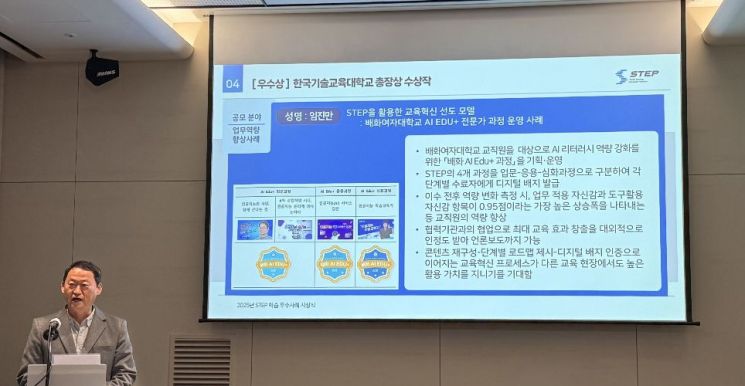
Cases are pouring in from STEP where non-majors who previously knew nothing about AI have become defense AI experts, developers have successfully found new jobs, and educational innovation is spreading to universities and companies.
STEP, the national vocational education platform operated by the Ministry of Employment and Labor and Korea University of Technology and Education, is establishing itself as a leading success model for developing the nation's vocational competencies.
"Just two years ago, I was a non-major who didn't even know what AI or data analysis was, but now I am an expert writing defense AI papers and proposing policy," he said.
This is the testimony of Lieutenant Colonel Kim Sunwoong, currently serving in the Army. He applied techniques learned from the 'AI-Based Unstructured Data Analysis' course at STEP (Smart Training Education Platform) to military documents and practical projects.
He also mastered advanced courses such as 'Establishing AI Service Objectives' and 'Data Architecture Requirements,' acquiring the capability to formulate data strategies for his organization.
The knowledge gained from STEP also led to academic publications.
He published a paper titled 'A Study on the Development Direction of AI-Based ARAS (Army Risk Assessment Support System)' in 'Defense and Technology,' and contributed to several journals including 'Military Review' and 'Pacific Convergence Research Journal.' He stated that STEP learning was a great help in writing his doctoral dissertation and obtaining a data analysis certification.
On November 20, Kim received the Grand Prize at the 'STEP Learning Best Practices Contest' hosted by the Ministry of Employment and Labor and Korea University of Technology and Education.
This year's contest saw 74 participants, and after expert reviews, eight learners including Kim were selected for their outstanding cases.
They shared experiences of developing their skills and transforming their lives through STEP.
STEP is also being actively utilized by vocational training institutions, universities, and companies. Lim Jinman from the Educational Innovation Team at Baewha Women's University designed an introductory-to-advanced AIEDU+ course using STEP content to enhance staff AI capabilities. This course greatly improved staff satisfaction and learning outcomes, and was featured as an excellent educational case in the university newspaper.
Ryu Hanseok, who had worked as a JAVA-based developer for over 30 years and was preparing for re-employment after retirement, studied Python at STEP and was able to return to the field by succeeding in web crawler development and logistics optimization projects.
He said, "Thanks to learning new technologies through STEP, I regained the confidence to work again."
Lee Namsun, a researcher designing milling tools, used STEP's virtual training to experience real cutting sites virtually, thereby improving his previously limited understanding of the field.
Based on this, he proposed a digital transformation training plan within his company, received high evaluations, and achieved early promotion as a result.
Lee Sangdal, who studied industrial safety management, applied analytical methods learned from STEP to on-site safety inspections. After two weeks of systematic observation, he confirmed that cases of not wearing helmet chin straps were indeed frequent.
He shared his STEP learning in a manager meeting and led improvement activities, resulting in the chin strap wearing rate among field workers rising from 23% to 89%.
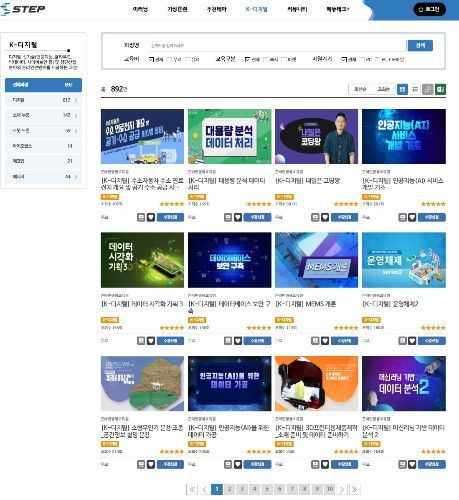
STEP, used by 4 million people annually, is an online public vocational education platform where anyone can take e-learning and virtual training courses for free. It offers 2,247 pieces of content in fields such as AI, machinery, electrical, and electronics, and provides LMS (Learning Management System) to universities, companies, and vocational training institutions, benefiting a total of 1,152 institutions and 970,000 people to date.
For job seekers, more than 300 employment support courses are available, including NCS basics, resume writing, and AI interviews, helping to reduce private education costs and bridge employment opportunity gaps.
Additionally, to replace expensive and high-risk training equipment that is difficult to build in the private sector, STEP provides over 200 immersive contents such as VR, AR, MR, and XR, and selects 4,000 people annually for free 10-week education through digital and new technology package courses.
The Ministry of Employment and Labor and Korea University of Technology and Education announced plans to continuously upgrade STEP by producing new AI content, improving the LMS, and revamping the UI/UX in response to rising demand for AI education.
© The Asia Business Daily(www.asiae.co.kr). All rights reserved.
![Clutching a Stolen Dior Bag, Saying "I Hate Being Poor but Real"... The Grotesque Con of a "Human Knockoff" [Slate]](https://cwcontent.asiae.co.kr/asiaresize/183/2026021902243444107_1771435474.jpg)
















