Petroleum Products See Largest Increase in Nine Months
Highest Growth Rate Since 6.3% in February
Last month, the consumer price index remained in the 2% range for the third consecutive month, continuing its upward trend. Prices of agricultural, livestock, and marine products, as well as petroleum products, rose by more than 5%, driving up overall inflation.
According to the "Consumer Price Trends for November 2025" released by the National Data Office on December 2, last month's consumer price index increased by 2.4% compared to the same month last year. The consumer price index had dropped to 1.7% in August this year, then rose to 2.1% in September and 2.4% in October, maintaining this trend last month as well.
Prices of agricultural, livestock, and marine products increased by 5.6% year-on-year, with the rate of increase widening compared to the previous month (3.1%). Among agricultural products, prices of fresh vegetables fell by 4.7%, but prices of fresh fruits such as rice (18.6%), apples (21.0%), and tangerines (26.5%) surged significantly. Key livestock and marine products such as mackerel (13.2%) and eggs (7.3%) also saw price increases.
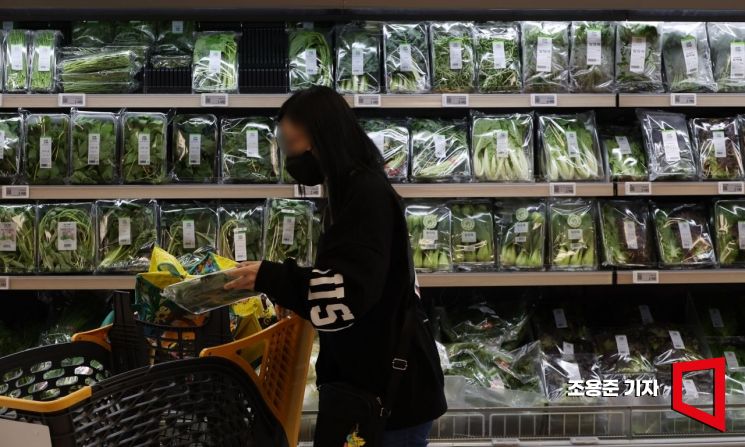 As the peak kimchi-making season begins, customers visiting a large supermarket in Seoul on the 19th are purchasing agricultural and marine products such as radish, green onions, napa cabbage, and salted seafood in preparation for kimchi-making. Photo by Jo Yongjun
Industrial products rose by 2.3%. Processed foods (3.3%) and petroleum products (5.9%) led the increase. Coffee (15.4%) and bread (6.5%) showed notable price hikes, while petroleum products such as gasoline (5.3%) and diesel (10.4%) continued their strong upward trend due to the impact of international oil prices and exchange rates.
Lee Dowon, Director of Economic Trend Statistics at the National Data Office, stated, "Overall, petroleum products recorded the highest rate of increase in nine months since February this year (6.3%)," adding, "This appears to be influenced by exchange rate effects and the partial reduction of the fuel tax cut."
Service prices rose by 2.3%. Personal services increased by 3.0%, with both dining out (2.8%) and non-dining out items (3.1%) rising. The overall increase in prices of daily-life services, such as insurance premiums and apartment management fees, contributed to the rise in perceived inflation. Public services increased by 1.4%, and rent rose by 0.9%.
The living cost index, which closely reflects perceived inflation, rose by 2.9%. This is the largest increase in one year and four months since July last year (3.0%). Core inflation also continued its upward trend. Excluding agricultural products and petroleum, core inflation rose by 2.3%, while the index excluding food and energy, which is classified as core inflation by the Organisation for Economic Co-operation and Development (OECD), increased by 2.0%.
© The Asia Business Daily(www.asiae.co.kr). All rights reserved.
![Clutching a Stolen Dior Bag, Saying "I Hate Being Poor but Real"... The Grotesque Con of a "Human Knockoff" [Slate]](https://cwcontent.asiae.co.kr/asiaresize/183/2026021902243444107_1771435474.jpg)















