"Network Advancement Essential in the AI Era... LTE Dependence Expected to Decrease"
SK Telecom and LG Uplus Face Fairness Debate Over 'Same Band, Same Fee' Principle
The government has decided to lower the reallocation fee for LTE frequencies by up to 15% below the base price, taking into account future changes in value. The transition to 5G standalone mode (SA) will be set as a condition for reallocation, and as a result, dependence on LTE frequencies is expected to gradually decrease.
On December 1, the Ministry of Science and ICT announced this policy at the 'Detailed Policy Plan for Mobile Communication Frequency Reallocation Public Briefing,' held at IT Square in Samseong-dong, Seoul.
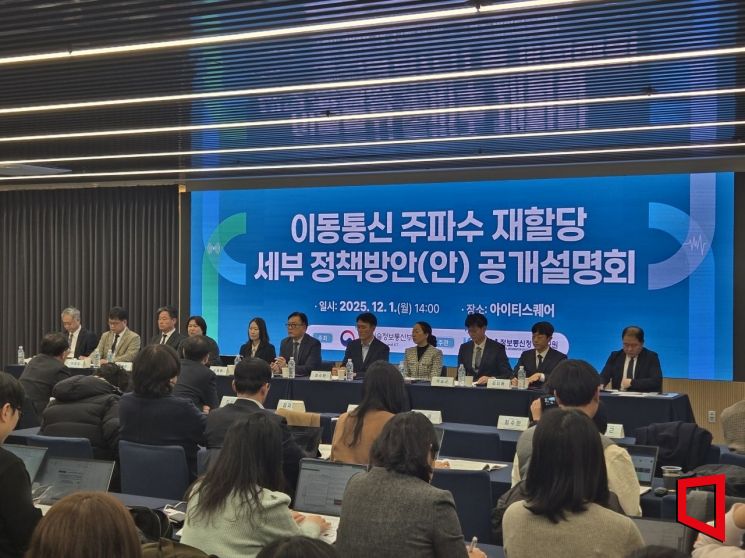 On the afternoon of the 1st, a discussion is taking place at IT Square in Samseong-dong, Seoul, hosted by the Ministry of Science and ICT, regarding the 'Detailed Policy Plan for Mobile Communication Frequency Reallocation.' Photo by Noh Kyungjo
"Reflecting the Decline in LTE Frequency Value in Fee Calculation"
Previously, the Ministry of Science and ICT decided to reallocate a total of 370 MHz of frequencies, whose usage period ends next year, to existing users and to establish detailed policy measures within the year. According to the Radio Waves Act, the government must notify operators of major changes one year before the expiration of the usage period, and operators must apply for reallocation six months before expiration. The frequencies to be reallocated include 20 MHz for 3G and 350 MHz for LTE. By carrier, SK Telecom will receive 155 MHz, KT 115 MHz, and LG Uplus 100 MHz.
Nam Youngjun, Director of Frequency Policy at the Ministry of Science and ICT, mentioned at the public hearing that the transition to 5G SA would be a condition for reallocation, stating, "We plan to set the reallocation fee by reflecting the decrease in the economic value of LTE frequencies."
Director Nam explained, "As network advancement is essential in the AI era, and as coverage and reduction of 5G shadow areas under the 5G SA model progress, the value of LTE frequencies will decline. Accordingly, the price for reallocated frequencies will be adjusted downward by about 15%."
The total reallocation fee for the three major carriers is expected to be approximately 3.1 trillion won if the number of indoor wireless stations is 10,000 or less, about 3 trillion won for more than 10,000, and around 2.9 trillion won for more than 20,000. In consideration of the reduced use of LTE frequencies, the government will allow the usage period for one block per operator in the 2.1 GHz and 2.6 GHz bands to be shortened after one year.
To prepare for the commercialization of 6G services, the usage period for bands requiring adjustment (1.8 GHz and 2.6 GHz) will be set at three years. The remaining bands will maintain the current five-year period until 2031. For the 2.1 GHz band currently used for 3G, operators will be allowed to choose whether to use LTE or higher technologies after service discontinuation.
SK Telecom and LG Uplus Differ on 'Same Band, Same Fee' Principle
In this reallocation, the 2.6 GHz band, which has become a point of contention between SK Telecom and LG Uplus, will be based on each company's previous allocation fee. LG Uplus secured 40 MHz of this band in the 2013 auction for 478.8 billion won (for eight years) and received an additional five years in the 2021 reallocation. During this process, LG Uplus met the 5G base station construction requirements and received a 27.5% price discount.
In contrast, SK Telecom won 60 MHz of the same band in the 2016 auction for a total of 1.2777 trillion won, with a ten-year usage period. The winning price rose due to intensified competition. SK Telecom argues that, for the sake of fairness, the same fee should be applied to the same frequency band.
Sung Seokham, Executive Vice President of Policy Cooperation at SK Telecom, stated during the discussion, "Applying the same value to the same band with the same value is the most important aspect of maintaining policy consistency." He argued that it is unreasonable for the fees for the two bands to differ by more than double solely because of different past auction prices.
Executive Vice President Sung also highlighted the technical equivalence of the 2.6 GHz bands. He said, "The two bands are technically interchangeable and are essentially the same 2.6 GHz LTE series. Even if SK Telecom equipment uses the competitor's 2.6 GHz block, or vice versa, the same service can be provided without any operational issues." He reiterated that there are no differences in frequency band, radio characteristics, device compatibility, or actual use as LTE supplementary networks.
LG Uplus countered that the 'same band, same fee' argument distorts government policy and actual cases. Park Kyungjoong, Executive Director of External Cooperation at LG Uplus, said, "Even within the same group, the value is determined differently for each frequency, reflecting the respective auction price. In particular, the 2.6 GHz band secured by our company in 2013 had low utility value at the time due to the lack of equipment and device ecosystem, whereas the 2.6 GHz band secured by another company in 2016 could be utilized as an ultra-wideband, resulting in a significantly different economic value."
He added, "The reallocation fee should comprehensively reflect not only the simple auction price but also the actual economic value of each frequency and the efficiency of network investment. As this reallocation could set the standard for future reallocations, it should be calculated in a rational and predictable manner in accordance with the Radio Waves Act and the government's consistent calculation principles."
The Ministry of Science and ICT plans to review and incorporate the opinions gathered at the public hearing and announce the final plan within the year.
© The Asia Business Daily(www.asiae.co.kr). All rights reserved.
![Clutching a Stolen Dior Bag, Saying "I Hate Being Poor but Real"... The Grotesque Con of a "Human Knockoff" [Slate]](https://cwcontent.asiae.co.kr/asiaresize/183/2026021902243444107_1771435474.jpg)

















