Estimated 56% Damage Attributed to Abnormally High Water Temperatures
"Helpless as Professional Alert Systems Disappear," Experts Warn
Seaweed farms in the Wando and Goheung areas of Jeollanam-do are on the brink of collapse due to large-scale withering damage. As abnormal marine conditions, presumed to be caused by high water temperatures, have persisted for an extended period, seaweed seedlings have been dying off in succession. However, there has been virtually no preemptive response from local governments, drawing strong criticism from those on the ground.
According to a tally by local fishermen as of November 30, out of approximately 290,000 lines of seaweed being farmed in the area, about 165,000 lines-amounting to 56%-have been affected. The damage is concentrated in the Nohwa, Geumil, Cheongsan, and Geumdang areas of Wando County, as well as Geumsan-myeon in Goheung County.
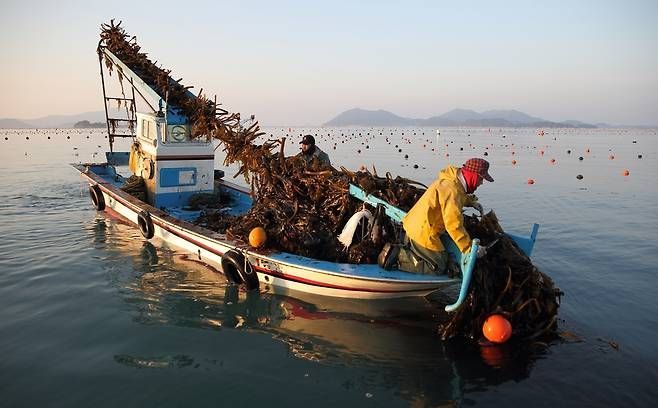 Seaweed farms in the Wando and Goheung areas of Jeollanam-do are on the brink of collapse due to large-scale damage from withering. Provided by Wando County
One seaweed farmer lamented, "Last year, the withering rate was around 20%, but this year, more than half have died. In some farms, over 90% have perished, leaving us with no choice but to give up."
Suspected Abnormal Water Temperatures, but the Exact Cause Remains Unclear
On-site, the cause is suspected to be abnormally high water temperatures. The optimal water temperature in early October, when seaweed seedlings are transplanted onto ropes, is around 22 degrees Celsius. This year, however, the temperature hardly dropped, leading to the analysis that young seaweed could not attach and grow properly.
Seaweed is a cold-water marine plant. If high water temperatures persist even during the autumn, growth can halt at the seedling stage, or entire stalks may detach and fall off.
According to related research, the surface water temperature around Korea has risen by 1.23 degrees Celsius over the past 50 years, which is 2.6 times the global average increase of 0.48 degrees Celsius during the same period. There are already reports that domestic aquaculture losses due to abnormal climate have exceeded 60 billion won.
However, no professional investigation has yet been conducted to pinpoint the exact cause. Fishermen are raising their voices, saying that the professional response system for analyzing water temperature changes and growth risks on-site has virtually disappeared.
"With the Disappearance of Professional Alert Systems, We Are Helpless"
An operator of a seaweed farm in Geumil-myeon criticized, "In the past, researchers from the National Institute of Fisheries Science regularly checked the condition of the sea and provided response guidelines. Since the work was transferred to local governments, there has been neither expertise nor early warnings."
He added, "Even if we cannot prevent abnormal climate itself, early warnings and management guidelines could have significantly reduced the scale of the damage."
Fishermen unanimously say that if there had been monitoring and early warnings regarding water temperature changes, they could have adjusted the timing of seedling transplantation or prepared other countermeasures. However, in the absence of professional personnel and a systematic observation system, they suffered damage with no means to respond.
"The Very Foundation of the Local Fisheries Industry Is Shaking"
Shin Euijun, a member of the Jeollanam-do Provincial Assembly (Democratic Party of Korea, Wando 2), recently received a report on the damage and called for an immediate full-scale investigation by the province.
Assemblyman Shin warned, "It is difficult to find a precedent for withering on this scale. If the situation is left unattended without a precise investigation into the cause and recovery measures, the entire local fisheries industry could be destabilized." He emphasized, "After surveying seaweed processing farms in the Wando area, I found the damage rate ranged from 30% to 80%, which is not just a problem for individual farms but a crisis for the regional industrial base. An urgent provincial-level survey and the involvement of experts to accurately determine the cause are desperately needed."
Soaring Prices and Concerns Over Prolonged Damage: "Next Year Looks Grim"
With production plummeting, it is now considered inevitable that seaweed prices will rise. Other seaweeds, such as kelp, are also suffering damage due to changes in marine conditions, raising concerns about price pressures across the seafood sector.
The pain is especially acute for Wando fishermen. Many lament, "This year, sea farming has been completely ruined, and with uncertainty over securing seedlings for next year, the damage is likely to be prolonged."
One fisherman said, "We have to start farming again without even knowing the exact cause, and we are afraid the same damage will happen again. Unless experts step in to identify the cause and provide countermeasures, we don't know if we can continue seaweed farming."
Fishermen are urging the government and local authorities to provide substantial financial support, accurately determine the cause, and establish a long-term response system for changing marine conditions.
As changes in the marine environment accelerate, establishing professional monitoring, building an early warning system, and, above all, devising measures to prevent recurrence through accurate identification of the cause have emerged as urgent tasks.
© The Asia Business Daily(www.asiae.co.kr). All rights reserved.

















