On the 29th, Gyeonggi Province Governor Kim Dong-yeon pledged to usher in the New Space era together with the Lee Jaemyung administration, following the successful launch of the "Gyeonggi Climate Satellite No. 1" from the United States.
In a post on his social media account that day, Governor Kim stated, "'Gyeonggi Climate Satellite No. 1' entered orbit early this morning, Korea time," adding, "The hopes of our 14.2 million residents have also been carried into space along with the satellite."
He went on to say, "Starting with No. 1, we plan to launch No. 2 and No. 3 next year," expressing his expectations that "the data collected by the satellites will not only enable a scientific response to the climate crisis, but also mark a major turning point in fostering the climate tech industry."
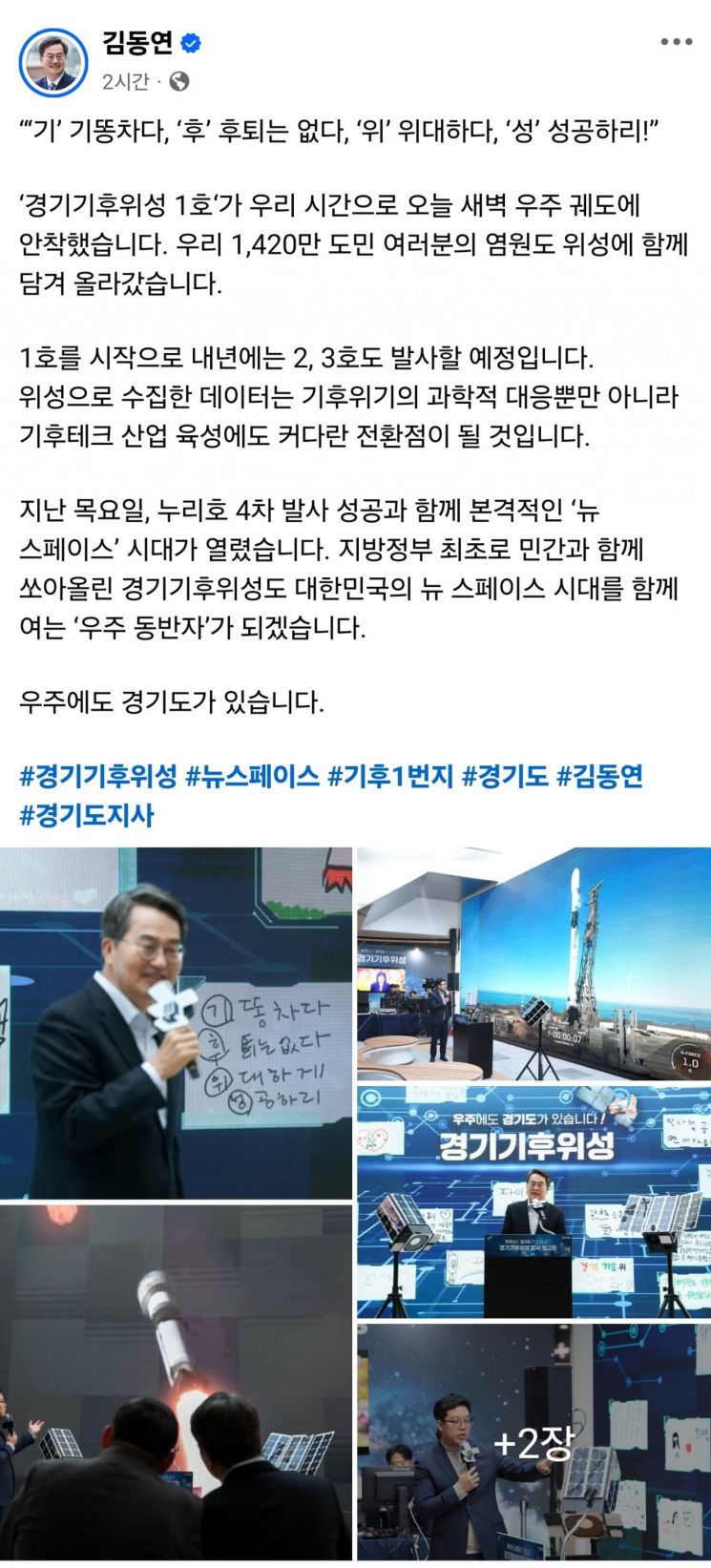
He also remarked, "Last Thursday, with the successful fourth launch of Nuri, the full-fledged 'New Space' era has begun," and added, "As the first local government to launch a satellite in partnership with the private sector, the Gyeonggi Climate Satellite will serve as a 'space partner' in opening the New Space era for Korea."
Earlier that day, at 3:44 a.m. (Korea time), Gyeonggi Climate Satellite No. 1 was launched from Vandenberg Space Force Base in California, United States, aboard a SpaceX Falcon 9 rocket. About 56 minutes later, at around 4:40 a.m., the satellite separated from the rocket, successfully entered its target orbit, and completed orbital insertion.
This marks the first time in Korea that a climate observation satellite led by a local government has been launched into space. The No. 1 satellite is an ultra-small optical satellite, weighing about 25 kilograms and built to the 16U CubeSat standard. From an altitude of 500 kilometers, the satellite will precisely capture changes in land use in the Gyeonggi region, the condition of rice paddies, forest degradation, and changes in development-restricted areas.
In particular, this satellite aims to provide a scientific foundation for climate and environmental policies within the province, focusing on climate crisis response, disaster and hazard monitoring, and environmental change surveillance.
© The Asia Business Daily(www.asiae.co.kr). All rights reserved.