Third-Party Risk Management Guidelines Take Effect from December 1
Insurance Companies to Evaluate GAs... Aimed at Preventing Misselling and Excessive Competition
Guidelines Significantly Relaxed at the Last Minute Due to GA Industry Opposition
Guidelines requiring insurance companies to establish risk management systems for corporate insurance agencies (GAs) that sell their insurance products on their behalf will go into effect starting December 1. However, there are concerns that the effectiveness of the system may be diminished, as the guidelines were significantly relaxed compared to the original draft at the last minute before implementation.
According to the financial sector on December 1, the 'Third-Party Risk Management Guidelines' for the insurance industry have come into effect as of this date. Third-party risk refers to the risks that arise when insurance companies entrust insurance sales to GAs, who act as trustees (third parties). Discussions began at last year’s Insurance Reform Meeting with the aim of preventing misselling and excessive competition, and in March, the Financial Supervisory Service announced plans to introduce the guidelines. Since then, financial authorities, the Korea Life Insurance Association, the Korea General Insurance Association, and the Korea Insurance GA Association have continued discussions regarding the establishment of the guidelines.
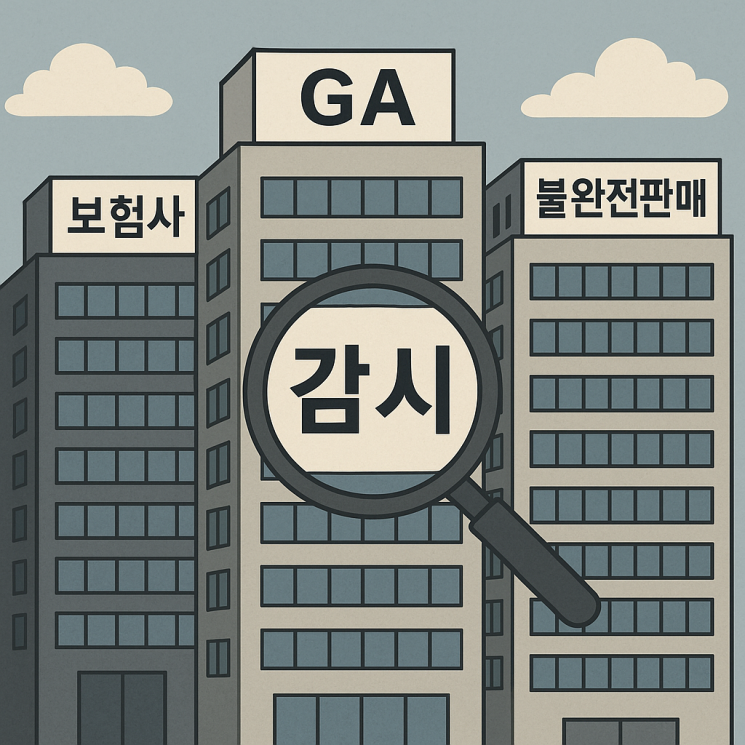 An image depicting an insurance company managing third-party risks related to corporate insurance agencies (GA). ChatGPT
In September, the life and non-life insurance associations released a draft of the guidelines. The draft included instructions requiring insurance companies to measure risks associated with GAs using both quantitative and qualitative methods. Quantitative indicators included the rate of misselling and the number of consumer complaints. Qualitative indicators covered the adequacy of the GA's internal controls and consumer protection systems. The guidelines also allowed insurance companies to use their own checklists to assess risk.
However, the GA industry pushed back, arguing that the detailed operational guidelines in the draft infringed on their independence and management autonomy. Their main concern was that insurance companies would be granted authority equivalent to that of the Financial Supervisory Service, including the right to request documents and conduct audits and inspections. The Korea Insurance GA Association requested revisions, pointing out that requiring GAs to submit the same documents repeatedly to all partner insurance companies would consume excessive manpower and time, and could expose their business strategies. Subsequent renegotiations between the Korea Insurance GA Association and the life and non-life insurance associations led to a recent agreement.
According to the agreement, the "delegating company's right to audit and request documents" was softened to "the insurance company's right to conduct checks and request documents, and the trustee's obligation to cooperate." The clause stating that insurance companies "must suspend or change" outsourcing in the event of third-party risk at a GA was revised to "should consider suspending or changing" outsourcing. A representative of the Korea Insurance GA Association explained, "Requests from insurance companies for document submission fall within the scope of cooperation," adding, "We have confirmed in a Q&A with the authorities that if insurance companies request materials that excessively pertain to GAs’ trade secrets, GAs may refuse to provide them."
Financial authorities plan to require insurance companies to set aside additional required capital when calculating the capital adequacy ratio (K-ICS) if they partner with GAs that receive low third-party risk ratings. There are also plans to provide incentives for contracts with high-performing GAs. An insurance industry official commented, "It is unfortunate that the right for GAs to refuse document submissions was introduced at the last minute," and added, "The indirect control method, where authorities regulate through insurance companies rather than directly, fails to properly address the reality that GAs often hold the upper hand in their relationships with insurers."
© The Asia Business Daily(www.asiae.co.kr). All rights reserved.
![Clutching a Stolen Dior Bag, Saying "I Hate Being Poor but Real"... The Grotesque Con of a "Human Knockoff" [Slate]](https://cwcontent.asiae.co.kr/asiaresize/183/2026021902243444107_1771435474.jpg)















