OECD World Economic Outlook, Household Finance and Welfare Survey, and Preliminary Q3 Growth Rate
to Be Released Sequentially Next Week
Next week (December 1-5), a series of major economic indicators that will provide insights into recent price trends and external trade conditions are scheduled for release. Results from surveys on the income, expenditure, and asset status of Korean households, as well as the preliminary third-quarter economic growth rate, are also set to be announced.
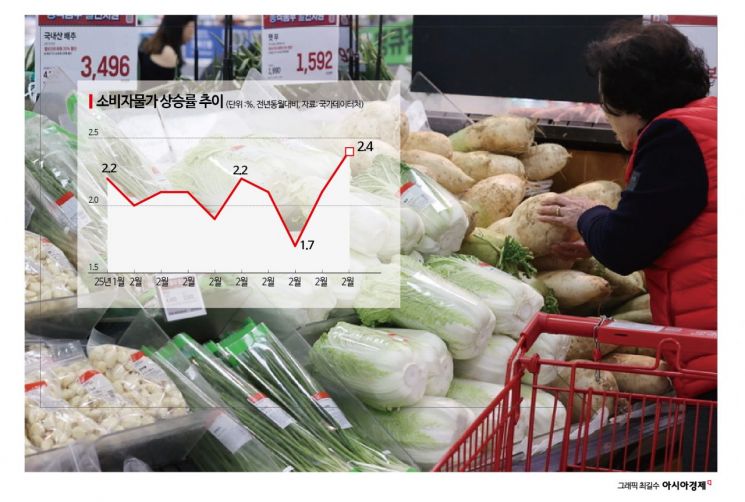
The National Data Office will release the "November Consumer Price Trends" on December 2. In October, the consumer price inflation rate reached 2.4%, the highest level in 15 months. With the won-dollar exchange rate recently surging to the upper 1,400 won range, there is keen interest in how the high exchange rate may have affected inflation through import prices.
On December 3, the "2024 Life Table," including national life expectancy, will be released. The life table is a statistical estimate of how long a person of a specific age can expect to live, assuming current age-specific mortality rates remain unchanged.
The results of the "2025 Household Finance and Welfare Survey," jointly released by Statistics Korea, the Bank of Korea, and the Financial Supervisory Service on December 4, are also drawing attention. This survey provides insights not only into the structure of household income, expenditure, and assets, but also into financial conditions such as interest burdens.
In last year's survey, as of the end of March, the average household assets in Korea increased by 12.95 million won (2.5%) year-on-year to 504.22 million won, while the average household income rose by 6.3% to 71.85 million won compared to the previous year.
The Organisation for Economic Co-operation and Development (OECD) will also release its "World Economic Outlook" on December 2, offering a forecast of global economic trends. The OECD provides growth outlooks for the world economy, its member countries, and G20 nations twice a year (May-June and November-December). In September, the OECD projected Korea’s growth rates at 1.0% for this year and 2.2% for next year, and since these figures are largely in line with recent forecasts from domestic and international research institutes, it is expected that the OECD will maintain its previous outlook.
Deputy Prime Minister and Minister of Economy and Finance Koo Yooncheol will preside over the "1st International Financial Policy Advisory Committee Meeting" on December 1. This committee, composed of 10 private sector experts, is expected to discuss issues such as foreign exchange market volatility and stablecoin challenges. On December 2, Deputy Prime Minister Koo will convene an economic ministers’ meeting focusing on measures to address "shrinkflation," and on December 4, he will meet with the annual consultation team from the international credit rating agency Fitch.
The Bank of Korea will announce the "Third Quarter National Income (Preliminary)" on December 3. According to the advance estimate released in October, real gross domestic product (GDP) for the third quarter increased by 1.2% compared to the previous quarter, driven by a recovery in consumption and investment, as well as robust exports. This marks the highest quarterly growth rate in a year and a half, since the first quarter of last year (1.2%). Attention is focused on how the growth rate will be adjusted, as data such as the September industrial activity trends are reflected in the preliminary figures.
The "October Balance of Payments (Preliminary)" to be announced on December 5 is also of interest. In September, the current account surplus reached 13.47 billion dollars, ranking second highest on a monthly basis and the highest ever for the month of September, thanks to strong semiconductor exports. The cumulative current account surplus for January to September this year (82.77 billion dollars) is also the largest on record.
The Bank of Korea anticipates that the surplus for October will be smaller than in September due to fewer business days during the Chuseok holiday period. However, it analyzes that the surplus is likely to expand again in November and December, supported by a boom in the semiconductor industry, stable oil prices, and improvements in the primary income balance.
Financial authorities are also set to announce a series of capital market policies through various meetings next week. At the third "Productive Finance Transformation" meeting to be held at the Korea Exchange on December 3, topics will include the establishment of the Business Development Company (BDC) system, which allows individuals to participate in unlisted and venture investments, support for innovative and venture companies, and improvements to the private equity fund (PEF) system.
On December 4, plans to strengthen the competitiveness of the KOSDAQ market will be unveiled. The Financial Services Commission stated that it intends to present fundamental reforms for the KOSDAQ market to support the growth of innovative companies and enhance investor confidence. The financial authorities will also separately announce PEF system improvements on December 7.
Lee Chanjin, Governor of the Financial Supervisory Service, will hold his first press briefing since taking office on December 1, where he is expected to address key issues such as the record-high preliminary fines related to the Hong Kong equity-linked securities (ELS) incident, household debt management, and the transition to productive finance.
© The Asia Business Daily(www.asiae.co.kr). All rights reserved.
![Clutching a Stolen Dior Bag, Saying "I Hate Being Poor but Real"... The Grotesque Con of a "Human Knockoff" [Slate]](https://cwcontent.asiae.co.kr/asiaresize/183/2026021902243444107_1771435474.jpg)
















