Constitutional Court: "Petition Filed Against a Party Lacking Respondent Status"
"No Possibility of Infringement as Presidential Powers Were Already Suspended"
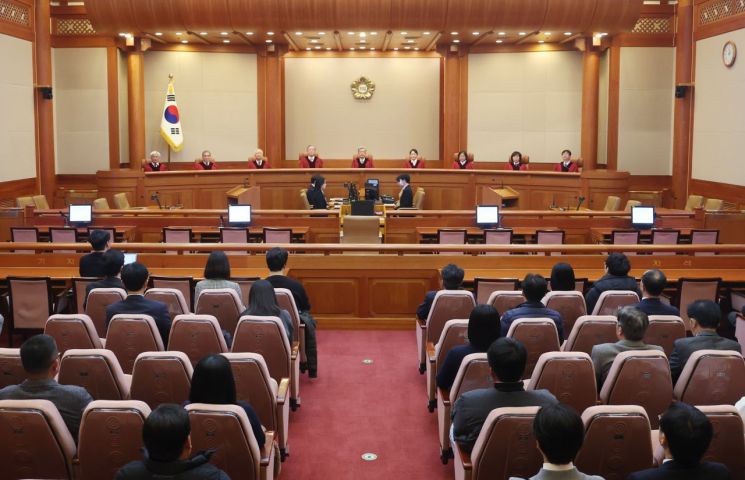 Kim Sanghwan, Chief Justice of the Constitutional Court, and others are seated on November 27 in the Grand Bench of the Constitutional Court in Jongno-gu, Seoul, ahead of the announcement of the November adjudication cases. Photo by Yonhap News
The Constitutional Court has dismissed the competence dispute petition filed by former President Yoon Sukyeol, who challenged the arrest warrant request by the Corruption Investigation Office for High-ranking Officials (CIO) and the court's issuance of the warrant following the proclamation of the 12·3 Martial Law.
On November 27, the Constitutional Court unanimously dismissed the competence dispute petition brought by former President Yoon against Oh Dongwoon, Chief of the CIO, and Shin Hanmi, Chief Judge of the Seoul Western District Court, with all nine justices in agreement.
The court determined that the petition against Chief Oh was inadmissible, as the actual party who requested the arrest warrant at the time was not Chief Oh, but Deputy Chief Prosecutor Cha Jeonghyeon of the CIO, thereby finding that Oh did not have the proper standing as a respondent.
The Constitutional Court stated, "On January 6, the party who requested the arrest warrant for Yoon Sukyeol was not the Chief of the CIO, but Prosecutor Cha Jeonghyeon. Therefore, the petition filed against the Chief of the CIO is inadmissible, as it was brought against a party lacking respondent status."
The CIO attempted to execute the first arrest warrant for former President Yoon on January 3, but was blocked by security and military personnel, resulting in a standoff that prevented execution. Subsequently, the CIO did not attempt re-execution until the first warrant's validity expired on January 6. On the expiration date, the CIO requested an extension from the court and was issued a second arrest warrant on January 7.
In response, former President Yoon's legal team filed a competence dispute petition the following day, arguing that the CIO's request for a second arrest warrant and its issuance by the Seoul Western District Court infringed upon the President's constitutional powers as Commander-in-Chief and the authority to declare martial law, as stipulated in Articles 66 and 77 of the Constitution.
The Constitutional Court also found that the request and issuance of the arrest warrant occurred after the National Assembly had already suspended the President's powers through its impeachment resolution on December 14 of the previous year, thereby eliminating the possibility of an infringement of presidential authority.
The court stated, "All actions in this case, as well as subsequent measures, took place while the petitioner's presidential powers were suspended and an acting president was exercising those powers. Therefore, it cannot be said that the petitioner's constitutionally or legally granted powers were at risk of being infringed."
Former President Yoon's legal team also argued that the request and issuance of the arrest warrant, citing the proclamation of martial law, infringed upon the President's authority to declare martial law, but this claim was not accepted.
The Constitutional Court explained, "The proclamation of martial law was made independently of the request and issuance of the arrest warrant. The request and issuance of the arrest warrant did not occur while martial law was in effect, as martial law was lifted on December 4 by a resolution of the National Assembly on that same day."
© The Asia Business Daily(www.asiae.co.kr). All rights reserved.
![Clutching a Stolen Dior Bag, Saying "I Hate Being Poor but Real"... The Grotesque Con of a "Human Knockoff" [Slate]](https://cwcontent.asiae.co.kr/asiaresize/183/2026021902243444107_1771435474.jpg)















