Interview with L&F CEO Choi Suan
L&F, a battery cathode materials company, has announced plans to double its LFP (lithium iron phosphate) battery production capacity in response to increasing North American demand for energy storage systems (ESS), aiming to achieve this by 2027.
Choi Suan, Vice Chairman and CEO of L&F, said in an interview at the Guji 3 Plant in Dalseong County, Daegu, on November 24, "Once the LFP cathode materials plant begins operations and establishes its presence in the market in the first half of next year, our long-term goal is to add a new 60,000-ton line equipped with innovative technology in 2027, reaching a maximum capacity of 120,000 tons." He also emphasized that, with the intensifying conflict between the United States and China, energy security cooperation with allies such as Korea has become essential for the United States, and that LFP batteries, which are most widely used in ESS, have become a core industry for national security.
Choi stated, "The United States and its allies cannot afford to take the risk of using Chinese batteries in ESS linked to data centers and renewable energy, which are directly tied to security and power supply. In the North American market, LFP batteries are no longer just a 'future growth engine' but a 'core industry.'" He added, "The moment energy security is breached, the very existence of the North American energy industry is threatened."
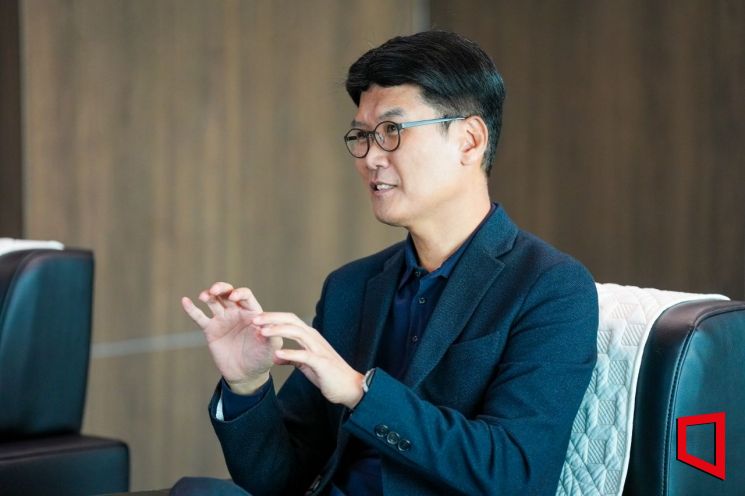 On the 24th of last month, Choi Suan, Vice Chairman and CEO of L&F, was interviewed by The Asia Business Daily at the L&F Guji 3 Plant in Dalseong County, Daegu. L&F
Choi recalled, "Three years ago, when we announced additional investment in an LFP pilot line at the Guji plant, many around us questioned whether it was 'brave' or why we were doing it." He continued, "Looking ahead, the North American ESS market is expected to reach 100 gigawatts (GW) next year and 300 GW by 2027. The ESS market connected to artificial intelligence (AI) data centers has already opened up widely." Choi added, "Compared to three years ago, requests from North American clients to discuss LFP cathode materials production have surged, and in the near future, supply is expected to fall far short of demand in the United States and Europe."
Currently, North American energy companies are even demanding local production in the United States. Choi said, "We are in ongoing discussions through our partnership with Mitra Chem in the U.S. We are talking on the premise of building a plant in the United States by 2027, and the target capacity is under intense discussion." He continued, "Meeting all the capacity requirements of the U.S. market would require a massive scale, so there is also intense debate within the company. For now, there are no significant trade barriers to manufacturing in Korea and exporting, so we will prioritize production in Korea and discuss more specific plans later."
While LFP batteries offer lower capacity compared to the ternary batteries that Korea has traditionally focused on, they are more affordable and have been dominated by China in the global market. The industry had previously hesitated to produce LFP batteries in Korea, believing it would be impossible to match China's low prices. However, with the rapid growth of the ESS market, Korean companies are gradually resuming LFP battery production.
Choi explained, "When tariffs are added to battery product prices, L&F's cathode materials are actually more price-competitive than Chinese products in the U.S. market. Many customers are also requesting products that are 100% free from Chinese supply chains, so we have already developed de-China LFP precursors. We are discussing supply chain partnerships with several countries, including Indonesia, Morocco, and India."
© The Asia Business Daily(www.asiae.co.kr). All rights reserved.
![Clutching a Stolen Dior Bag, Saying "I Hate Being Poor but Real"... The Grotesque Con of a "Human Knockoff" [Slate]](https://cwcontent.asiae.co.kr/asiaresize/183/2026021902243444107_1771435474.jpg)















