Suwan Underpass Construction Stalled for Over a Year
"Current Route and Method Not Feasible"
Complex Obstacles and High-Rise Buildings Create Major Challenges
The Suwan Underpass (Section 13), a key section of Phase 2 of the Gwangju Metro Line 2, has faced prolonged delays without even breaking ground. As it has been determined that construction is not feasible with the current planned route and construction method, Gwangju City has begun considering changes to the route and design.
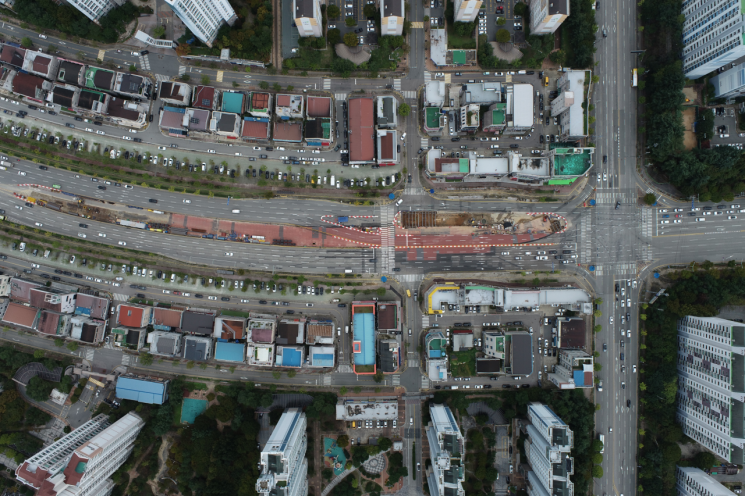 At the end of June, the construction site of Section 13 near the Unnam Jugong 5 Complex intersection. Photo by Gwangju City.
According to the Gwangju Urban Railway Construction Headquarters and other sources on the 27th, although construction began last November on the entire Phase 2 section (Gwangju Station-Chonnam National University-Ilgok-Cheomdan-Suwan-Unnam District-City Hall), work on Section 13, the Suwan Underpass, has not started for over a year.
This section is considered one of the most challenging construction sites, as it is densely packed with high-rise buildings around the underpass. Various obstacles such as thermal pipelines and power transmission lines are intricately entangled between the underpass and surrounding buildings, and many of the buildings have deep underground parking lots. This makes construction virtually impossible using the current shallow-depth excavation method. The potential for prolonged power and water outages during construction is also a significant concern.
The inability to secure access routes for construction vehicles and materials is another major issue. The headquarters has concluded that construction is not possible with the current route and method, and has begun reviewing alternatives. The plan is to prepare measures including partial route adjustments and design changes, then finalize the project direction after holding public hearings with local residents and consulting with relevant government agencies.
However, if route and design changes become a reality, project costs will rise significantly, and the construction suspension could be prolonged due to the budget review and revised design procedures. While Gwangju City still aims to open Phase 2 by 2030, there are growing concerns that this goal may be difficult to achieve.
Other challenging sections of Phase 2 are facing similar issues. Section 7 (Chonnam National University rear gate-Ochi-dong Overpass) and Section 10 (Bonchon-dong OB Brewery-Yangsan District Intersection) have not even begun construction because contractors have not been selected.
As of October, the construction progress rates for Phase 2 are as follows: Section 8 at 5.13%, Section 9 at 5.4%, Section 11 at 6.75%, Section 12 at 7.19%, Section 13 at 4.45%, and Section 14 at 8.7%. Gwangju City claims that there will be no delays in the overall schedule by adopting a tunnel construction method, which has a relatively shorter construction period, for the sections where work has not started. However, there are also concerns that delays are inevitable if solutions for the difficult sections are not found.
There is also criticism that this situation was a foreseeable problem. When the original route was changed in 2021 due to residents' complaints, it is reported that sufficient consultation on obstacles and underground structures was not conducted, which is now being cited as the reason for having to reconsider route changes once again.
© The Asia Business Daily(www.asiae.co.kr). All rights reserved.
![Clutching a Stolen Dior Bag, Saying "I Hate Being Poor but Real"... The Grotesque Con of a "Human Knockoff" [Slate]](https://cwcontent.asiae.co.kr/asiaresize/183/2026021902243444107_1771435474.jpg)















