"Thousands of Humanoids to Be Deployed Within 5?10 Years"
Mid- to Long-Term Mass Production Plans for Humanoids
The Core of Humanoid Development: Cost Reduction and Versatility
The First Step Toward Building a Smart Factory
It has been confirmed that Boston Dynamics (BD) is deploying and operating its humanoid robot Atlas at Hyundai Motor’s plant in the United States. BD has also unveiled a mid- to long-term plan to deploy “thousands” of humanoids at industrial sites within the next 5 to 10 years.
According to The Asia Business Daily’s coverage on November 28, Boston Dynamics recently began a pilot operation by deploying the humanoid robot Atlas at Hyundai Motor Group’s Metaplant America (HMGMA) in Georgia, USA.
During a webinar held online on November 18 (local time), Aya Durbin, BD’s Humanoid Product Manager, stated, “We have already started going on-site with Hyundai Motor,” adding, “This project with Hyundai Motor is our first case of deploying humanoid robots in the field.” A Hyundai Motor Group official also confirmed, “We understand that this is the ‘Proof of Concept (PoC)’ stage, where we are conducting pilot operations on-site.”
Hyundai Motor Group is accelerating its transition to a next-generation smart factory system using physical AI and robotics technologies. The development and deployment of humanoid robots on production lines is considered the first step in building a smart factory. As labor costs at factories are reduced and 24-hour operation becomes possible, the industry expects a significant increase in production volume.
Given that Hyundai Motor Group recently announced plans to more than double its local production share in the United States to respond to tariffs, it is expected that the company will actively leverage robotic technology to boost HMGMA’s operating rate. Eunyoung Lim, a researcher at Samsung Securities, estimated, “If Hyundai Motor Group achieves full automation by deploying humanoids, production volume at the same plant will increase by more than 60%.”

“Thousands Within 5-10 Years” - Mid- to Long-Term Mass Production Plan
In this webinar, BD also presented a concrete mid- to long-term outlook, including the timing and scale of humanoid sales and mass production. Manager Durbin said, “We are working with Hyundai Motor to create a ‘hardened’ product (humanoid),” and added, “If product reliability improves over the next one to two years, this will lead to actual sales.”
When asked about the scale of mass production, she mentioned, “Our goal is to deploy ‘thousands’ of humanoids within the next 5 to 10 years.” Compared to the roadmaps of global competitors who have proposed short-term mass production of over 10,000 units, this is a relatively conservative and realistic figure.
Previously, Hyundai Motor Group announced plans to build a robot factory in the United States with an annual capacity of 30,000 units. However, this figure includes not only humanoid robots, but also quadruped robots, logistics robots, and a variety of other robot product lines. Accordingly, Hyundai Motor Group appears to be expressing its intention to first establish a large-scale mass production system, then gradually expand production as market conditions and technological reliability improve.
In contrast, competitors are presenting more aggressive plans. Tesla has announced a goal to expand its production scale to 50,000 units by 2026, starting with 5,000 units this year. Figure AI also plans to initially mass-produce 10,000 units and then expand to a total of 100,000 units over the next four years. China’s UBTECH has also set production targets of 5,000 units in 2026 and 10,000 units in 2027, accelerating the race to secure market leadership.
An industry insider commented, “Unlike competitors who prioritize the speed of innovation, BD has made a strategic decision to expand mass production only after sufficiently securing technological maturity, safety, and on-site suitability,” adding, “This is in line with Hyundai Motor Group’s usual manufacturing philosophy.”
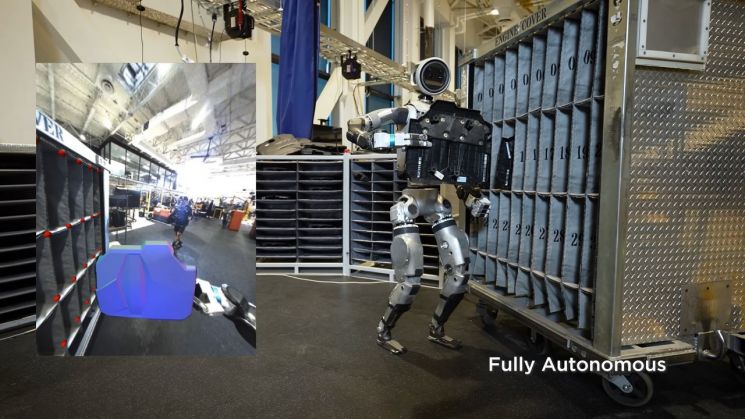 Boston Dynamics Atlas accurately recognizes and organizes parts through the camera. Provided by Boston Dynamics
The Key to Development: ‘Cost Reduction and Versatility’
Recently, BD has emphasized that the core goals of Atlas development are cost reduction and expanded versatility. While BD’s hardware is already among the world’s best, the initial hydraulic-based Atlas had limitations due to high costs and challenging maintenance. In response, BD shifted its strategy to reduce unnecessary specifications and enhance price competitiveness.
To this end, BD unveiled the “E-Atlas,” which uses electric power instead of hydraulics, and the third-generation model currently in development is expected to be operable 24 hours a day with a swappable battery system. The emphasis on practicality is also evident in the robot’s hand (gripper) design. Unlike competitors developing five-fingered hands, BD chose to refine three grippers with high precision, judging that focusing on functions needed in industrial settings is more efficient than simply mimicking the human hand.
BD’s approach to the lower body structure is also unique. While it is commonly believed that legged robots are more expensive than wheeled robots, BD explains that “in reality, legged robots are efficient from a cost perspective.” Implementing high-performance omni-directional wheels requires many actuators and increases weight and power consumption. In contrast, legged robots can move through narrow spaces and various terrains, offering superior on-site versatility, according to BD.
BD is also focusing on developing AI, which serves as the “brain” of humanoids. Robots learn the basics such as balance, grasping, and distance judgment through pre-training based on a large behavior model (LBM), and then undergo post-training in a virtual reality (VR) environment where humans provide corrections. Through this process, robots independently accumulate optimal behavioral patterns for each task.
Hyundai Motor Group plans to unveil the latest Atlas, equipped with these new technologies, at CES 2026 in January next year. At this event, the company is expected to present its vision for future manufacturing innovation, centered on AI robot development and smart factory construction.

© The Asia Business Daily(www.asiae.co.kr). All rights reserved.
![Clutching a Stolen Dior Bag, Saying "I Hate Being Poor but Real"... The Grotesque Con of a "Human Knockoff" [Slate]](https://cwcontent.asiae.co.kr/asiaresize/183/2026021902243444107_1771435474.jpg)


















