Jointly Organized by Five Korean Institutions
Strategies for Maritime Security, Economic Security, and Science and Technology Security Discussed
The Korea Maritime Institute (KMI), led by President Cho Jeonghee, held the 2025 Joint Academic Seminar on Maritime Security at the Asti Hotel in Busan on November 25, under the theme "Uncertainties in the Global Maritime Order and South Korea's Strategic Response to Maritime Security."
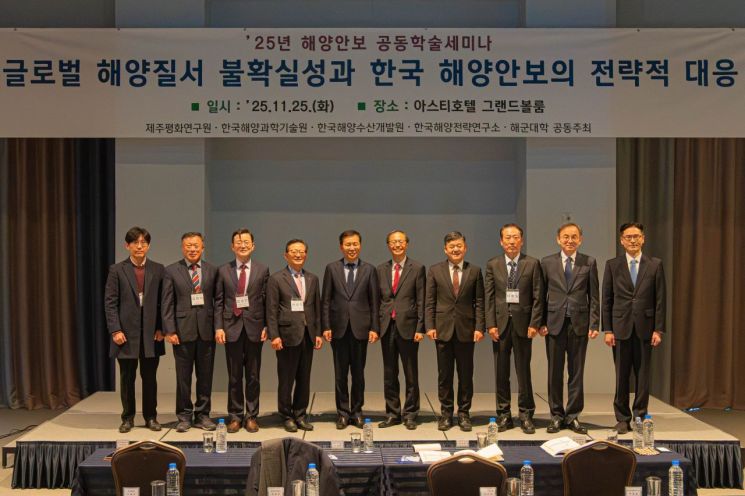 KMI is holding a joint academic seminar on "Changes in the Global Maritime Order and South Korea's Maritime Security Response" and taking a commemorative photo. Provided by KMI
This seminar was jointly organized by five institutions: KMI, Jeju Peace Institute (JPI), Korea Institute of Ocean Science and Technology (KIOST), Korea Institute for Maritime Strategy (KIMS), and the Naval War College. It has served as a platform for academic and policy discussions since 2024, aiming to explore South Korea's maritime security strategies amid the accelerating changes in the global maritime environment.
During the opening ceremony, Cho Jeonghee, President of KMI, emphasized the need for an integrated approach to South Korea's maritime security in the context of changes in the international maritime order. Kang Donggil, Chief of Naval Operations (with a congratulatory message delivered on behalf of Kim Seonghwan, President of the Naval War College), and Won Taeho, President of the Korea Institute for Maritime Strategy, delivered welcoming remarks. Assemblyman Cho Seunghwan reaffirmed the national importance of maritime security through a video message.
In the keynote speech, Yang Heecheol, President of KIOST, presented on the current state of South Korea's maritime security and the necessity of a comprehensive maritime strategy.
The first session, "Changes in the Global Maritime Security Environment and Maritime Economic Security," was chaired by former Ambassador Lee Yongil. Kim Giju, Senior Research Fellow at the Korea Institute for Defense Analyses, analyzed changes in the global maritime security environment centered on the Indo-Pacific. Lim Byungho, Associate Research Fellow at KMI, presented the need for introducing a maritime economic security index. Park Dongjun, Director at the Jeju Peace Institute, and Jeon Jeongsik, Director of International Cooperation at the Korea Coast Guard (with An Cheolho, Head of the Maritime Security Division at Busan Coast Guard, participating as a proxy), discussed the impact of international developments on South Korea's maritime economic security and policy improvement measures.
The second session, "Rising Tensions in Middle Eastern and East Asian Waters and Maritime Security," was chaired by Jeong Sangman, Director of the Maritime Security Center at KIMS. Kim Minseok, Professor at the Naval War College, discussed the possibility of escalation in the Russia-Ukraine war and changes in the Indo-Pacific security environment. Kim Giwon, Senior Research Fellow at the Korea Institute for Defense Analyses, presented the maritime security implications of the hybrid war between Israel and Hamas. Joo Jaewoo, Professor at Kyung Hee University, explained the structural risks to the East Asian maritime order posed by the spread of "salami tactics" and routine status quo changes in waters surrounding China.
The third session, "Directions for the Advancement of Marine Science and Technology to Respond to Changes in the Maritime Order," was chaired by Kim Eung, Director of the Maritime Territory Research Division at KIOST. Kim Jinwoo, Director at the Naval War College, proposed technological implementation plans for establishing integrated manned and unmanned combat systems. Jeong Sanggi, Senior Researcher at KIOST, explained technologies to ensure the reliability of maritime unmanned mobility operations. Cho Seongho, Senior Researcher at KIOST, introduced development directions for underwater acoustic detection technology based on unmanned maritime platforms. Han Donggyun, Professor at Hanyang University, presented new maritime security strategic challenges arising from rapid technological changes.
More than 160 participants from government, military, research institutes, and academia attended the seminar. A total of 14 maritime security experts-including nine presenters, two discussants, and three session chairs-engaged in diverse discussions on South Korea's strategic responses to changes in the global maritime order.
Cho Jeonghee, President of the Korea Maritime Institute, stated, "In an era where traditional security, economic security, and science and technology security are converging, South Korea must establish a more integrated and future-oriented maritime security strategy system." He added, "KMI will continue to contribute to the refinement of the national maritime security strategy in cooperation with relevant organizations."
© The Asia Business Daily(www.asiae.co.kr). All rights reserved.
![Clutching a Stolen Dior Bag, Saying "I Hate Being Poor but Real"... The Grotesque Con of a "Human Knockoff" [Slate]](https://cwcontent.asiae.co.kr/asiaresize/183/2026021902243444107_1771435474.jpg)
















