Bank of Korea's "Weighted Average Interest Rates of Financial Institutions in October"
Deposit Rates Rise for Second Consecutive Month as Market Rates Increase
Household Loan Rates Turn Upward After 11 Months
Credit and Corporate Loan Rates Conti
The interest rates on home mortgage loans handled by banks have turned upward for the first time in three months. This shift is attributed to a significant increase in market rates, such as bank bonds, which serve as benchmark rates. However, the extent of the rise was limited, as the reductions in bank spreads implemented in August and September were reflected with a time lag. With both mortgage and jeonse loan rates climbing, the overall household loan interest rate, which includes these products, has resumed its upward trend for the first time in 11 months.
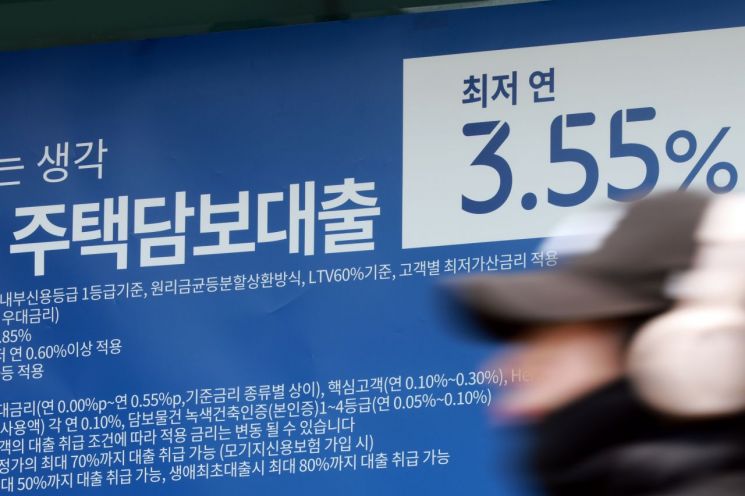
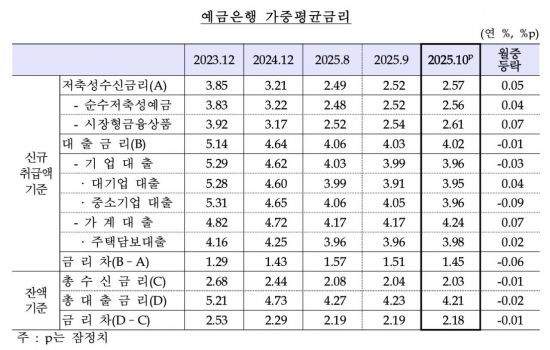
According to the "Weighted Average Interest Rates of Financial Institutions for October," released by the Bank of Korea on November 26, the interest rate on new mortgage loans at deposit banks last month stood at an annualized 3.98%, up 0.02 percentage points from the previous month.
The mortgage loan rate, which had risen to 4.27% in January this year, declined from February to May, then alternated between increases and decreases in June and July, remained flat in August and September, and has now turned upward again. Nevertheless, the rate has remained in the 3% range for seven consecutive months since April (3.98%).
Kim Minsoo, Head of the Financial Statistics Team at the Economic Statistics Department, explained, "While the five-year bank bond rate, a benchmark rate, rose by 0.11 percentage points in October, the impact of some banks lowering their spreads in August and September was reflected with a delay, which limited the increase."
Specifically, the fixed-rate mortgage loan interest rate rose by 0.03 percentage points to 3.97%, and the variable-rate mortgage loan interest rate also increased by 0.03 percentage points to 4.11% compared to the previous month.
Looking ahead, mortgage loan rates are expected to be increasingly influenced by benchmark rates. Kim added, "Since the household debt measures announced on June 27, banks appear to be managing household loans primarily by controlling total lending volume, such as reducing loans through loan brokers, rather than raising spreads."
The interest rate on jeonse loans rose by 0.02 percentage points to 3.78% per annum compared to the previous month.
The interest rate on general credit loans fell by 0.12 percentage points to 5.19% per annum over the same period. The Bank of Korea explained that, although short-term bank bond rates (a benchmark rate) increased, some banks expanded preferential rates for credit loans, which contributed to the decline.
Including these products, the overall household loan interest rate rose by 0.07 percentage points to 4.24% per annum compared to the previous month. Kim stated, "Although the credit loan rate fell, the rates on mortgage and jeonse loans rose, and the share of credit loans, which have higher interest rates, increased."
The corporate loan interest rate fell by 0.03 percentage points to 3.96% per annum compared to the previous month, marking a decline for five consecutive months since June this year. The main factor was a 0.09 percentage point drop in the interest rate for loans to small and medium-sized enterprises (SMEs), which stood at 3.96%. Despite the rise in short-term market rates such as short-term bank bonds, the SME loan rate fell due to the execution of some policy loans ahead of the year-end. The interest rate for large corporations rose by 0.04 percentage points to 3.95%, due to a base effect following the expansion of crisis response support loans in September.
The interest rate on time and savings deposits (based on new deposits) increased by 0.05 percentage points to 2.57% compared to the previous month, marking the second consecutive month of increase.
In detail, the pure savings deposit rate, led by time deposits, rose by 0.04 percentage points to 2.56% per annum. The market-type financial product rate, centered on certificates of deposit (CDs) and financial debentures, increased by 0.07 percentage points to 2.61%.
The loan-deposit interest rate spread (based on new transactions) narrowed by 0.06 percentage points to 1.45 percentage points compared to the previous month. Based on outstanding balances, the spread narrowed by 0.01 percentage points to 2.18 percentage points.
Meanwhile, the proportion of fixed-rate household loans fell by 5.9 percentage points to 56.2% compared to the previous month. In contrast, the proportion of fixed-rate mortgage loans rose by 2.5 percentage points to 94%.
Among non-bank financial institutions, the deposit interest rates for one-year time deposits at savings banks, credit unions, mutual finance companies, and community credit cooperatives all declined. Regarding loan interest rates (based on general loans), savings banks and community credit cooperatives saw increases of 0.81 percentage points and 0.29 percentage points, respectively, while credit unions and mutual finance companies experienced decreases.
© The Asia Business Daily(www.asiae.co.kr). All rights reserved.
![Clutching a Stolen Dior Bag, Saying "I Hate Being Poor but Real"... The Grotesque Con of a "Human Knockoff" [Slate]](https://cwcontent.asiae.co.kr/asiaresize/183/2026021902243444107_1771435474.jpg)
















