FT Points to Ireland as a Weak Link in European Defense
Defense Spending Only 0.25% of GDP; Navy Resources Lacking
"Prioritizing Military Neutrality to Avoid Responsibility"
As Europe strengthens its defense capabilities around the North Atlantic Treaty Organization (NATO), there have been reports that Ireland’s policy of prioritizing military neutrality is becoming a weak point in European defense. According to Yonhap News on the 25th (local time), citing the Financial Times (FT) of the United Kingdom, “There is growing frustration among the UK and European Union (EU) member states that Ireland is using its neutral status to avoid taking on 21st-century responsibilities.”
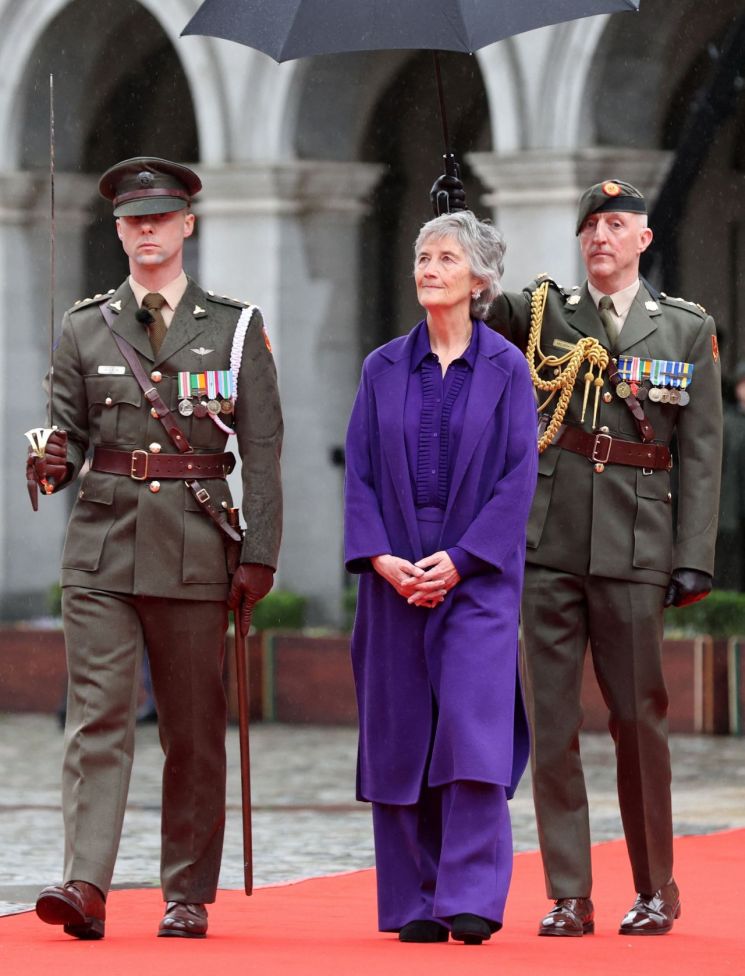 Catherine Connolly, the new President of Ireland, is participating in the guard of honor inspection after the inauguration ceremony at Dublin Castle on the 11th (local time). Photo by Reuters Yonhap News
Ireland’s defense budget is expected to reach an all-time high of 1.5 billion euros (approximately 2.5 trillion won) in 2026. However, this accounts for only 0.25% of its gross domestic product (GDP), the lowest among EU countries. NATO recently raised its defense spending target to 5% of GDP.
Ireland has attracted the European headquarters of major U.S. tech and pharmaceutical companies, generating substantial tax revenue. This year, the country is expected to post a fiscal surplus of 10.2 billion euros (about 17.3 trillion won). In comparison, its defense budget is considered extremely small.
Recently, threats to Atlantic undersea infrastructure have increased, and there is heightened alert after the Russian vessel Yantar, suspected of espionage, entered waters near Scotland in the UK. Despite this, Ireland is said to be taking a bystander’s stance. Catherine Connolly, the newly inaugurated President of Ireland, has been an outspoken opponent of military expansion.
According to Yonhap News, Ireland established its navy in 1946, faced a shortage of vessels in the late 1960s, and currently operates only 4 out of 8 ships due to a lack of resources. Its security communications infrastructure is also insufficient, reportedly leaving the country unable to communicate about potential threats such as the entry of Russian vessels.
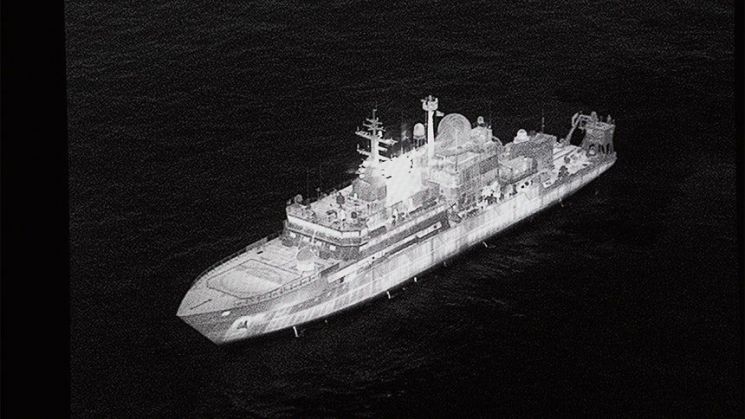 On the 19th (local time) in London, UK, during a speech by Defense Secretary John Healy, a photo of the Russian vessel Yantar, suspected of espionage activities, was displayed on the screen. UK Ministry of Defense
The Financial Times particularly highlighted Ireland’s geographical importance to global undersea communications infrastructure as it sits at the western edge of Europe. About three-quarters of the Northern Hemisphere’s undersea cables pass through Irish waters. Ireland is also known to rely on undersea pipelines for most of its energy needs.
Kevin Mac Ounlea, a former commander of the Irish Navy, told the Financial Times, “Ireland’s ability to protect its undersea cables is virtually zero.” Another former European security official stated, “Ireland is defenseless.” Former lawmaker and Irish Army commander Cathal Berry also commented, “Ireland is home to big tech, large pharmaceutical companies, and big data, making it a high-value target. While it is an EU member, it is not a NATO member. If someone wants to strike the EU without fear of NATO retaliation, Ireland is the starting point.”
However, it is reported that there is little public opinion in Ireland in favor of joining NATO. Peter Coyle, chairman of the Irish think tank Azure Forum, said, “Thanks to (military) neutrality, the budget is free from defense spending. This has become a kind of creed, making it difficult to change.”
As security threats in Europe grow, Ireland is set to assume the rotating EU presidency in the second half of next year and will also host the European Political Community (EPC), an expanded European security consultative body. Ossian Smyth, former Irish Minister of State for Environment, Climate and Communications, noted, “We started from nothing, but now there is much to protect and we can no longer rely on the kindness of others.”
© The Asia Business Daily(www.asiae.co.kr). All rights reserved.
![Clutching a Stolen Dior Bag, Saying "I Hate Being Poor but Real"... The Grotesque Con of a "Human Knockoff" [Slate]](https://cwcontent.asiae.co.kr/asiaresize/183/2026021902243444107_1771435474.jpg)
















