Enhertu HER2 Target and TOPO1 Inhibitor
24% Resistance Occurs Within One Year
Samsung Epis Holdings, Celltrion, and Others
Overcoming Enhertu Resistance with New ADC Designs
Korean biotech companies are preparing for the "second act" of the antibody-drug conjugate (ADC) race following the blockbuster ADC drug "Enhertu." As Enhertu expands its indications to various solid tumors such as breast cancer, gastric cancer, and non-small cell lung cancer, and establishes itself as a first-line treatment, the market for therapies targeting patients who develop resistance or non-responsiveness to Enhertu is growing. The ADC strategies of Korean biotech firms are converging on overcoming resistance and non-responsiveness to Enhertu.
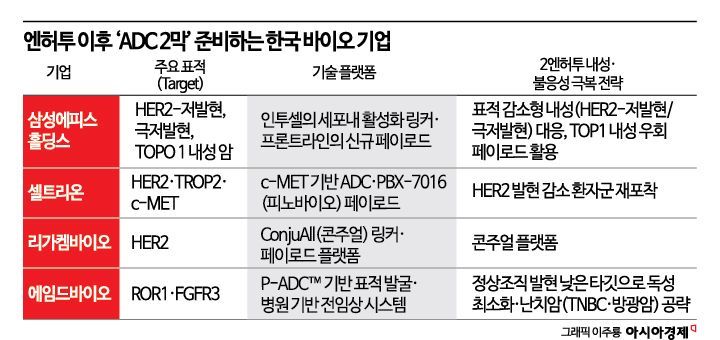
According to industry sources on November 26, major Korean biotech companies such as Samsung Epis Holdings and Celltrion, as well as ADC-focused biotechs like LegoChem Biosciences, AIMEDBIO, and Qurient, are actively developing ADC anti-cancer drugs. ADCs are next-generation targeted anti-cancer drugs that deliver highly potent cytotoxic agents (payloads) precisely to cancer cells via an antibody and a linker. The antibody acts as a navigation system, the drug as a missile, and the linker as the targeting device. Enhertu, known as an "ADC game-changer," is expanding the overall anti-cancer drug market as a first-line treatment.
ADC resistance arises in two main ways. First, there is reduced target expression. When treatment with Enhertu begins, expression of its target, HER2 (human epidermal growth factor receptor 2), decreases, leading to more patients with HER2-low or ultra-low expression. With fewer targets, the drug loses effectiveness. Second, there is drug resistance. Currently, most ADCs use TOPO-1 (topoisomerase I) inhibitors as their payloads, but cancer cells can develop mechanisms to expel these drugs, reducing their efficacy.
Samsung Epis Holdings is targeting the ADC market by diversifying its designs and collaborating with ADC-specialized biotechs. In partnership with IntoCell, Samsung Epis Holdings selects the indications and targets, applies the linker and payload technology, and directly manufactures the ADC. The company possesses "intracellular activation linker" technology, which ensures the payload is released only in the acidic, enzymatic, or reductive environment inside the cancer cell. This technology is designed so that even if target expression is low, the drug can still function inside the cell. The company is also developing new payload platforms with mechanisms different from the traditional TOPO-1 inhibitors, aiming to bypass resistance.
Celltrion is strengthening its "target switching" strategy by utilizing various targets such as HER2, TROP2 (trophoblast cell-surface antigen 2), and c-MET (hepatocyte growth factor receptor). Its core pipeline, CT-P70 (c-MET ADC), targets patients with c-MET overexpression, who account for over 40% of gastroesophageal cancer cases. By applying a Topo-1-based payload and PBX-7016, Celltrion aims to achieve greater tumor penetration and efficacy compared to the existing DXd (Enhertu).
ADC-focused biotechs are also accelerating their efforts. LegoChem Biosciences has garnered attention with its HER2 ADC "LCB14," developed using its proprietary linker-payload platform "ConjuAll," which showed an objective response rate (ORR) of 75% and a disease control rate (DCR) of 100% in Enhertu-refractory patients. AIMEDBIO is increasing its competitiveness in hard-to-treat cancers such as triple-negative breast cancer (TNBC) and bladder cancer by identifying targets like ROR1 (receptor tyrosine kinase-like orphan receptor 1) and FGFR3 (fibroblast growth factor receptor 3), which are rarely expressed in normal tissues.
An industry insider stated, "HER2 is already a market defined by Enhertu. Now, the competition is shifting to new targets and payload designs, and Korean companies are quickly preparing for the next-generation ADC era."
© The Asia Business Daily(www.asiae.co.kr). All rights reserved.
![Clutching a Stolen Dior Bag, Saying "I Hate Being Poor but Real"... The Grotesque Con of a "Human Knockoff" [Slate]](https://cwcontent.asiae.co.kr/asiaresize/183/2026021902243444107_1771435474.jpg)















