Mayor Seungro Lee: “Ending 70 Years of Stigma, Creating a Premium Residential Area”
99.4% Relocation Rate, 46-Story Towers and 2,201-Unit Large Complex Planned
Seongbuk District in Seoul (Mayor Seungro Lee) has officially begun the demolition of ‘Miyari Texas,’ the city’s last remaining red-light district, which had existed for 70 years. With the closure of this brothel district, a key pledge of the eighth popularly elected administration, the stigma of being the last red-light district in central Seoul is set to disappear into history.
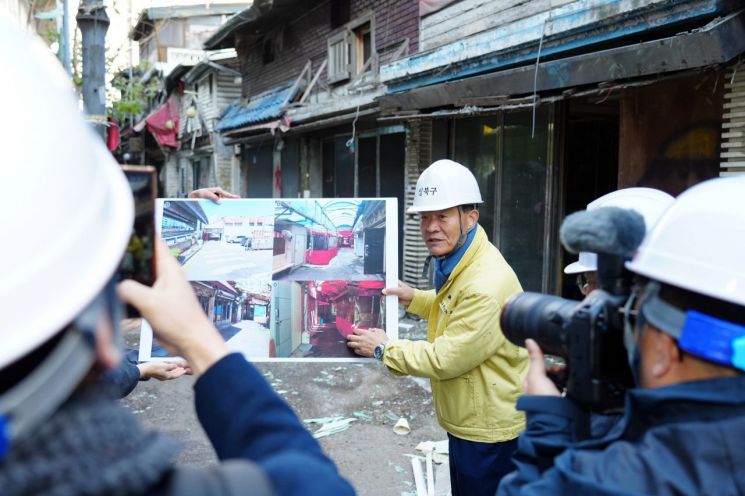 Seungro Lee, Mayor of Seongbuk District, is explaining the demolition status at Sinwol-gok 1 District, formerly known as 'Miyari Texas.' Provided by Seongbuk District.
Seongbuk District is pushing forward with a redevelopment project in the Sinwol-gok 1 District, which includes Miyari Texas, to address the long-standing local demand for improved residential environments and to revitalize the urban image. The district has defined this demolition not simply as an urban renewal project, but as the resolution of a long-standing social issue in the city center, and is promoting it as a symbolic initiative marking a historical turning point.
Sinwol-gok 1 District is located at 88-142 Hawolgok-dong, Seongbuk District (covering 56,024.5 square meters), and is designated as an urban redevelopment housing project with the participation of 414 association members. The plan includes 11 buildings with 6 basement floors and 46 above-ground floors, totaling 2,201 residential units (including 197 rental units) and 170 officetel units. Public facilities such as a cultural park and a children's park will also be established.
Since designating Sinwol-gok 1 District as a redevelopment area in 2009, Seongbuk District integrated it with Seongbuk 2 District into a combined maintenance area in 2016, secured project implementation approval in 2020, and received management disposition approval in 2022. After announcing the relocation of association members and tenants in September 2023, the district proceeded with compensation negotiations and eviction lawsuits, and began full-scale demolition in April of this year.
At the time of last year’s relocation notice, about 70 out of 115 businesses in the area were still operating. The number of sex workers was estimated at around 160 to 200. A moving allowance of 20 million to 30 million won per business was set, but compensation for loss of business rights was not recognized due to the illegal nature of the establishments. However, since February of this year, the association has been negotiating additional compensation equivalent to 100% to 300% of the business rights value for each establishment.
The process has not been without difficulties. Seongbuk District held multiple meetings to resolve the relocation issues of sex workers and business owners. In November and December 2023, the head of the Urban Management Bureau met with representatives of sex workers, and since August of last year, about 30 business owners and workers have held weekly rallies in front of the district office, demanding alternative commercial spaces and rental housing as relocation measures.
As of November 19, the relocation rate in the district has reached 99.4%. Of the four businesses that have not yet relocated, three are scheduled to move by the end of the year, and negotiations are ongoing with the remaining one. The demolition rate stands at 54.3%, with most commercial and residential buildings already demolished. The concentrated brothel areas will be demolished in phases, divided into two zones.
 Interior view of a prostitution establishment scheduled for demolition. Provided by Seongbuk District.
During this process, Seongbuk District has activated support measures for the social rehabilitation of women victimized by prostitution. Using its own funds, the district is providing up to 2.1 million won per month for 12 months to participants in the self-support program for victims of prostitution. In two rounds in October and this month, a total of 12 people were selected as beneficiaries, and the program is expected to continue until the end of next year. The association has also referred to cases in Cheongnyangni 4 and Cheonho 1 Districts to negotiate adjustments to compensation per business and reach collective agreements.
Miyari Texas, once the most prominent red-light district in Seoul, was established after the Korean War in the 1950s and 1960s, and at its peak, hundreds of establishments clustered there, making it a symbol of urban blight. With the disappearance of other red-light districts such as Cheongnyangni 588 (Dongdaemun District) and the area near Cheonho Station (Gangdong District), this demolition marks the historical end of the last brothel district in Seoul. Through this project, Seongbuk District aims to break the structural cycle of illegal prostitution and transform the underdeveloped area into a future-oriented residential and cultural complex.
Mayor Seungro Lee stated, “With the full-scale demolition of Miyari Texas in Sinwol-gok 1 District, a long-standing local aspiration and social issue, we are taking another step toward making Seongbuk a premium residential city. This demolition marks not only an improvement in the environment, but also serves as an important opportunity to redefine Seongbuk District’s history and identity.”
Seongbuk District plans to continue strengthening communication with residents and will focus all administrative resources on making the Sinwol-gok 1 District area a safe and pleasant residential community through tailored administration that combines local regeneration and social recovery.
 A bird's-eye view of Sinwol-gok 1 District reborn with 6 basement floors, 46 above-ground floors, 11 buildings totaling 2,201 households (including 197 rental units), and 170 officetel units. Provided by Seongbuk District Office.
© The Asia Business Daily(www.asiae.co.kr). All rights reserved.
![Clutching a Stolen Dior Bag, Saying "I Hate Being Poor but Real"... The Grotesque Con of a "Human Knockoff" [Slate]](https://cwcontent.asiae.co.kr/asiaresize/183/2026021902243444107_1771435474.jpg)


















