Establishing a New 16,500m² Business Site in Gimje
Featuring Exhibition Hall and Production Plant
Securing Safety Technologies Such as
GPS Automatic Control, Three-Point Seatbelts, and IoT Diagnostics
Aiming for Expansion Beyond Children's Veh
"We can manufacture dozens of units per day here. The domestic market is well within our capacity."
On November 20, Ju-il Kang, CEO of Iverse, guided visitors to a new business site located within the Baekgu Industrial Complex in Gimje, about 9 kilometers from the company’s headquarters in Deokjin-gu, Jeonju, North Jeolla Province. This spacious location features a two-story exhibition hall and a newly built production plant, standing side by side. The combined floor area of the two buildings totals 9,900 square meters (about 3,000 pyeong), which is five times larger than the existing headquarters. The site also includes an office building, employee amenities such as shower facilities, and a golf practice range.
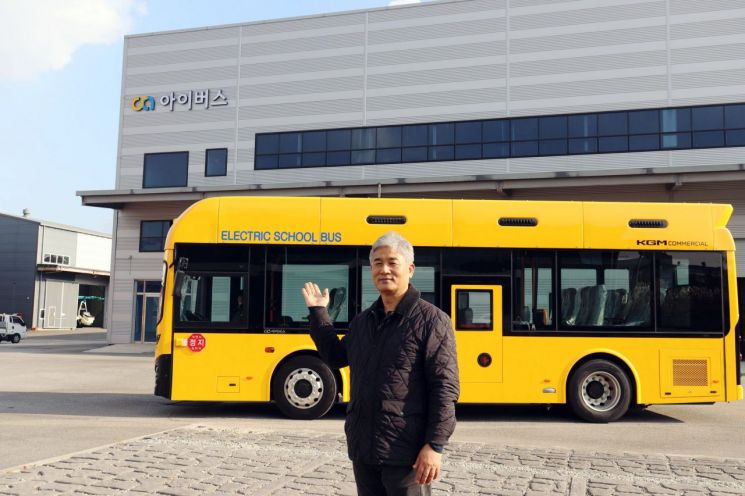 On the 20th, Ju-il Kang, CEO of Iverse, introduced the new business site located in Baekgu Industrial Complex, Gimje, Jeonbuk. The vehicle in the background is a newly unveiled 9-meter electric bus model, which CEO Kang personally drove to transport the press corps to this location. Innobiz Association
Iverse will fully relocate its headquarters to this site within three months. The new plant, approximately 130 meters in length, will feature automotive assembly lines on both sides, creating a structure reminiscent of a scaled-down Hyundai Motor factory. Additionally, the company is in the process of acquiring adjacent land to build a test track, enabling newly produced vehicles to undergo immediate test drives before delivery.
Currently, the domestic children’s school bus market is divided between Hyundai Motor and Iverse at a ratio of 8 to 2. In 2026, in addition to new demand, there will be a mandatory replacement of around 900 school-use official vehicles that are over 11 years old, opening up a market estimated at 50 billion won. Iverse’s daily production capacity is around eight units. During a recent press conference at the headquarters, when asked how the company would handle the expected surge in demand, Kang effectively answered by unveiling this new core facility for the first time.
GPS Automatic Control & IoT Diagnostics... Differentiating with Safety Technology
On this day, CEO Kang unveiled a new 9-meter, 27-seater electric bus model for the first time. Iverse’s lineup now includes vehicles ranging from 11- and 15-seater models based on the Staria to 12-meter, 46-seater electric buses. The large electric school buses feature carbon fiber reinforced plastic (CFRP) to reduce body weight while enhancing collision safety. The basic chassis are supplied by Hyundai Motor, KGM Commercial, and Woojin Industrial Systems, then fitted and modified with safety equipment and control technology tailored to internal and external structures. Iverse currently holds nine patents in related safety and control technology fields.
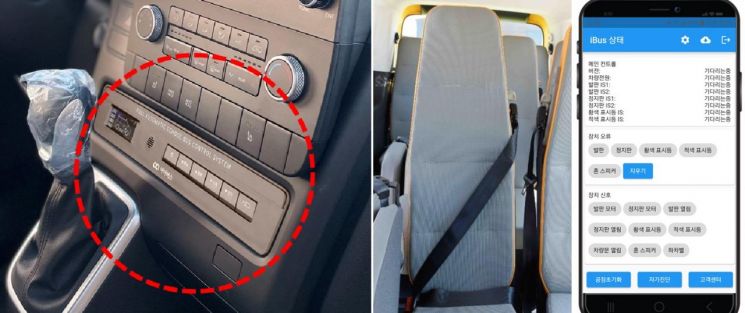 From the left: GPS-based fully automatic integrated control system, 3-point seatbelt seat, vehicle inspection application. Ibus
Iverse’s core technology is its "GPS-based fully automatic integrated control system." This system can register up to 100 locations, and when the vehicle arrives at a designated spot, the step, stop sign, and child safety lights deploy automatically without driver intervention. Upon stopping at a school, the system links with a "child disembarkation confirmation device," requiring the driver to turn off the engine and press a confirmation bell at the rear of the bus. If this step is skipped, a siren and warning lights activate after one minute. This is designed to prevent "sleeping child" incidents, where children are accidentally left inside vehicles, potentially leading to suffocation.
The child-specific seat with a three-point seatbelt was developed by Iverse before Hyundai Motor, according to the company. The seat is designed so the belt height can be adjusted according to body size. For vehicle inspection, a smartphone-based Internet of Things (IoT) diagnostic system enables remote checks, allowing simple adjustments to be made instantly via the app. On this day, the company also unveiled its in-house certification facility. During a demonstration of the "Maximum Safety Inclination Angle Test," an 11-meter, 39-seater large bus remained stable even at a 28-degree tilt, meeting the legal standard.
From Children to Seniors... Focusing on Mobility Rights for the Transportation Disadvantaged
Iverse’s emphasis on child safety technology is rooted in CEO Kang’s personal experiences. He became keenly aware of the importance of child safety while working with the Korea Child Safety Foundation following the 1999 Sealand fire accident in Hwaseong. His previous experience of more than 10 years handling vehicle inspection work at the Korea Transportation Safety Authority also played a role. These experiences became the starting point for founding Iverse in 2018 and entering the school bus business.
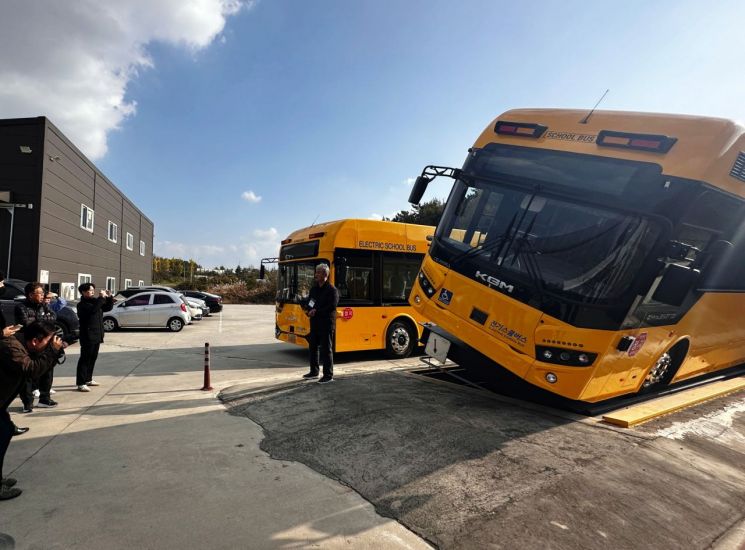 On the 20th, Juil Kang, CEO of Iverse, demonstrated the 'Maximum Safety Inclination Angle Test' of a large bus in front of the press corps. Innobiz Association
CEO Kang stated, "Our goal is to expand our school bus EV lineup to include models such as the Kia PV5 and Staria EV, and to secure a market share of over 50%. We aim to become a company that sets the standard for children’s school buses through ongoing investment in safety." Iverse is also seeking to expand its business into senior protection vehicles. This is to address the current practice of repurposing aging children’s school buses as vehicles for senior welfare facilities. CEO Kang is developing dedicated vehicle markings and is actively proposing related policy improvements to lawmakers.
© The Asia Business Daily(www.asiae.co.kr). All rights reserved.
![Clutching a Stolen Dior Bag, Saying "I Hate Being Poor but Real"... The Grotesque Con of a "Human Knockoff" [Slate]](https://cwcontent.asiae.co.kr/asiaresize/183/2026021902243444107_1771435474.jpg)


















