Islamic Gallery Newly Established in the World Culture Gallery
Open to the Public Starting on the 22nd
Exhibition of Islamic Cultural Artifacts Including Quran Manuscripts
Media Recreation of the "Reception Room of a Damascus Noble"
The National Museum of Korea announced on the 21st that it will open a newly established Islamic Gallery on the third floor of the World Culture Gallery in its permanent exhibition hall, starting from the 22nd.
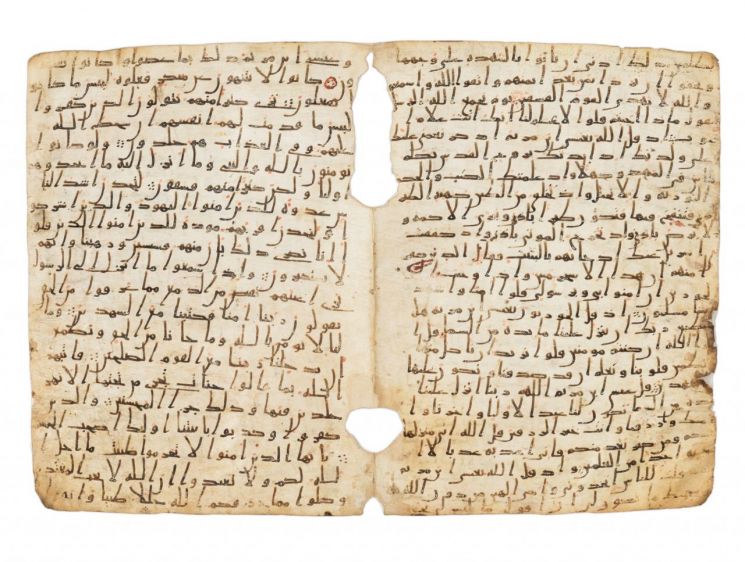 Early Quran Manuscript (Late 7th Century to Early 8th Century, Umayyad Caliphate). Courtesy of the Museum of Islamic Art, Doha
This exhibition, co-hosted with the Museum of Islamic Art in Doha, Qatar, one of the world’s leading Islamic museums, is titled “Islamic Art: A Journey of Radiant Light.” It will showcase a total of 83 diverse Islamic artworks, including early Quran manuscripts. Since 2019, the National Museum of Korea has been introducing world cultures through exhibitions featuring collections from major museums around the globe. Islamic culture is the fifth theme in this series, marking the first Islamic-themed exhibition in the permanent exhibition hall.
The exhibition introduces the Islamic world, which originated on the Arabian Peninsula in the 7th century and now has about 2 billion followers in 57 countries worldwide, by dividing it into three themes: religious art from the 7th to the 19th century, the embrace and expansion of culture, and court culture and manuscripts.
The exhibition is designed to showcase the essence of Islamic calligraphic art, ranging from early Quran manuscripts written on parchment to large manuscripts from the Timurid Empire. The exhibition space is crafted with a domed roof and octagonal structure, creating an immersive experience for visitors as if they are entering a mosque.
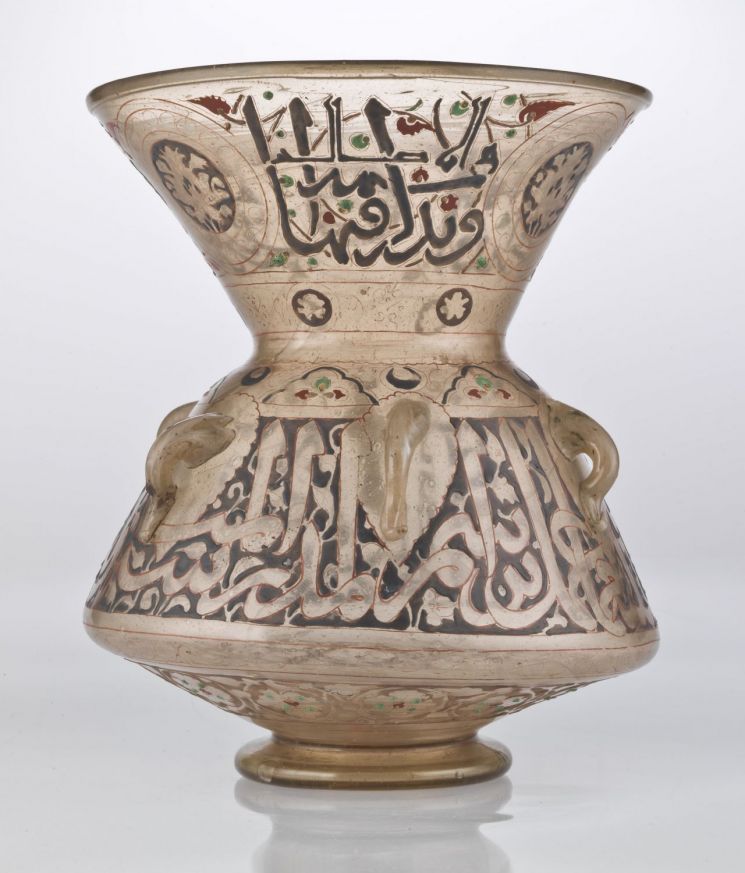 Mosque lamp (late 14th century to early 15th century, Mamluk dynasty). Courtesy of the Museum of Islamic Art, Doha
The exhibition also highlights the process by which Islamic culture, which began on the Arabian Peninsula, encountered various regions and developed into a dynamic and syncretic culture. It sheds light on the world of Islamic art, where glass, ceramics, and metal crafts created by Islamic artisans achieved harmony by blending with the artistic traditions and techniques of different regions through a process of cultural embrace and expansion.
One of the highlights of the exhibition is a media installation recreating the “Reception Room of a Damascus Noble,” a signature display at the Museum of Islamic Art in Doha. The space is designed to vividly evoke the atmosphere of the flourishing Islamic culture of the time. Throughout the exhibition hall, there are “Aha! Learning Spaces” tailored for children, as well as a “Digital Experience” area where visitors can create new patterns by combining Islamic geometric motifs themselves.
On the eve of the exhibition’s opening, at 8:00 p.m. on the 21st, curator Kwon Hyeun will host a live exhibition tour on the National Museum of Korea’s YouTube channel. At 1:00 p.m. on the 22nd, in the Education Practice Room of the museum’s Education Center, Dr. Mounia Chekhab Abudaya, Deputy Curator of the Museum of Islamic Art in Doha and a renowned Islamic studies scholar who planned this exhibition, will give a lecture titled “A Journey of Radiant Light - Introducing Islamic Art from Doha to Seoul.” Admission is on a first-come, first-served basis without prior reservation.
Yoo Hongjun, Director of the National Museum of Korea, stated, “This exhibition is a meaningful occasion to introduce Islamic art in collaboration with the Museum of Islamic Art in Doha, Qatar. I hope that visitors will gain a proper understanding of the brilliant Islamic culture that flourished across eras and regions, and that this will serve as an opportunity to reflect on the diversity and coexistence of human cultures.” The exhibition will run until October 11 next year.
© The Asia Business Daily(www.asiae.co.kr). All rights reserved.
![Clutching a Stolen Dior Bag, Saying "I Hate Being Poor but Real"... The Grotesque Con of a "Human Knockoff" [Slate]](https://cwcontent.asiae.co.kr/asiaresize/183/2026021902243444107_1771435474.jpg)
















