Speech at Cairo University in Egypt, Filling All 3,050 Seats
The First Letters of Stability (S), Harmony (H), Innovation (I), Network (N), and Education (E)
Presenting Peace Between the Korean Peninsula and the Middle East Based on Stability and Har
During his tour of four countries in the Middle East and Africa, President Lee Jaemyung proposed the 'SHINE Initiative' in a speech at Cairo University in Egypt on the 20th (local time), encompassing peace, prosperity, and cultural cooperation between the Korean Peninsula and the Middle East. 'SHINE' is an acronym for Stability, Harmony, Innovation, Network, and Education. President Lee emphasized, "Based on the SHINE Initiative, which covers the three areas of peace, prosperity, and culture, we will open a future of mutual prosperity between the Middle East and the Korean Peninsula."
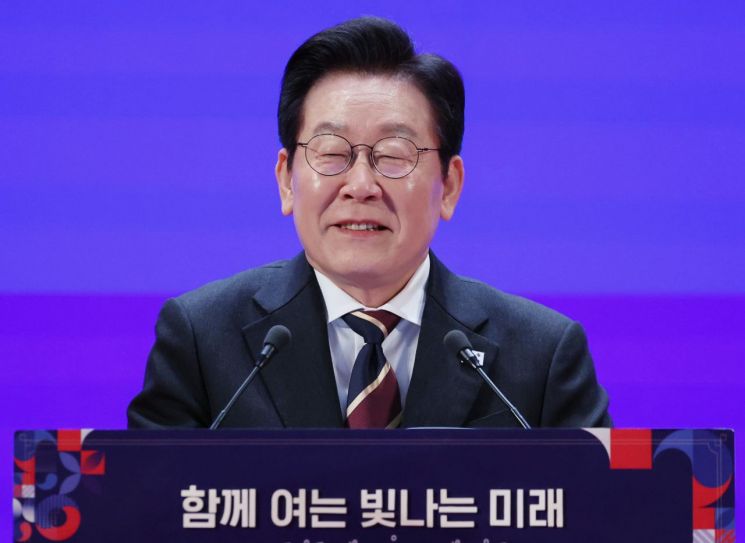
Beginning his speech under the theme "Opening a Bright Future Together," President Lee stated, "Although 30 years of diplomatic relations between Korea and Egypt may seem short compared to the long histories of both countries spanning thousands of years, we have achieved much in that short period," adding, "The two countries have established a comprehensive cooperative partnership, steadily building a strong foundation by increasing trade, investment, and exchanges in people and culture." Korea and Egypt first established diplomatic relations in 1995.
He then presented 'peace between the Korean Peninsula and the Middle East, based on stability and harmony' as the first vision of the SHINE Initiative for the Middle East. President Lee explained, "Since 2007, Korea has contributed to peace in the Middle East by dispatching the Dongmyeong Unit to Lebanon, and we have consistently supported the two-state solution regarding the Israel-Palestine issue."
He also stated, "We have provided humanitarian aid to alleviate food shortages in conflict regions," and announced that, on the occasion of this visit to Cairo, "we will newly contribute 10 million dollars to the Egyptian Red Crescent Society to help overcome the Gaza crisis together." The Egyptian Red Crescent Society is a non-governmental organization (NGO) providing humanitarian relief and medical services within Egypt.
Furthermore, President Lee referred to Korea's experience of division and separated families, saying, "In Korea, there is a saying, 'Dongbyeongsangnyeon' (sympathy through shared suffering). Those who have experienced the same pain understand each other more deeply," and added, "The people of Korea, who have endured the devastation of war, deeply empathize with those threatened by conflict. As a responsible member of the global community, Korea will steadfastly uphold the value of solidarity in the Middle East as well."
Joint Prosperity through 'Innovation (I)'... Vision for Expanding People-to-People and Cultural Exchanges through 'Network (N) + Education (E)'
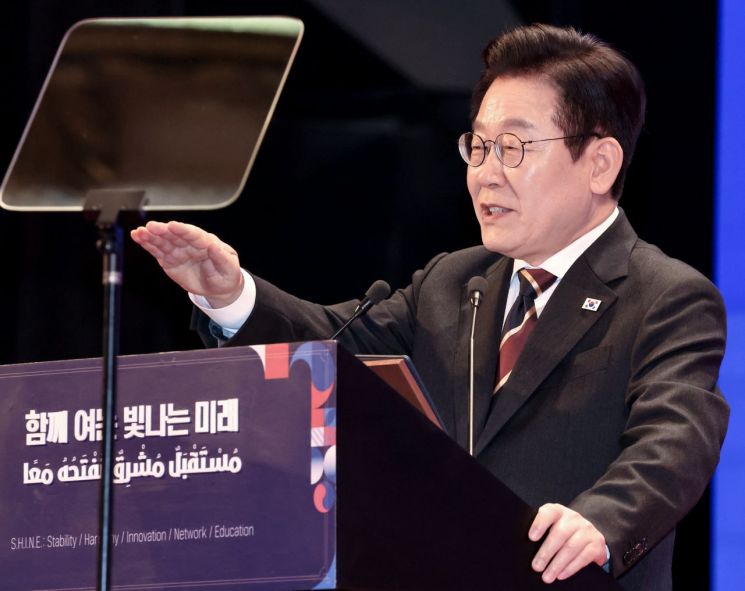
As the second vision, he presented an economic cooperation blueprint of 'joint prosperity through innovation.' President Lee stated, "Korea will pursue tailored cooperation for the economic development of each country, just as Egypt has its 'Vision 2030'," and explained, "Samsung's latest smartphones are connecting Egyptian people to the world, and Hyundai Rotem's subway trains are serving as the main mode of transportation for Cairo citizens." He continued, "Through joint manufacturing in the industrial sector, we are contributing to increased exports and employment in Middle Eastern countries," and added, "We will continue efforts to strengthen the institutional foundation for free trade, such as the Korea-Egypt Comprehensive Economic Partnership Agreement (CEPA)."
President Lee mentioned Korea's 'Miracle on the Han River,' stating, "Korea as we know it today would not exist without cooperation in Middle Eastern oil, gas, and construction contracts." He added, "Now it is Korea's turn to contribute to the 'Miracle on the Nile.' We will solidify cooperation in energy and construction, and expand the horizons of cooperation into future innovation sectors such as artificial intelligence (AI) and hydrogen."
As the third vision, he proposed 'expanding people-to-people and cultural exchanges through network and education.' President Lee said, "Nothing strengthens friendship between two countries more than frequent meetings between people and learning each other's cultures," and cited the example of Egyptian youth studying mechanical, electrical, and automotive technology at Beni Suef Technological University. He stated, "We will expand inter-university exchanges, including with Cairo University, and increase the number of Egyptian students who can study in Korea by expanding ICT master's scholarship programs and training opportunities."
He also pledged to expand exchanges through K-culture. President Lee said, "K-culture, including food, fashion, and beauty, holds infinite potential to expand exchanges between Korea and the Middle East," and added, "Just as many Koreans love hummus, a Middle Eastern dish made from chickpeas, as the popularity of K-halal food spreads in Egypt and as people in both countries enjoy each other's cuisine as their own, our peoples will become even closer friends." He also proposed cooperation between the recently opened Grand Egyptian Museum and the National Museum of Korea, emphasizing, "Sharing historical experiences together will become an important pillar of cultural exchange." At the same time, he stated that, in the long term, Korea would establish an environment to nurture Middle East experts and broaden Koreans' understanding of the region step by step.
Mentioning Korea's 'March 1st Movement' in 1919 and Egypt's 'Independence Movement,' Emphasizing the Path of Peace... "We Will End the Era of Hostility and Confrontation Between North and South Korea"
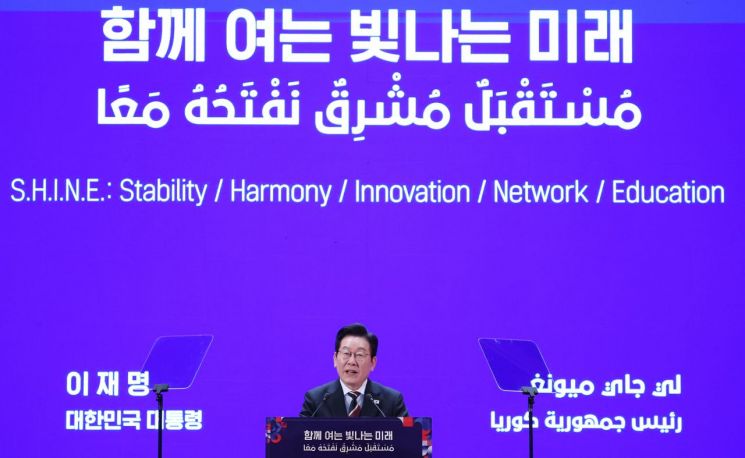
President Lee also referenced Korea's 'March 1st Movement' in 1919 and Egypt's 'Independence Movement,' noting similar historical and geopolitical experiences. He particularly pointed out that both Egypt and Korea are strategic hubs where continents and oceans meet, saying, "Korea also suffered the loss of sovereignty in the early 20th century amid the competition of great powers, and even now we endure the pain of division caused by war."
He continued, "Although we were separated by thousands of kilometers, the citizens of Korea and Egypt were connected by the spirit of independence, freedom, and equality," and recalled the historical significance of the Cairo Declaration in 1943, stating, "In Cairo in 1943, Korea regained its lost light." The Cairo Declaration was a joint statement announced on December 1, 1943, after meetings between the leaders of the United States, United Kingdom, and China at the end of November, declaring an end to Japanese aggression, postwar territorial arrangements, and Korea's independence.
President Lee also emphasized the path of peace through the decisions of leaders. He quoted former Egyptian President Anwar Sadat, who visited Israel and said, "War can never be a solution. We want our children to live in peace," and evaluated, "President Sadat's courageous choice became a turning point in Middle Eastern history." He added, "President Abdel Fattah el-Sisi did not give up on dialogue or mediation during the two years of the Gaza crisis, and the Sharm el-Sheikh Peace Summit, co-hosted with President Trump, led to the historic Gaza ceasefire." President Sadat was the first leader of an Arab country to recognize Israel and sign a peace agreement in 1978.
President Lee then connected this to his vision for peace on the Korean Peninsula. He said, "Former presidents, including Kim Daejung, pioneered the path of peace by crossing forbidden lines," and declared, "The Lee Jaemyung administration also aims to end the era of hostility and confrontation between North and South Korea and open a new era of peaceful coexistence and joint growth." He elaborated that the administration would gradually expand inter-Korean exchanges and cooperation in feasible areas, support normalization of relations with the international community including North America, and pursue denuclearization of the Korean Peninsula through a gradual and practical approach (exchange, normalization of relations, denuclearization). He also explained that President Abdel Fattah el-Sisi "expressed strong support" for this vision.
Concluding his speech, President Lee said, "The essence of the SHINE Initiative is simple. Your dreams for peace and prosperity are the future of our two countries," and delivered a message to the youth: "You are the protagonists who will unite the miracles of the Han River and the Nile River and leap forward together toward the world."
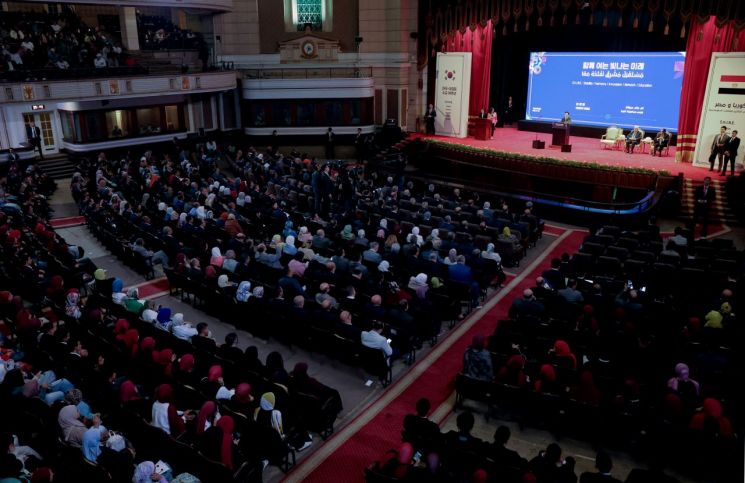
Addressing the audience that filled the auditorium with 3,050 seats, President Lee said, "I hope today's meeting will be the starting point for an even brighter and more splendid journey ahead for Korea and Egypt, and for Korea and the Middle East." He ended his speech with unscripted remarks, "I love Egyptian civilization. The people of Korea love Egypt. The people of Korea and the people of Egypt love the new future that awaits both countries."
© The Asia Business Daily(www.asiae.co.kr). All rights reserved.
![Clutching a Stolen Dior Bag, Saying "I Hate Being Poor but Real"... The Grotesque Con of a "Human Knockoff" [Slate]](https://cwcontent.asiae.co.kr/asiaresize/183/2026021902243444107_1771435474.jpg)

















