HD Hyundai, UNIST, and Ulsan National University Sign Industry Cooperation MOU
Calls for Government Support and the Need for a Significant Technological Lead
Youngok Kim, CAIO: "China Has Already Shifted to Unmanned and AI-Based Production"
Jung Kiseon, Chairman of HD Hyundai, stated that “there is a growing sense of crisis in the shipbuilding industry these days,” adding that even the recently booming domestic shipbuilding sector is facing structural challenges.
On the 20th, right after signing an agreement with UNIST for cooperation on shipbuilding and marine artificial intelligence (AI) at the HD Hyundai Global Research & Development Center (GRC Center) in Seongnam, Gyeonggi Province, Chairman Jung made these remarks. In his congratulatory address, after expressing his gratitude to the attendees, he said, “Recently, many people around me say that there is nothing to worry about, since we have secured many new orders, our performance is strong, and the MASGA (Make American Shipbuilding Great Again) project is expected to expand our business in the United States.” However, he added, “To be honest, I feel even more anxious these days.”
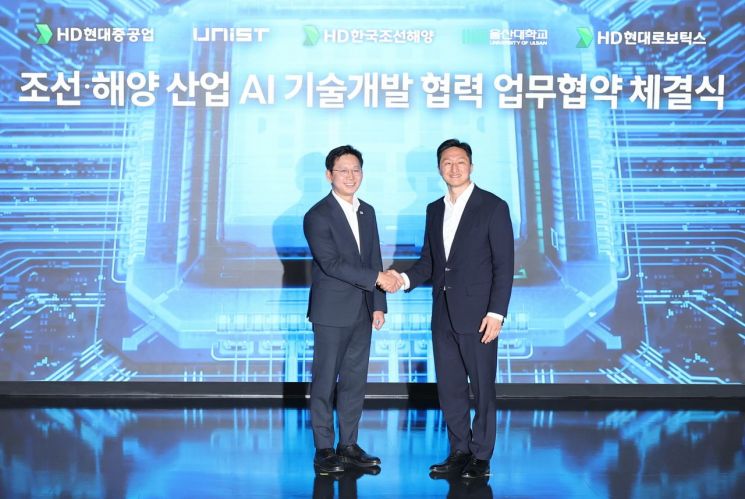 Deputy Prime Minister and Minister of Science and ICT, Hoon Bae (left), and Jung Kiseon, Chairman of HD Hyundai, are posing for a commemorative photo at the "Shipbuilding and Marine Industry AI Technology Development Cooperation Agreement Signing Ceremony" held on the 20th at the HD Hyundai Global R&D Center in Seongnam, Gyeonggi Province. Photo by Yonhap News
Chairman Jung cited a recent survey released by the Federation of Korean Industries, stating, “In the steel, machinery, secondary battery, display, automobile, and parts industries, it has already been assessed that China’s competitiveness surpasses Korea’s. Even in fields where we currently maintain an advantage-such as shipbuilding, semiconductors, and electrical and electronics-respondents believe that China will overtake us within five years.” He continued, “Going forward, Korea must achieve tangible results as soon as possible by integrating AI into traditional manufacturing industries like shipbuilding, energy, and construction machinery more quickly and precisely, in order to reduce costs and improve quality and fuel efficiency.”
Chairman Jung defined AI technology not as a tool for solving on-site problems, but as the core of manufacturing competitiveness, emphasizing, “We must lead in the speed at which we create visible, tangible competitiveness.” He added, “AI developed domestically must not fall behind Chinese and American models in terms of accuracy, model optimization, or price competitiveness. The more we experience the speed at which global companies are moving, the faster Korea must respond.”
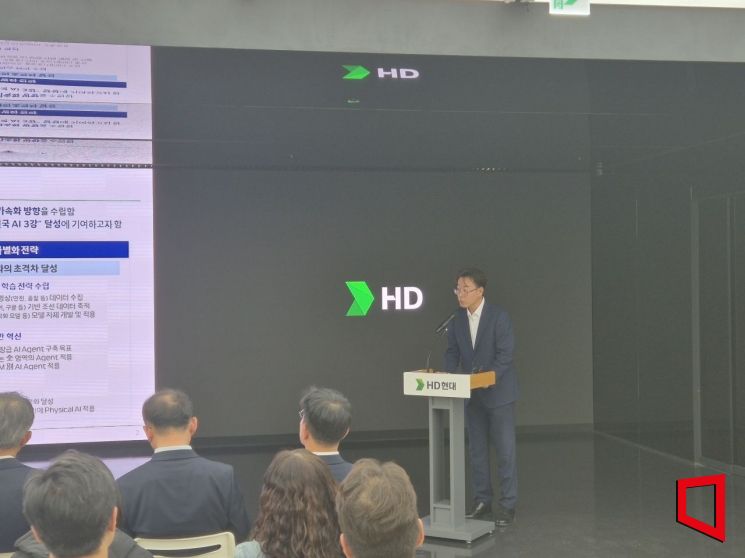 Youngok Kim, Executive Director and Chief AI Officer (CAIO) of HD Hyundai, is presenting the status of the group's 'AI Transformation (AIX)' initiative after the signing ceremony for the 'Cooperation Agreement on AI Technology Development in the Shipbuilding and Marine Industry' held on the 20th at the HD Hyundai Global R&D Center in Seongnam, Gyeonggi Province. Seongnam - Photo by O Ji-eun
Youngok Kim, Executive Director and Chief AI Officer (CAIO) of HD Hyundai, who presented the status of the group’s ‘AI Transformation (AIX)’ initiative on the same day, made similar points. Kim stated, “China has already abandoned its labor-centered cost-competitiveness strategy and is transitioning to an unmanned, automated, AI-based shipbuilding production system. The technological gap that Korea has maintained for a long time is narrowing rapidly.”
She emphasized that HD Hyundai’s response strategy is ‘Physical AI,’ which involves integrating AI modules into ships as physical products. She explained that achieving a significant technological lead is only possible if AI learns from the shipbuilding data accumulated across all stages-design, production, and operation. To this end, she revealed that joint projects among affiliates are underway, including ▲ design automation, ▲ digital manufacturing based on production simulation, and ▲ the introduction of ‘AI Master Agents.’
Kim also stressed that the core of AI competitiveness in shipbuilding lies not in text data, but in on-site video data such as welding, painting, and assembly. She requested government-level support for the GPU infrastructure, security systems, and cloud environments needed to handle such data. In particular, she proposed establishing an ‘AI Regulatory Sandbox’ in Ulsan to provide an institutional foundation that would enable a one-stop process from collecting video data to developing AI models and exporting them globally.
© The Asia Business Daily(www.asiae.co.kr). All rights reserved.
![Clutching a Stolen Dior Bag, Saying "I Hate Being Poor but Real"... The Grotesque Con of a "Human Knockoff" [Slate]](https://cwcontent.asiae.co.kr/asiaresize/183/2026021902243444107_1771435474.jpg)

















