"Improvement Measures for State-Owned Assets System to Be Announced Next Month"
"Incentives Planned for Minority Shareholders Investing Long-Term in Individual Stocks"
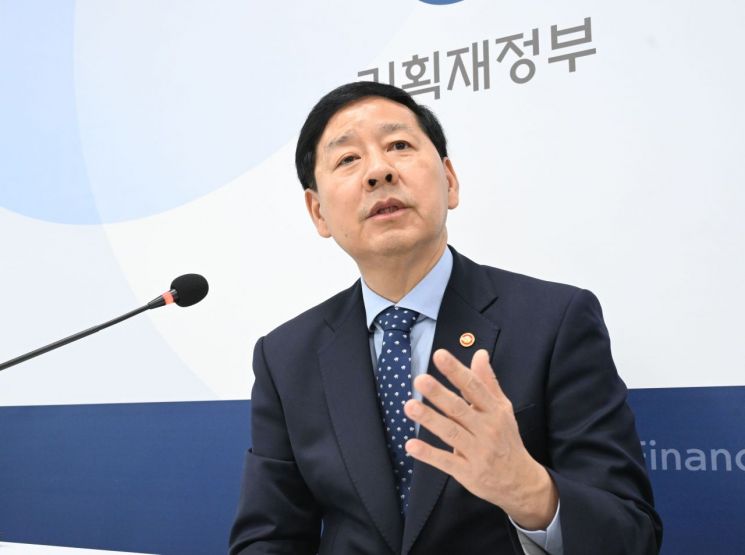 Koo Yoonchul, Deputy Prime Minister for Economy and Minister of Economy and Finance, is answering reporters' questions at a press briefing held at the Ministry of Economy and Finance press room in the Central Building of the Government Complex Sejong on the afternoon of the 19th.
Koo Yoonchul, Deputy Prime Minister for Economy and Minister of Economy and Finance, stated on the 19th that the government will consider easing the separation of banking and commerce regulations in advanced industries such as artificial intelligence (AI), as long as it does not compromise fundamental principles.
At a press briefing held at the Government Complex Sejong, Deputy Prime Minister Koo said, "If there is a need to raise capital, we will actively discuss with relevant ministries how and to what extent this can be done," expressing this position. He added, "We will first address what can be resolved through the creation of the National Growth Fund, and if further measures are necessary, we will consider discussing the easing of the separation of banking and commerce regulations."
Regarding the Special Act on Investment in the United States, which provides the legal basis for establishing an investment corporation and managing funds, he emphasized, "We will submit the special act bill to the National Assembly and go through the necessary procedures within this month." He further stated, "To ensure the retroactive application of the 15% automobile tariff as of November 1, the bill must be submitted within this month without exception."
This statement is interpreted as reaffirming the principle of enacting a special law, amid calls from the opposition party for the National Assembly to ratify the Korea-U.S. tariff agreement memorandum of understanding (MOU). The government maintains that the MOU is not legally binding and therefore does not require ratification by the National Assembly.
Regarding the recent trend of a strong dollar, he explained, "The depreciation of the won is due to a shortage of dollars caused by various factors leading to capital outflows," and added, "We are working with major players in the foreign exchange market to prevent excessive uncertainty or instability in the exchange rate."
On the appropriate exchange rate level that the Korean economy and inflation can withstand, he said, "It is difficult to specify because the exchange rate is determined by the market," and added, "The Ministry of Economy and Finance is closely monitoring the situation to manage the exchange rate stably." When asked about the direction of 'structural improvement in foreign exchange supply and demand,' which he mentioned in meetings with large exporters such as Samsung Electronics and SK Hynix, he also refrained from providing specifics, citing the sensitivity of the foreign exchange market.
Regarding the controversy over the undervalued sale of state-owned assets during the Yoon Suk Yeol administration, he stated, "Each ministry is conducting a comprehensive investigation, and once the results are available, we will consolidate them and proceed with institutional improvements." He continued, "To ensure that taxes paid by the public or state-owned assets are not sold below their value or through non-transparent procedures, as pointed out by the media or the National Assembly, we will prepare improvement measures by early to mid-December."
The ruling party has formed a special committee to investigate the sale of state-owned assets during the Yoon Suk Yeol administration and is conducting a thorough review to determine whether there were any cases of undervalued sales, non-transparent procedures, or hasty orders to compensate for tax revenue shortfalls.
Regarding enhanced tax benefits for long-term stock market investment, he said, "We are determined to implement measures to provide incentives to minority shareholders who make long-term investments in individual stocks," and explained, "We will disclose the details, including the extent of incentives compared to the past, after further review."
On the tax reform bill currently under discussion in the National Assembly, he commented, "The highest tax rate for separate taxation of dividend income will likely be set lower than the government's proposal of 35%." Regarding discussions on expanding inheritance tax deductions, which are not included in the government proposal, he said, "I understand that various discussions are taking place in the National Assembly," and added, "We are open-minded and will make a reasonable decision."
© The Asia Business Daily(www.asiae.co.kr). All rights reserved.
![Clutching a Stolen Dior Bag, Saying "I Hate Being Poor but Real"... The Grotesque Con of a "Human Knockoff" [Slate]](https://cwcontent.asiae.co.kr/asiaresize/183/2026021902243444107_1771435474.jpg)















