JP Morgan and Societe Generale Accelerate Stablecoin Adoption
South Korea Still in Early Stages
Urgent Need for Relevant Legislation
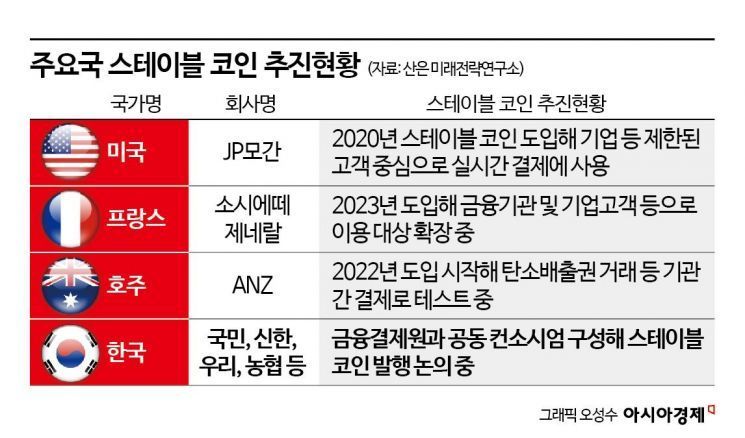
As advanced financial institutions in countries such as the United States and Europe are accelerating the adoption of stablecoins, there is a growing argument that South Korea should promptly establish relevant regulations and introduce a won-based stablecoin to avoid falling behind this global trend.
According to the “Current Status of Stablecoin Initiatives in the Financial Sector” report by the Korea Development Bank Future Strategy Research Institute, released on November 20, major financial institutions in advanced economies-including those in the United States, Europe, and Australia-have been issuing stablecoins and utilizing them in real transactions for several years, thereby speeding up their adoption.
Stablecoins are virtual assets designed to maintain price stability by being pegged 1:1 to specific assets such as the US dollar. Tether (USDT) and USD Coin are representative examples.
In 2020, JP Morgan in the United States introduced JPM Coin, a type of dollar-based stablecoin, which is used for real-time, round-the-clock payments by a limited group of corporate clients. By digitizing dollar deposits into stablecoins, the bank has shortened transaction times and enabled instant 24-hour settlements, helping to overcome the traditional limitations of banking hours and locations.
France’s Societe Generale also released the euro-based stablecoin EURCV in 2023, initially using it within its group financial institutions and gradually expanding its use to corporate clients. Australia and New Zealand Banking Group (ANZ) in Australia introduced a stablecoin pegged to the Australian dollar in 2022, utilizing it for inter-institutional settlements such as carbon credit trading. Major Japanese banks, including Mitsubishi UFJ and Mizuho Bank, are also conducting proof-of-concept tests for yen-based stablecoins.
At the national level, regulations are being established to ensure the stability of stablecoins. In July, the United States passed the “Genius Act,” a stablecoin regulatory bill, thereby incorporating stablecoins into the institutional framework. The European Union also implemented the Markets in Crypto-Assets (MiCA) regulation last year, specifying requirements for stablecoin issuers and reserve assets.
These laws commonly stipulate that: ▲ issuers must hold reserve assets (collateral) at a minimum ratio of 1:1 to maintain the value of the stablecoin; ▲ reserve assets must consist of highly liquid assets such as cash and deposits; and ▲ as stablecoins are issued for payment purposes, interest payments are prohibited.
The report analyzes that advanced financial institutions are accelerating the issuance of stablecoins to enhance the efficiency of payment and remittance methods. It also notes growing concerns that institutions failing to adopt related infrastructure could be excluded from the financial ecosystem, prompting them to move up their issuance timelines.
Seo Daehoon, a researcher at the Korea Development Bank Future Strategy Research Institute, explained, “Foreign financial institutions are rushing to introduce stablecoins, taking into account the lock-in effect, where consumers are reluctant to switch to other systems once they become accustomed to one.”
In contrast to the rapid adoption by major overseas financial institutions, there are significant concerns that South Korea could fall behind, as no relevant legislation has yet been enacted domestically. In Korea, a consortium of six major banks-including KB Kookmin Bank, Shinhan Bank, Woori Bank, and NongHyup Bank-and the Korea Financial Telecommunications & Clearings Institute is in the early stages of discussing a joint issuance of stablecoins, with banks taking the lead in these initial discussions.
Researcher Seo emphasized, “In the short term, a won-based stablecoin is likely to be used for inter-institutional settlements and undergo proof-of-concept testing through small-scale issuance, so demand will be limited. For full-scale adoption, however, it is essential to promptly establish relevant regulations, as seen in cases overseas.”
© The Asia Business Daily(www.asiae.co.kr). All rights reserved.

















