"It Looked as If Kanai Was Bowing His Head While Listening to the Interpreter"
"Intention to Portray the Japanese Side as Having Been Summoned for a Protest"
Amid intensifying anti-Japanese sentiment in China following Japanese Prime Minister Sanae Takaichi's remarks suggesting possible intervention in the event of a Taiwan contingency, many Japanese media outlets have interpreted that China intentionally released a video showing diplomatic officials from both China and Japan.
On November 19, Japanese media outlets such as the Asahi Shimbun reported, "It is unusual for China Central Television (CCTV), a state-run broadcaster, to air a video that appears to emphasize diplomatic superiority at a practical level."
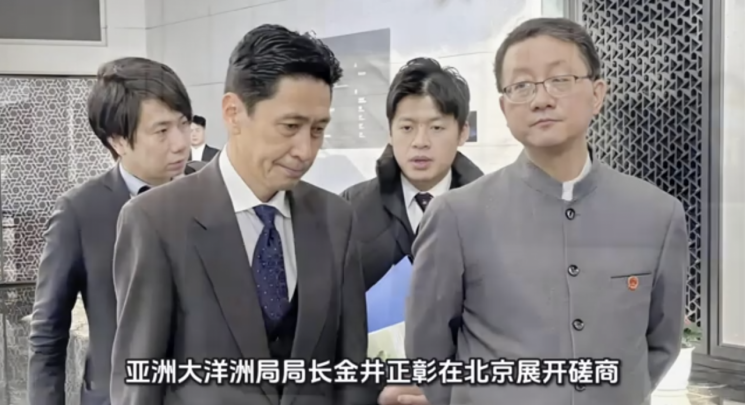
The previous day, Liu Jinsong, Director-General of the Department of Asian Affairs at the Chinese Foreign Ministry, met with Masaaki Kanai, Director-General of the Asian and Oceanian Affairs Bureau at Japan's Ministry of Foreign Affairs, who was visiting China, at the Foreign Ministry building in Beijing.
The video in question was taken after the director-level consultations between the two countries' diplomatic authorities had concluded. In the footage, Director-General Liu is seen standing near the entrance of the building with his hands behind his back or in his pockets, looking down at Director-General Kanai with a stern expression, while Kanai slightly bows his head toward Liu.
The Asahi Shimbun noted, "Some local Chinese media used the headline 'Japanese official leaves the Chinese Foreign Ministry with head bowed,'" and interpreted this as an attempt by China to create the impression that Japan had come to offer an explanation, thereby projecting China's superior position.
The Yomiuri Shimbun pointed out that there appeared to be an intention to portray the Japanese side as having been summoned for a protest. The report also added, "Ahead of these talks, there were critical voices within the Liberal Democratic Party questioning whether Japan was going to apologize, while the Japanese government emphasized that this was a routine reciprocal visit."
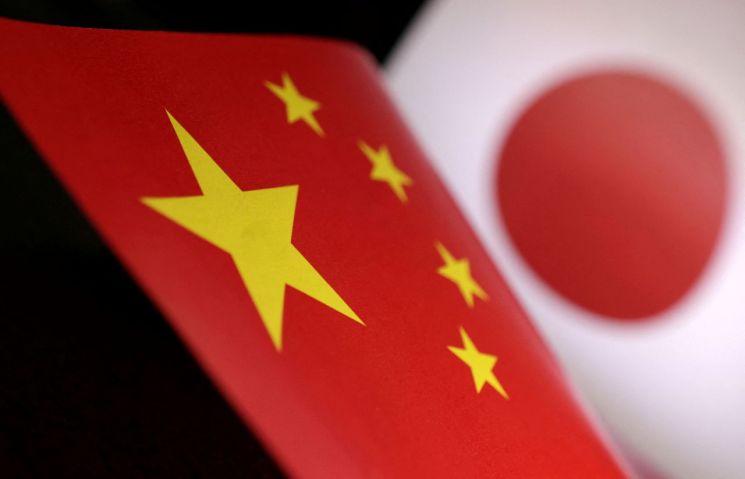
The Mainichi Shimbun reported, "CCTV's coverage of the video appears to be part of a propaganda campaign aimed at showing that China is taking the lead in the situation," and added, "Director-General Liu's Mao suit-style attire conveyed a patriotic message to the Chinese public." Jiji Press also stated, "It seems to be part of a propaganda effort to highlight China's superiority."
Jiji Press, noting that its own reporter was present at the scene, added, "When both sides appeared and stopped in the lobby, it looked as though the Japanese official, Kanai, was listening to the Chinese director-general, who had his hands in his pockets. However, Kanai was actually listening to the interpreter standing next to him, which made it appear as if he was bowing his head."
Meanwhile, on November 7, Prime Minister Takaichi stated in the House of Representatives that, for the first time as a sitting Japanese prime minister, a 'Taiwan contingency' could be considered a 'situation threatening Japan's survival,' which would allow Japan to exercise its right to collective self-defense (use of force). China immediately issued a strong protest in response. In the wake of these remarks, China has continued to take tough measures, such as advising against travel to Japan and urging students to reconsider studying there. As anti-Japanese sentiment has intensified, the release of Japanese films such as "Crayon Shin-chan: The Super Star! The Blazing Kasukabe Dancers" and "Cells at Work!", which were scheduled to premiere in China, has been temporarily suspended. CCTV explained this measure as "a cautious decision based on a comprehensive assessment of the overall market performance of Japanese films and the sentiments of Chinese audiences."
© The Asia Business Daily(www.asiae.co.kr). All rights reserved.


















