National Assembly Future Institute Forum
"Retirement Age and Wage Reform Should Be Discussed on Two Tracks"
Calls for Introduction of Job-Based Pay System
"Legislation Within the Year Seems Unlikely"
As the proposal to extend the statutory retirement age to 65 has emerged as a major issue in political circles, there have been calls to discuss wage system reform alongside it. Some argue that a uniform extension of the retirement age could increase companies' wage burdens and deepen the dual structure of the labor market, and therefore recommend considering the introduction of a job-based pay system.
On the 19th, the National Assembly Future Institute held a forum at the National Assembly on the topic of "Social Agreement for Retirement Age Extension and Wage System Reform." Jung Hyeyoon, Associate Research Fellow at the National Assembly Future Institute, who was the first presenter, diagnosed that extending the retirement age is not just an employment issue but also a problem of the "dual structure of the wage system." The domestic labor market is divided between large corporations and regular employees, where the seniority-based wage system increases pay with years of service, and small and medium-sized enterprises and non-regular workers, where there is no structured wage system. In this context, extending the retirement age could further burden companies and entrench the dual structure.
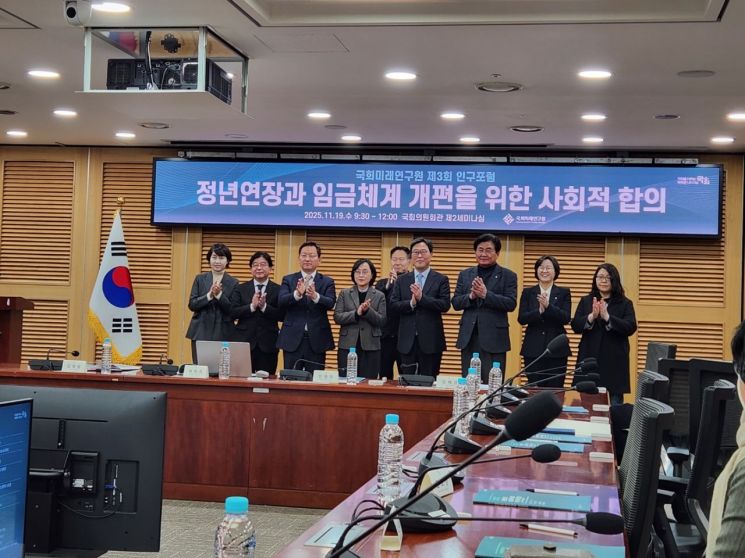 On the 19th, the National Assembly Future Institute held a forum at the National Assembly on the topic of "Social Agreement for Retirement Age Extension and Wage System Reform." Photo by Choi Yuri
Accordingly, she suggested the need to introduce a job-based pay system, where wages are determined by job responsibilities and competencies. This could reduce companies' wage burdens, enabling them to employ more older workers, and provide a foundation for "equal pay for equal work" in workplaces with ambiguous wage structures. Jung stated, "If only the retirement age is extended under the current circumstances, there is a risk of a sharp increase in labor costs, more early retirements, and fewer opportunities for young people. We should view the job-based pay system not as a replacement for the seniority-based system, but as a wage order that enhances generational fairness and corporate sustainability, and seek consensus accordingly."
There were also calls to refer to Japan's case, where a gradual extension of the retirement age was induced by mixing seniority and job-based elements. In 2004, Japan revised its laws to maintain the statutory retirement age at 60 while mandating employment security up to 65. Instead, companies were given the option to choose among extending the retirement age, introducing a continued employment system (rehiring after retirement), or abolishing the retirement age altogether. In addition, companies were allowed to autonomously decide on work styles and wage systems. Kim Myungjung, Senior Research Fellow at Nissei Basic Research Institute, explained, "Even companies that initially adopted the continued employment system have increasingly shifted to extending or abolishing the retirement age. Although it takes time, if companies judge that abolishing the retirement age is beneficial, they tend to move toward raising wages for older employees."
Political circles also agreed on the need to discuss retirement age extension and wage system reform together. However, they noted that more discussion is needed regarding the methodology, such as the introduction of a job-based pay system. As a result, the Democratic Party of Korea, which had pledged to legislate the extension of the retirement age to 65 within the year, appears to be stepping back from a rapid push.
Kim Hyungdong, a member of the People Power Party and opposition secretary of the National Assembly's Climate, Energy, Environment and Labor Committee, stated, "The discussion on extending the retirement age should address not only the issue of poverty among the elderly after retirement, but also youth issues and disparities among workers, from a broader societal perspective. The introduction of a job-based pay system is the result of institutional design, and we must first establish a foundation of equal pay for equal work."
Jung Hyekyung, a member of the Progressive Party, said, "We need to address labor's distrust of the job-based pay system, for example, by discussing job-based pay without wage reductions or by allowing workers to participate in job evaluations. Companies must also take greater responsibility and strive to resolve the dual structure of the labor market."
Min Byungdeok, a member of the Democratic Party of Korea, said, "Retirement age extension and wage reform should proceed on two tracks, but further discussion is needed on the necessity of job-based pay reform. I anticipate that it may be difficult to legislate the retirement age extension within the year to fulfill the campaign pledge."
© The Asia Business Daily(www.asiae.co.kr). All rights reserved.
![Clutching a Stolen Dior Bag, Saying "I Hate Being Poor but Real"... The Grotesque Con of a "Human Knockoff" [Slate]](https://cwcontent.asiae.co.kr/asiaresize/183/2026021902243444107_1771435474.jpg)















